


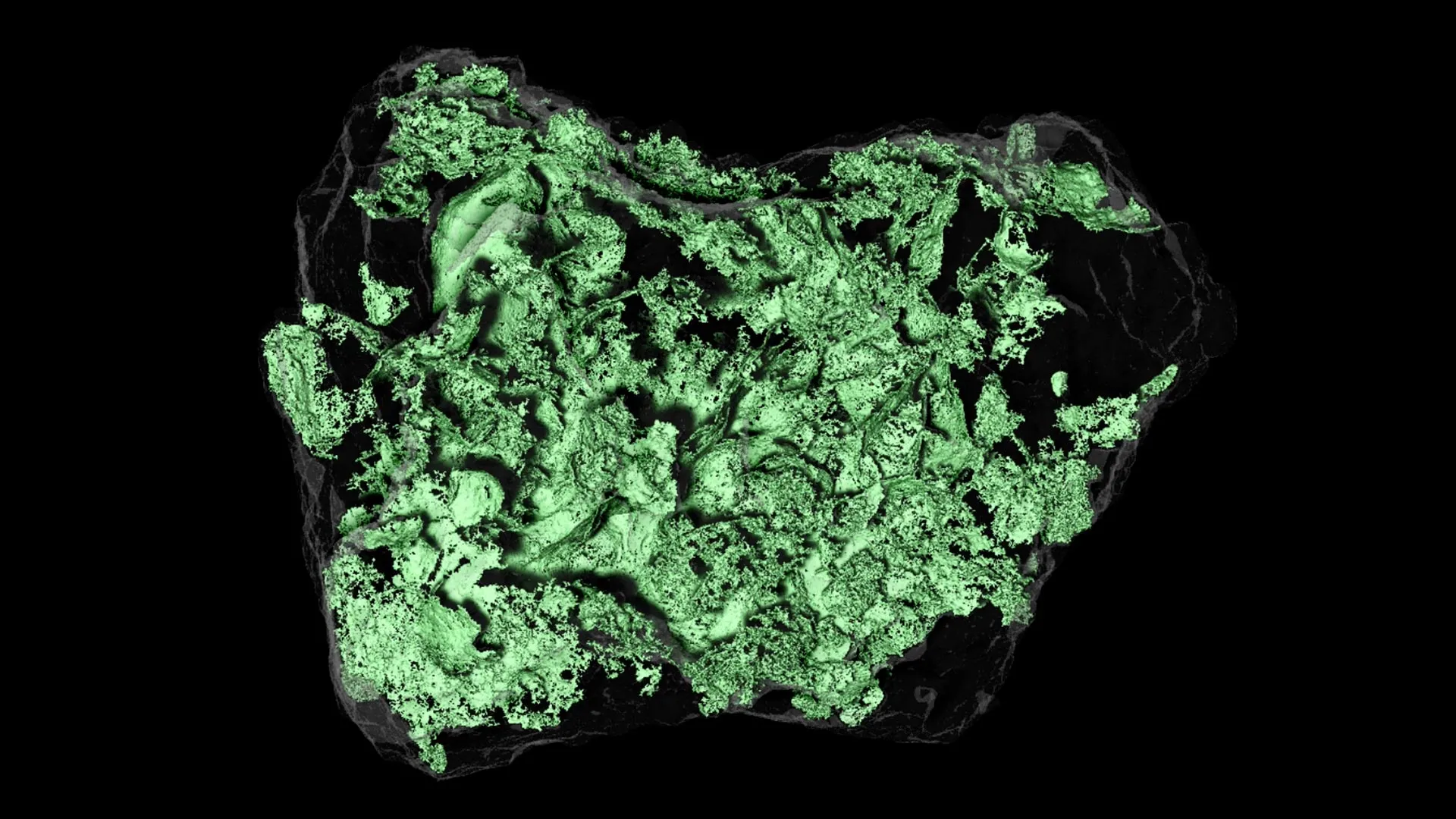
NASA’s OSIRIS-REx mission encountered an unexpected mystery when it arrived at asteroid Bennu in 2018. Instead of the relatively smooth terrain that earlier observations had suggested, the spacecraft found a rugged landscape dominated by enormous boulders, with very few areas suitable for collecting samples.
“When OSIRIS-REx got to Bennu in 2018, we were surprised by what we saw,” said Andrew Ryan, a scientist at the University of Arizona’s Lunar and Planetary Laboratory, who led the mission’s working group responsible for analyzing the physical and thermal properties of its samples. “We expected some boulders, but we anticipated at least some large regions with smoother, finer regolith that would be easy to collect. Instead, it looked like it was all boulders, and we were scratching our heads for a while.”
The discovery was especially confusing because of what astronomers had previously learned about Bennu’s ability to retain heat. Measurements from NASA’s Spitzer Space Telescope in 2007 indicated that the asteroid’s surface warmed and cooled rapidly as it rotated through sunlight and darkness.
Scientists describe this property as low thermal inertia. Materials with low thermal inertia, such as beach sand, quickly gain heat in sunlight and lose it once the Sun disappears. Large, solid rocks behave differently. Much like concrete, they typically hold on to warmth and release it gradually.
Bennu’s boulder-covered surface appeared to contradict those earlier measurements, leaving researchers with a puzzling question: How could an asteroid covered in massive rocks cool so quickly?
Hidden Cracks Reveal the Secret of Bennu’s Boulders
Observations collected by OSIRIS-REx while surveying Bennu offered an early clue. The asteroid’s boulders might contain far more empty space than scientists had assumed, allowing them to lose heat faster than ordinary solid rocks.
When samples from Bennu were returned to Earth, researchers finally had an opportunity to examine that possibility directly.
Ryan and his colleagues used several laboratory techniques to investigate tiny rock fragments collected from the asteroid. Their findings, published in Nature Communications, confirmed that the rocks were indeed highly porous. However, porosity alone could not fully explain Bennu’s unusually rapid heat loss.
The researchers discovered another important feature. Many of the rock particles contained extensive networks of cracks running through their interiors.
To investigate how these fractures influence the movement of heat, researchers at Nagoya University in Japan examined the samples using a technique called lock-in thermography. This method uses a laser to heat a tiny area of a sample while measuring how the heat spreads through the surrounding material, much like ripples expanding across the surface of a pond.
“That’s when things became really interesting,” Ryan said. “The thermal inertia measured in the lab samples turned out to be much higher than what the spacecraft’s instruments had recorded, echoing similar findings obtained by the team of OSIRIS-REx’s partner mission, JAXA’s (Japan Aerospace Exploration Agency) Hayabusa-2.”
The difference between laboratory measurements and spacecraft observations suggested that the size and internal structure of Bennu’s rocks were essential to understanding their behavior.
Because the returned samples were much smaller than the enormous boulders covering Bennu, scientists needed a way to determine how heat would move through the material on a much larger scale.
NASA Uses 3D Scans to Look Inside Asteroid Rocks
At NASA’s Johnson Space Center in Houston, researchers prepared the samples for detailed X-ray imaging while taking special precautions to prevent contamination.
Inside a glove box filled with protective nitrogen gas, team members sealed individual rock particles in airtight containers. They then transported the containers to a laboratory for X-ray computed tomography, or XCT scanning. After imaging, the particles were returned to the glove box without being exposed to Earth’s environment.
“The sample goes into its own ‘spacesuit,’ gets a CT scan, and then comes back to its pristine environment, all without having any exposure to the terrestrial environment,” said Nicole Lunning, lead OSIRIS-REx sample curator within the Astromaterials Research and Exploration Science division at NASA Johnson and one of the study’s co-authors. “We can image right through these airtight containers to visualize the shape and internal structure of the rock that’s inside.”
The scans gave scientists a detailed view of the samples’ interiors, revealing structures that could not be examined simply by looking at their surfaces.
“X-ray computed tomography allows us to look at the inside of an object in three dimensions, without damaging it,” said study co-author and NASA Johnson X-ray scientist Scott Eckley.
Each scan also produced a permanent three-dimensional digital record of the particle’s exterior and internal features. These records were added to a publicly accessible database, allowing the samples to be studied without repeatedly handling the original material.
Ryan’s team then incorporated the X-ray scan data into computer simulations designed to track how heat travels through asteroid rocks. By extending the calculations from individual particles to the much larger boulders found on Bennu, they were able to reproduce the low thermal inertia observed by the spacecraft.
A Discovery That Could Change How Scientists Study Asteroids
The results resolved a key mystery about Bennu’s unusual surface. Scientists had previously considered whether the asteroid’s boulders might be extremely porous, with a soft, fluffy, or even sponge-like internal structure.
Although the rocks do contain substantial pore space, the researchers found that their widespread internal fractures were equally important to understanding how they retain and release heat.
“It turns out that they’re really cracked too, and that was the missing piece of the puzzle,” Ryan said.
The discovery has implications beyond Bennu. Astronomers frequently rely on measurements of how an asteroid absorbs and releases heat to estimate the physical properties of its surface. Until now, interpreting those observations has been difficult without actual rock samples to examine.
Ron Ballouz, a scientist at the Johns Hopkins University Applied Physics Laboratory in Laurel, Maryland, and the study’s second author, explained that the findings provide a valuable connection between measurements made remotely and the true internal structure of asteroid material.
“We can finally ground our understanding of telescope observations of the thermal properties of an asteroid through analyzing these samples from that very same asteroid,” Ballouz said.
