


The world’s development banks continue to finance expansions of large climate-polluting livestock operations, but environmental advocates are notching a victory after they say the World Bank’s private lending arm has withdrawn funding for a controversial feed mill in Brazil.
A coalition of environmental groups said the International Finance Corp. will not go forward with a $20 million loan to Brazil’s Grupo Agronorte after activists and the Indigenous Apinajé community called for the IFC to halt the funding.
In May more than 100 advocacy and Indigenous groups, organized by the Stop Financing Factory Farming coalition, wrote to the IFC—the world’s largest development finance institution focusing on private sector investments in lower-income countries. The groups asked it to cancel the loan, which the IFC announced in March.
The IFC did not respond to questions from Inside Climate News, but it has removed the Agronorte loan from its disclosure portal.
The Agronorte operation, which mills soy for livestock feed, is more than 1,000 miles south from the Apinajé territory, but the groups argue that it would ramp up pressure for soy production in their region.
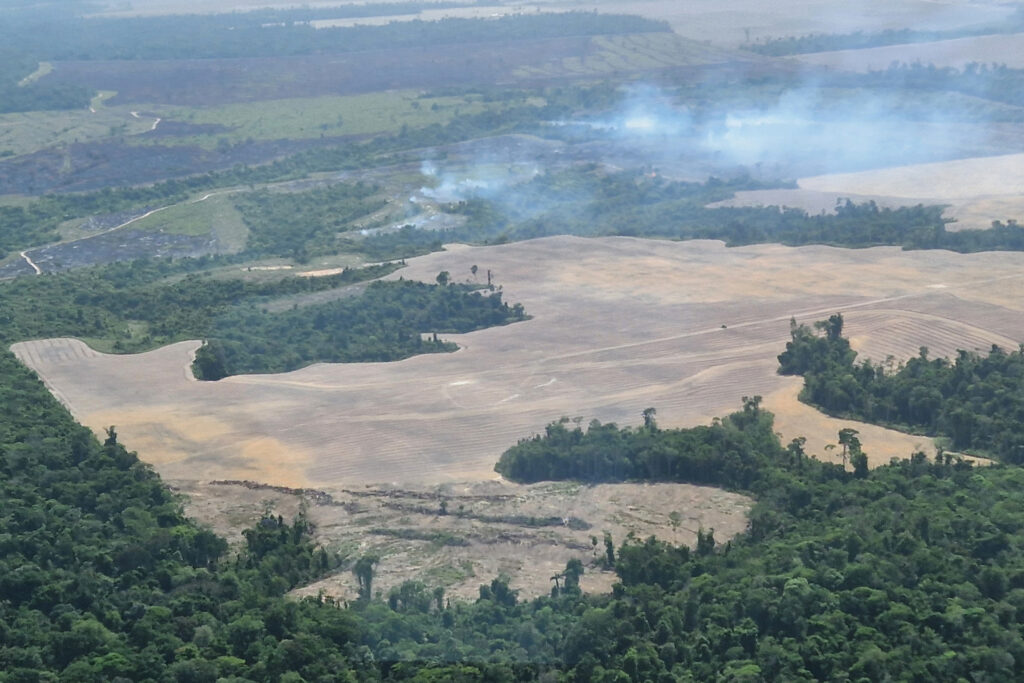
Soybean plantations have spread across the Amazon and neighboring Cerrado, now the most productive soy-growing regions of the world, largely to feed growing global demand for livestock feed. Much of that expansion has occurred on illegally deforested swaths of the Amazonian rainforest, the most climatically critical landscape on Earth, and has increasingly crossed into the Cerrado, a grasslands region that researchers say is among the most at-risk ecosystems on the planet.
The groups note in their letter that the founder and majority owner of Agronorte, Gilmar Gonçalves Carvalho, is facing a federal lawsuit in Brazil, accusing him and his associates of illegally cutting down nearly 5,000 acres of rainforest bordering Indigenous lands.
“For many years, we have been fighting against Agronorte’s owner,” said an Apinajé chief in a written statement provided by the Stop Financing Factory Farming coalition, withholding their name because of security concerns. Environmental defenders are among the most targeted activists in the world, including in Brazil.
“The area he claims, which overlaps with our territory, is now completely deforested,” the chief added. “We were deeply concerned that, if he obtained this funding, he would continue to deforest the area around our territory without consulting us. That is why it was so important for the IFC to stop this project.”
The groups pointed out in their letter that the IFC has acknowledged Agronorte has no systems in place to ensure the soybeans it processes aren’t grown on illegally deforested land. “Funding a company involved in land conflicts and accused of illegal deforestation is not aligned with IFC policies, nor with the objectives of the Paris Agreement or the Global Framework for Biodiversity,” the groups wrote, adding that large-scale, monocultural grain farming does little to contribute to the bank’s mission of eradicating hunger, given that most of what Agronorte produces would be animal feed for export.
The World Bank and other multilateral development banks have long maintained that funding large-scale agriculture projects, including livestock, adheres to their missions of boosting economic conditions in developing regions. In 2018, three years after countries signed the Paris climate agreement, these banks agreed to align their funding to meet the goals of the historic accord.
But watchdog groups and researchers have found that the banks continue to fund livestock operations, despite the greenhouse gas impacts.
The production of livestock globally accounts for somewhere between 16.5 percent and just under 20 percent of total greenhouse gas emissions. Researchers have determined that, even if the world stopped using fossil fuels, the largest source of heat-trapping gases, it would be impossible to control global warming without reducing emissions from the food system, largely from cattle.
Livestock accounts for one-third of man-made methane globally, roughly the same as the oil, coal and natural gas industries combined. Methane, though short-lived, has roughly 80 times the climate warming potential over a 20-year period of carbon dioxide, the most prevalent greenhouse gas.
Yet, the World Bank Group, which includes the IFC, poured about $1.4 billion into livestock production in developing countries between 2023 and 2024. The IFC approved 38 industrial livestock investments worth nearly $2 billion between 2020 and 2025, according to a recent Stop Financing Factory Farming analysis.
Another of the group’s analyses found that, in 2024, development institutions significantly cut their investments in animal agriculture, but that spending on large-scale livestock facilities and related supply chains still outstripped investments in smaller-scale operations 5 to 1.
This story is funded by readers like you.
Our nonprofit newsroom provides award-winning climate coverage free of charge and advertising. We rely on donations from readers like you to keep going. Please donate now to support our work.
In its 2024 “roadmap” for achieving net-zero emissions in the food system, the World Bank identified livestock production as a major opportunity to cut planet-warming gases. That same year the bank said it planned to expand its agribusiness investments to $9 billion a year by 2030.
Advocacy groups say those numbers are raising concerns, not just about the World Bank, but about development bank investment writ large. Recent research from the University of Vermont’s Institute for Agroecology finds that development bank investment tends to favor large-scale commodities produced for export markets, often at odds with the banks’ intentions of helping grow regional economies in lower-income countries. These large scale, monocultural systems are usually associated with more climate pollution and environmental damage, the report notes.
The Stop Financing Factory Farming coalition is applauding the IFC’s withdrawal of Agronorte’s loan as a rare win, but pointed to other recent development bank loan reversals.
“I do think the pressure is working,” said Ashley Schaeffer Yildiz, who oversees global finance and food systems for Friends of the Earth U.S., a founding member of the Stop Financing Factory Farming coalition.
In July of last year the European Bank for Reconstruction and Development canceled its proposed €40 million investment in Rex Concepts SA, which operates Burger King and Popeyes franchises in Eastern Europe. The investment would have financed up to 600 new fast food outlets across Poland, Romania and the Czech Republic.
In October, the investigative arm of the Inter-American Development Bank, responding to pressure from advocacy groups, issued a report that found several violations of the bank’s own environmental rules in connection with a $50 million loan to Pronaca, a major chicken and hog producer in Ecuador. The IFC has also loaned at least $170 million to Pronaca despite ongoing concerns among Indigenous communities over contaminated rivers, foul odors and health impacts.
In 2022, IDB Invest, the private sector arm of the Inter-American Development Bank, withdrew a $200 million loan package to Brazilian beef producer Marfrig Global Foods, and in 2009 the IFC withdrew a $90 million loan to the Brazilian beef packer Bertin. In both cases, the banks withdrew the loans after environmental groups found the companies had sourced cattle from illegally deforested areas of the Amazon.
The Stop Financing Factory Farming coalition says it is keeping a close eye on some other recently proposed loans by the IFC, including a $150 million loan to New Hope Singapore Pte. Ltd., to expand animal feed production across Vietnam, Egypt, Bangladesh, Cambodia and Nepal, and a $100 million loan to Brazil’s Agrícola Alvorada, which produces soy and corn in the Amazon and Cerrado and supplies commodities to a company linked to deforestation.
“Development banks, clearly, want to improve food security, they want to improve climate resilience,” Schaeffer Yildiz said. “And yet they continue to finance industrial livestock and the feed supply chains that enable it. So we are definitely continuing to follow [the banks’] investments in the sector.”
About This Story
Perhaps you noticed: This story, like all the news we publish, is free to read. That’s because Inside Climate News is a 501c3 nonprofit organization. We do not charge a subscription fee, lock our news behind a paywall, or clutter our website with ads. We make our news on climate and the environment freely available to you and anyone who wants it.
That’s not all. We also share our news for free with scores of other media organizations around the country. Many of them can’t afford to do environmental journalism of their own. We’ve built bureaus from coast to coast to report local stories, collaborate with local newsrooms and co-publish articles so that this vital work is shared as widely as possible.
Two of us launched ICN in 2007. Six years later we earned a Pulitzer Prize for National Reporting, and now we run the oldest and largest dedicated climate newsroom in the nation. We tell the story in all its complexity. We hold polluters accountable. We expose environmental injustice. We debunk misinformation. We scrutinize solutions and inspire action.
Donations from readers like you fund every aspect of what we do. If you don’t already, will you support our ongoing work, our reporting on the biggest crisis facing our planet, and help us reach even more readers in more places?
Please take a moment to make a tax-deductible donation. Every one of them makes a difference.
Thank you,

