


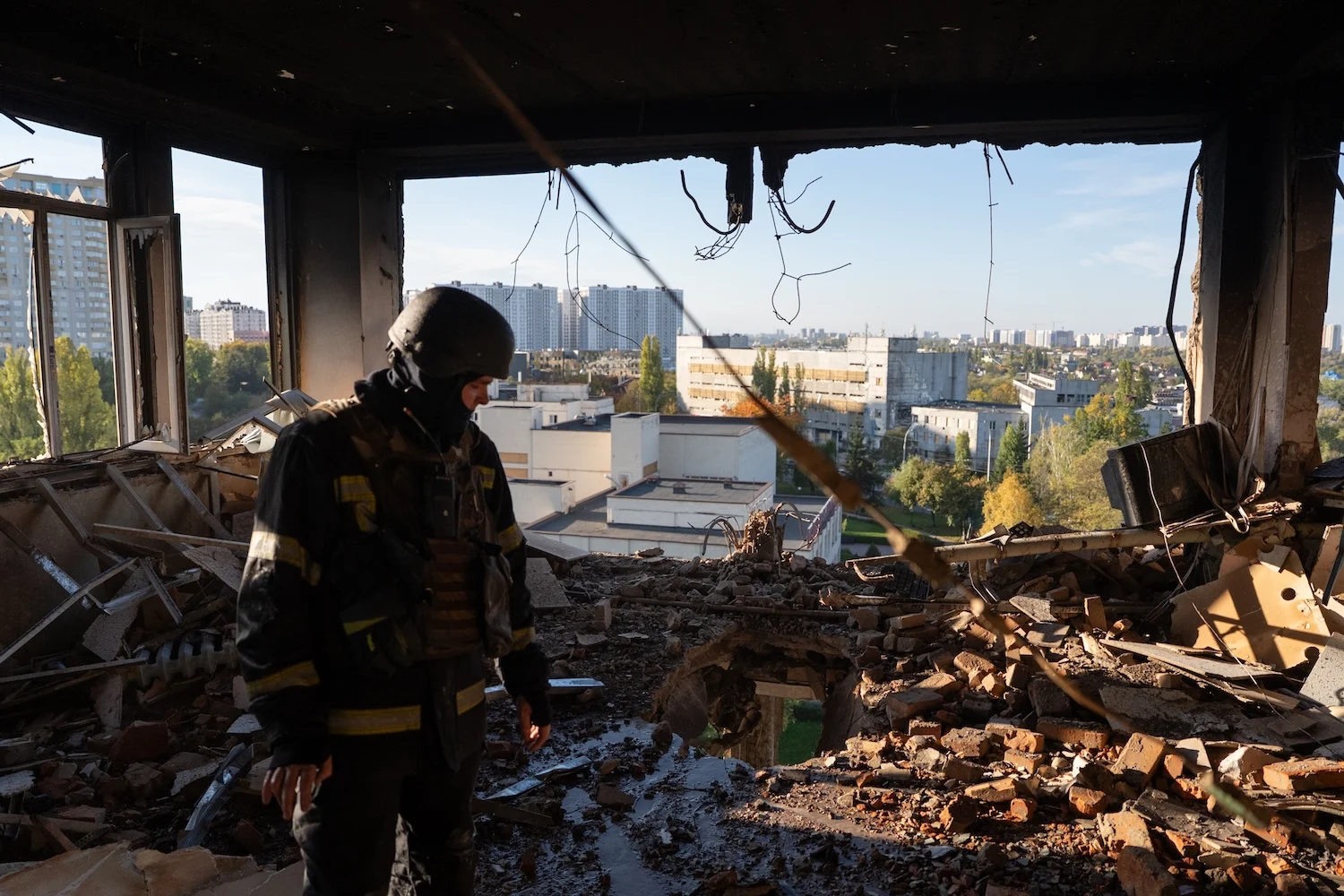
U.S. President Donald Trump said on Monday that he would be open to talks with Russia and China over the future of Ukraine, arguing that “Russia, frankly, has been fine on Ukraine. They haven’t been doing much.” That came amid an onslaught of Russian drone and ballistic missile attacks on Ukrainian hospitals, schools, and energy facilities.
The reason that Ukrainian President Volodymyr Zelensky is pleading for a complete restoration of Starshield, the military internet service provided by SpaceX, along with full intelligence sharing with Washington and the delivery of Patriot missiles, is precisely because of the stepped-up pace of Moscow’s aerial offensive.
Just in September, Moscow launched almost 4,000 attacks on civilian targets in Ukraine—a 65 percent increase over the year before—with 145 strikes damaging Ukrainian energy infrastructure, according to the Kyiv School of Economics. The attacks are especially deadly for civilians, with more than 300 killed last month, an 85 percent increase over the year before, and the pace is only intensifying in the first half of October, the United Nations monitoring mission in Ukraine said.
The Russian drone-and-missile offensive is meant, like each one before it in every winter of the war, to leave Ukrainians in the dark and cold during winter, in a bid to break popular support for continuing to fight. Moscow launched 76 attacks on energy targets in just the past week. Zelensky said on Monday that the attacks continued over the weekend in about a dozen regions and warned that combined-heat-and-power plants, critical for heating during winter, remain vulnerable.
In response, Ukraine itself this year has greatly stepped up its own aerial offensive, especially against Russian oil facilities—precisely the reason Trump soured on Zelensky at a time of sky-high gas and diesel prices ahead of U.S. midterm elections. But the Ukrainian long-range strikes, coupled with years of Western sanctions, have successfully choked off much of Moscow’s energy earnings, the life blood of its war machine. The Ukrainian attacks on Russian refineries—the direct cause of Trump’s ire—have been especially effective, with Russian exports of refined products at their second-lowest level of the war last month.
Zelensky met with U.S. envoy Steve Witkoff in Oslo, Norway, on Tuesday for another round of talks, with Jared Kushner joining remotely. The Ukrainian president reiterated his willingness to accept a mutual cease-fire on attacks on energy facilities but only if Moscow reciprocates.
The pressing concern for Ukraine this fall is that the Russian strikes threaten to overwhelm an energy system that has been battered but has still survived four winters of war. Not a day has gone by since mid-July without a Russian attack on Ukrainian energy facilities, Ukrainian Prime Minister Sergii Koretskyi said over the weekend, with more than 2,000 strikes during that time. Ukraine has now lost about two-thirds of its prewar electricity generation capacity.
Both Ukraine’s power sector and Russian attack capabilities have evolved during the war. Ukrainian power plants have been hardened, with protective shielding and more robust air defenses, and the electricity system itself has been made more resilient through decentralization, including a greater use of renewable energy. Russian attacks, though, have kept pace with Ukraine’s efforts; the introduction of jet-powered drones, coupled with long-range ballistic missiles, is making it harder for Ukraine to prevent the increasing number of successful Russian strikes.
That’s why the sudden reversal of U.S. policy this month—including limitations on Ukraine’s use of Starshield, lingering questions over U.S. intelligence sharing (such as warnings of ballistic missile launches), and a U.S. refusal so far to allow European partners to transfer Patriot interceptors to Ukraine—has caused Zelensky so much concern.
Almost all regions of the country have been damaged by Russian strikes, said Slawomir Matuszak, an expert on the Ukrainian economy at the Centre for Eastern Studies in Warsaw, Poland. But he said the nationwide electricity crisis is not notably worse than in prior years. The real problem, he said, is in Kyiv, which even in the best of times doesn’t generate all its own electricity and relies on imports from other regions. Now, all three of Kyiv’s power plants have been taken offline, and Russia has systematically switched its targeting to destroy high-voltage transmission, said Ukrenergo, the country’s transmission system operator.
“I’d go as far as to say that, at the national level, the situation isn’t any worse than it was a year ago,” Matuszak said. “However, things are much more difficult in Kyiv, as almost all power generation capacity within the city was destroyed in January and February, meaning that nearly all the electricity now has to be supplied from outside the city.”
Zelensky said on Monday that more than half a million people were without power after Moscow’s weekend attacks. On Tuesday, Russia again struck a substation in the capital, knocking out power across Kyiv and paralyzing public transport.
The transmission strikes also make it harder for Europe to provide assistance to Ukraine, Matuszak said. Even though Europe can supply more than 2 gigawatts of electricity to Ukraine, the damaged transmission network makes it hard to send that power to needy regions, especially in the capital and cities farther east. And that is a particular challenge, the grid operator said, because Russian strikes often target repair crews trying to fix the damage from previous attacks.
