


- To help address Louisiana’s serious coastal erosion problem, a recent study investigated how native estuarine animals were impacted by an innovative fill material for coastline restoration: Sand made from recycled glass.
- The study, which is part of a larger five-year research project examining the impacts of the sand on coastal ecosystems, found “no significant differences” in survival of animals exposed to the recycled glass sand compared with other sediment types.
- The researchers recorded interactions between five species and five types of sediment, as well as a control group without sediment, over the course of about a month.
- Sand made from recycled glass has potential to help mitigate environmental impacts of sand mining, researchers say, but the supply is limited, and scalability constraints mean a range of other approaches will be needed.
Every 100 minutes, the U.S. state of Louisiana loses a soccer field’s worth of land to coastal erosion. It’s a natural process intensified by the acceleration of sea level rise and human activities like oil and gas extraction and alterations to the course of the Mississippi River. During the past century, the state lost 4,662 square kilometers (1,800 square miles) of land.
Vanishing wetlands and altered estuaries make coastal communities, ecosystems and economies — including Louisiana’s $319 billion seafood industry — increasingly vulnerable to hurricanes, storms, and floods. The state has spent billions of dollars on restoration, including using offshore sand and river sediment to rebuild barrier islands and shorelines. But suitable sediment for these massive projects is in short supply.
Since 2020, a New Orleans-based company called Glass Half Full has been testing a potential solution: Transforming used glass bottles into sand and gravel to construct small experimental islands and berms for coastal restoration projects. Before such projects can be scaled up, however, the effects of introducing these fill materials into the environment must be better understood. So Glass Half Full teamed up with Tulane University in New Orleans to create Project ReCoast, a five-year research project funded by the U.S. National Science Foundation that explores the use of sand made from recycled glass in coastal restoration.
One of the resulting studies, published in the journal Restoration Ecology in April, found no significant differences in survival of several native estuarine animals exposed to recycled glass sand compared with other sand types.
The researchers wanted to see what would happen when animals that habitually interact with sediment — burying themselves in it and feeding from it, for example — were exposed to sand made from recycled glass. They conducted the experiment with five native estuarine fish and shellfish species relevant to the local economy: Atlantic croaker (Micropogonias undulatus), a common bait fish; Gulf killifish (Fundulus grandis); blue crab (Callinectes sapidus); white barnacle (Semibalanus balanoides); and eastern oyster (Crassostrea virginica).
They placed one individual from each species in its own aquarium, except for the oysters and white barnacles, which were placed in pairs since they don’t move. The individuals were then exposed to one of five sediment types: sediment dredged from the Mississippi River; a construction sand mix; a pool-filter sand used in aquariums; a fine recycled glass sand; and, finally, a mixture of Mississippi River sediment and two coarser recycled glass sands. A control group consisted of an individual from each species placed in separate aquariums containing no sediment.
The animals were monitored for 30-38 days to document any deaths linked to recycled glass sand exposure. “That’s a relatively short period of time, but we designed our experiments so that the animals could not avoid interacting with the sediment,” Hank Bart, a professor emeritus of ecology and evolutionary biology at Tulane University and the corresponding author of the study, told Mongabay via video call.
Among the 340 animals in the study, the researchers recorded 45 deaths and sought to understand the causes. “Was it because they were rooting around in the glass sand? Was it because they were eating the glass sand when they were eating the food? Or was it something else? And it turned out in almost all cases it was something else,” Bart said.
According to the paper, most of the deaths occurred when the animals attempted escape; the fish, for example, occasionally startled and jumped out of the aquariums. After analyzing the data, the study concluded recycled glass sand is “no more harmful” to the five native estuarine species tested than the other sediments or the no-sediment control.
“The results suggest that recycled glass sand would have little or no lethal effects on these organisms, at least for the periods of time we exposed them, if used as a resource for coastal restoration,” the authors write.


More research needed
Ansley Levine is a researcher who collaborated with Project ReCoast to study the efficacy of sand made from recycled glass in salt marsh restoration. Levine, who was not part of the recent study, said it’s important to test ecological responses whenever something new is introduced into a given environment. Research like the recent study is “essential for proactively testing proposed solutions to socio-ecological issues, before large-scale implementation,” she told Mongabay by email.
Romain Lavaud, an adjunct professor at Louisiana State University and researcher at Tennessee-based environmental consulting firm Dynamic Solutions, LLC., who was not involved in the research, told Mongabay via video call that the study is a promising avenue for further exploration. However, he said it could have gone beyond recording only death and survival by documenting “sub-lethal” effects that impair an organism without killing it.
“For example, if in the study like this one you saw some effect of different types of sediment on the capacity to feed — slightly lower feeding, or, for example, higher respiration, which means that the organism is working harder to maintain itself — then you could infer that in the long term this could have potential impacts that you cannot discern by just looking at did it survive or did it die,” Lavaud said.
Different sediment types used in the experiment:
Images courtesy of Hank Bart.

Next steps
The Project ReCoast team is working to fill in some of those gaps. In the initial experiment, the animals interacted with the sediments for about a month so the researchers could evaluate acute mortality. After euthanizing and preserving the surviving animals from the initial experiment, the researchers are now investigating whether their interaction with the sediment caused internal damage that, over longer periods, can lead to chronic effects, such as damage to stomach and delicate gill tissues.
They also conducted a separate experiment outside a controlled environment, placing custom-made trays filled with the various sediment types along the shoreline of Lake Pontchartrain in southeastern Louisiana and observing whether fish and invertebrate species would avoid those containing recycled glass sand. “They did not,” Bart said via email. “Trays with all the sediment treatments were colonized by a variety of types of sea life.” Both studies are ongoing.

Can recycled glass sand help mitigate sand mining impacts?
About 50 billion metric tons of sand are extracted globally each year, with significant environmental impacts. Sand made from recycled glass can often replace mined sand, according to Franziska Trautmann, co-founder and CEO of Glass Half Full. But its potential is limited by the available volume as well as the intended use. So far, the Project ReCoast team has mostly examined its suitability for coastal restoration in Louisiana, with some research expanding to the neighboring states of Mississippi, Alabama and Texas.
“We do not make broad claims about the safety and feasibility of using recycled glass sand in coastal restoration, but our research has shown it to be safe and effective in our region and projects,” Trautmann told Mongabay in an email.
Levine agreed that glass sand could help reduce the ecological burden of sand mining, but said economic and scalability constraints mean additional approaches are required. “Glass sand is one potential solution out of a range of solutions we will need to employ to address pressing environmental issues, such as sand mining, across the globe,” she said.
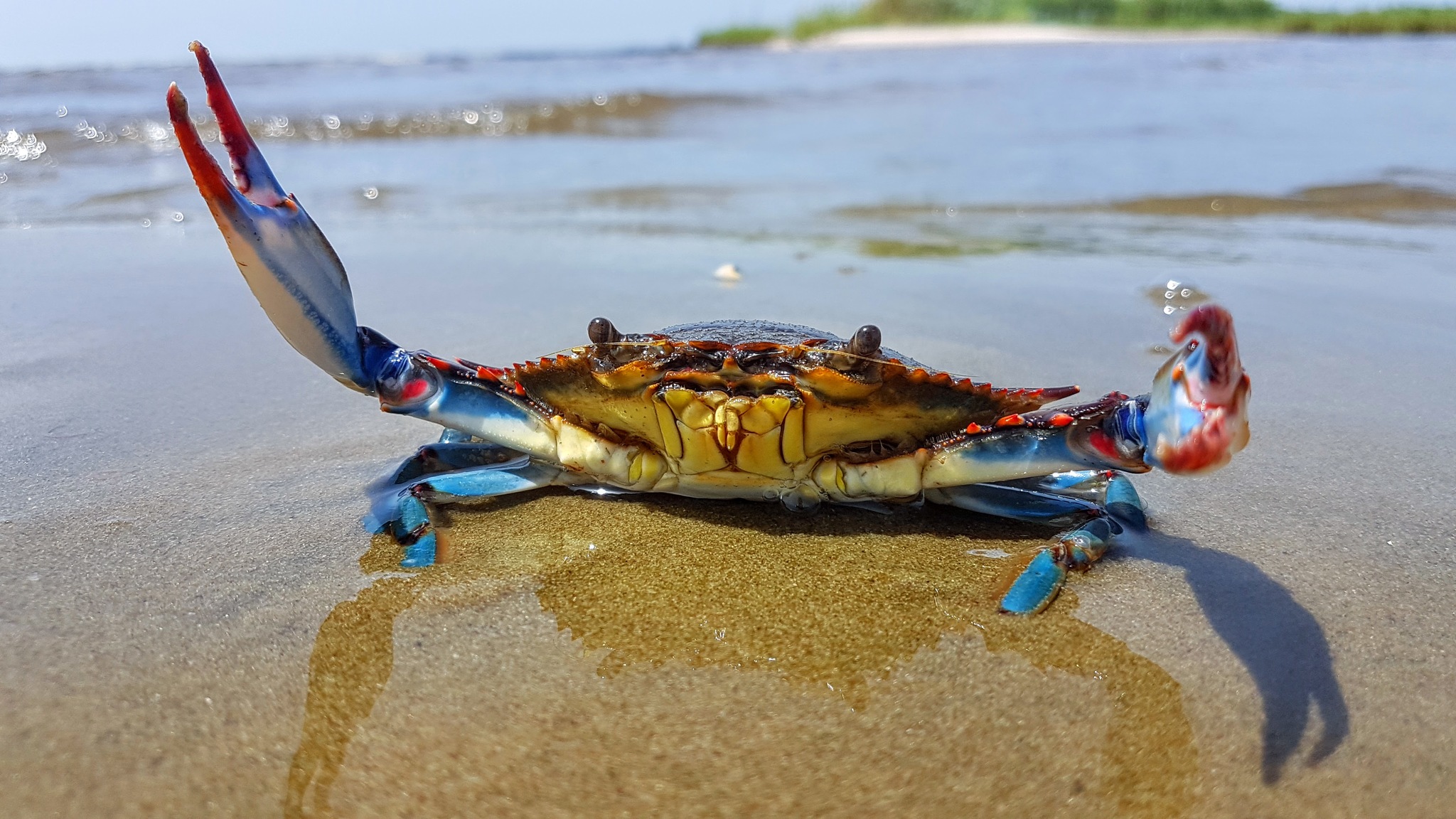
Banner image: Atlantic blue crab (Callinectes sapidus) in Louisiana, one of five species observed in the Project ReCoast study. Image © Sean Krieg via iNaturalist (CC BY 4.0).
19,000 Great Pyramids a year: Report flags unsustainable rate of sand mining
Citations:
Campbell, D. C., Gleason, G., Cruz, S., & Bart, H. L. (2026). Gaining ground: Survival of native estuarine fauna exposed to recycled glass sand, a potential material for coastal restoration. Restoration Ecology. doi:10.1111/rec.70407
Twumasi, Y. A., Merem, E. C., Ning, Z. H., Yeboah, H. B., Loh, P. M., Osei, J. D., … Simon, O. (2026). Coastal erosion and sea level rise in Louisiana: A critical analysis of the challenges, impacts, and mitigation strategies. International Journal of Geosciences, 17(05), 313-334. doi:10.4236/ijg.2026.175015
Levine, A. J., Sparks, E., Biber, P., & Woodrey, M. S. (2025). Efficacy of recycled glass sand as a soil substrate for salt marsh restoration. Restoration Ecology. doi:10.1111/rec.14369
Feedback: Use this form to send a message to the editor of this post. If you want to post a public comment, you can do that at the bottom of the page.

