


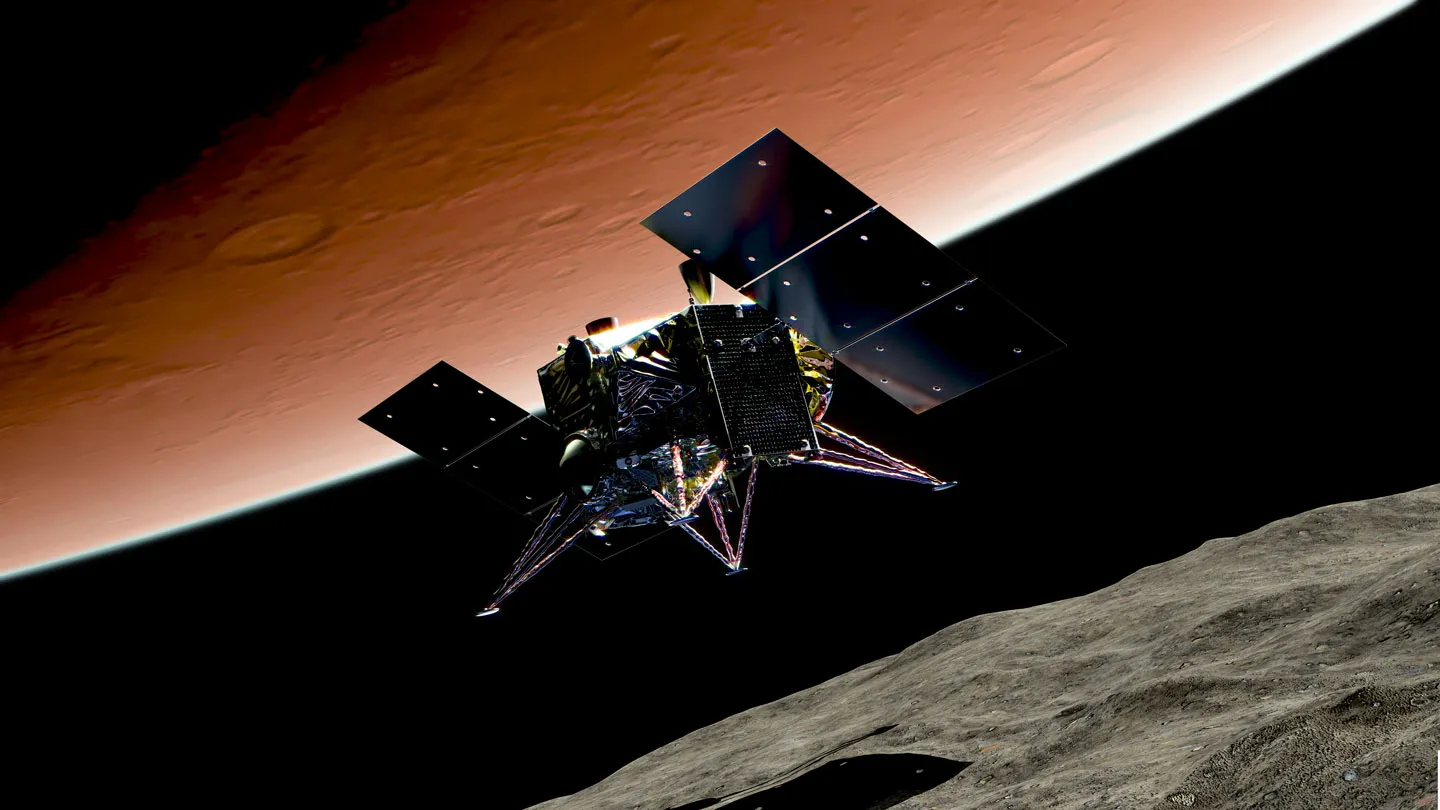
For decades, scientists have dreamed of getting Martian rocks into Earth’s laboratories — a Herculean feat that would revolutionize our knowledge of the Red Planet. An audacious mission from the Japanese space agency might offer the next best thing: rocks from Mars’ larger moon, Phobos.
That’s the task confronting the Martian Moons eXploration (MMX) spacecraft, due to launch October 19 at 3:41 p.m. EDT. The mission aims to crack the long-standing mystery of how Mars got its two odd moons by delivering a sample of Phobos to Earth in 2031. These rocks are no substitute for true Martian material — but given that NASA’s plans to fetch the Perseverance rover’s prized samples are in limbo, scientists are eager for even an indirect glimpse of Mars.
“It’s a chance to get a totally different sample and view of Martian materials,” says planetary scientist Briony Horgan of Purdue University in West Lafayette, Ind., who is not involved in the MMX mission. “It’ll be a great contribution to our sample collection back here on Earth.”
Focus on Phobos
If it’s successful, MMX will be the first mission to reach Phobos. Three previous spacecraft from Russia failed.
The MMX itinerary is action-packed: After launch, the spacecraft will spend about one year cruising out to Mars, then slip into orbit around Mars alongside Phobos for about three years. During its stay, the spacecraft will deploy a small rover named Idefix to scout the moon for good sampling sites. The main spacecraft will then make two landings to grab 10 grams of sample, about the weight of four U.S. pennies. It will use two different devices to snag the sample: One will drill two centimeters down into the rock, while the other will blow pressurized gas at the surface to collect loose material.
Once loaded up, MMX will zip past the smaller moon Deimos before making the one-year trek home to drop its cargo in Australia’s outback, just as Japan’s two previous asteroid sample-return missions have done. After the Japanese space agency JAXA sorts and catalogs the samples, it will share portions of them with other institutions.
Such a small handful of rock may not sound impressive, but it’s enough to thrill researchers. “A few grams of sample are going to be a real bonanza for scientists,” says planetary scientist Michael Zolensky of NASA’s Johnson Space Center in Houston, where 15 percent of the sample will eventually end up.
MMX is designed to reveal the enigmatic origins of Phobos and Deimos — the only moons in the inner solar system besides our own. “The Martian moons are so different from [the] terrestrial moon: They are two, very small [and] very dark,” says planetary scientist Tomoki Nakamura of Tohoku University in Sendai, Japan.
The strange objects look like rocks that wandered in from the outer asteroid belt and got trapped around Mars. But their tidy circular orbits suggest they coalesced after a massive collision tore material off the Red Planet. Or perhaps they came about some other way that scientists simply haven’t imagined, says planetary scientist Kiyoshi Kuramoto of Hokkaido University in Sapporo, Japan. “The natural world often reveals aspects that exceed our expectations,” he says.
Studying the features and composition of Phobos’ surface could solve the mystery. But although MMX carries sophisticated instruments to explore Phobos, those observations may not suffice. Hence bringing rock back to Earth’s labs, where scientists can enlist equipment far too large or delicate to ever send to space.
Martian mysteries under the microscope
Although sample analysis will focus on understanding Phobos, researchers will also be able to use the rocks to fine-tune our understanding of Mars. For example, pinpointing the material’s age will allow scientists to calibrate the chronology of cosmic collisions in the neighborhood of Mars. Currently, scientists estimate ages on Mars based on a timeline based on our moon, which may not apply at the Red Planet.
Scientists even have reason to hope that stray grains from Mars will be hidden amid the MMX treasure. This material could be ancient relics of the two bodies mixing during a moon-forming process, potentially including grains that hail from deeper in the Martian crust than scientists have seen so far in rare meteorites the cosmos has delivered us. No matter how Phobos formed, the material could also include fresher debris flung off the Red Planet by cosmic collisions.
The biggest challenge may be positively identifying which grains came from Mars. Such lucky samples would lack valuable geologic context and be far from pristine. “They’re material that’s been blasted off Mars from some unknown location, micron-sized things, sitting on the airless body Phobos, getting irradiated by space,” says planetary scientist Nancy Chabot of the Johns Hopkins University Applied Physics Laboratory in Laurel, Md. Nonetheless, scientists are prepared to get creative and use the latest technology to tease out every secret they can manage in any sample they can snag.
MMX offers a very different type of sample return than what NASA has initiated with the Perseverance rover, which has spent years squirreling away fresh material drilled from the most interesting outcrops it can find. That’s all in hopes of a future mission ferrying the rock to Earth for scientists to hunt for signs of ancient microbes. But the U.S. Congress has axed funding for that successor due to spiraling costs and concerns about feasibility — particularly of accomplishing the first ever launch from Mars.
Even if MMX can’t give scientists the satisfaction of an ultimate Mars sample return, there’s still plenty to learn, says planetary scientist Vicky Hamilton of the Southwest Research Institute in Boulder, Colo., who is not involved in the mission. “It’s always a happy day when we’re getting a sample from another object in space and bringing it back to Earth to study,” she says.
