


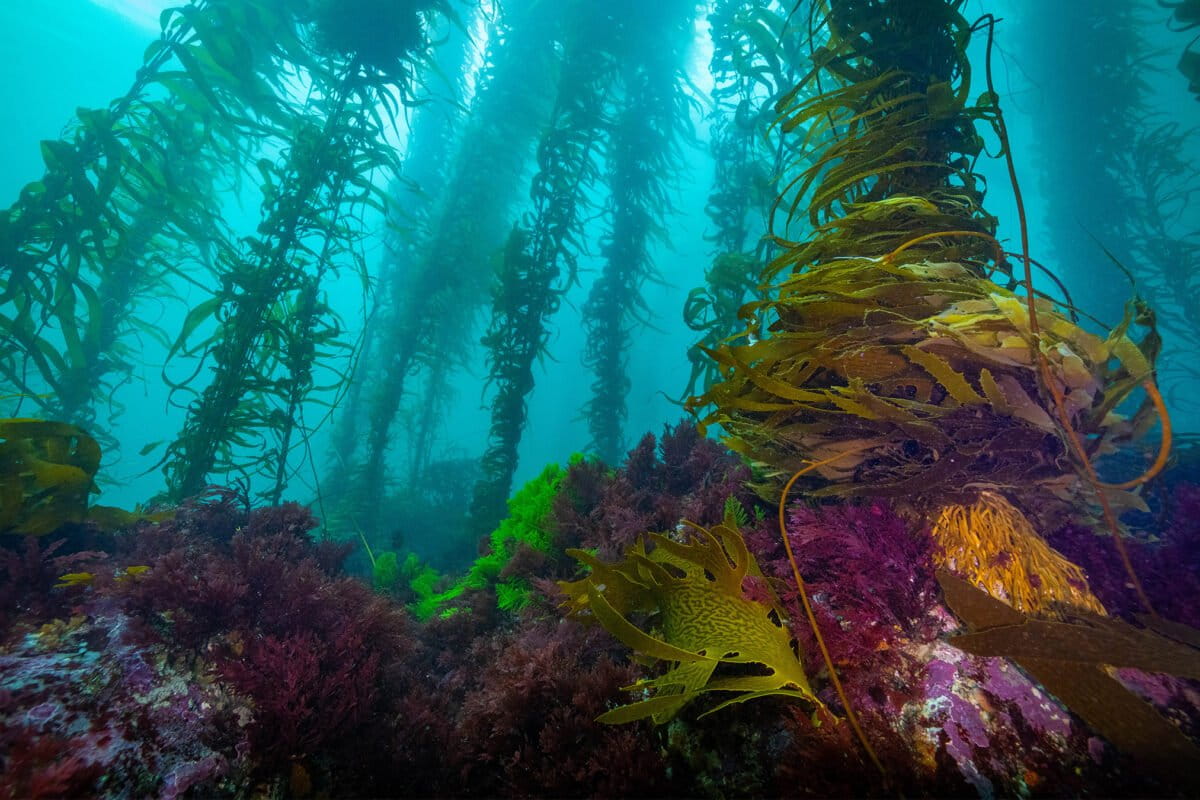
- The long-spined sea urchin (Centrostephanus rodgersii), also known as Centro, is an invasive species in the waters around Tasmania, Australia, and it’s been munching away the state’s kelp forests.
- A state program offers financial incentives to support a commercial fishery for the urchins and their highly valuable roe, with the aim of reducing urchin numbers in targeted areas so that kelp can rebound.
- Researchers say the program has been effective in helping to recover some of the state’s kelp forests.
- Now, however, they warn that progress is threatened by a shift to short-term funding cycles that undermine stability for harvesters and put kelp recovery on wobbly ground.
For nearly a decade, divers off Tasmania’s east coast have been getting a boost from the government to harvest the invasive sea urchins killing off kelp forests that fringe the Australian island state.
A state program offers financial incentives to support a commercial fishery for the highly valuable roe of the long-spined sea urchin (Centrostephanus rodgersii), also known as Centro. The aim is to reduce urchin numbers in targeted areas so the kelp can rebound. Researchers say the program has been effective in helping the recovery of some of the state’s kelp forests. Now, however, they warn that progress is threatened by a shift to short-term funding cycles that undermine stability for harvesters and put kelp recovery on wobbly ground.
John Keane, senior research fellow and wild fisheries program leader at the University of Tasmania’s Institute for Marine and Antarctic Studies (IMAS) in Hobart, has been studying Centro for more than 15 years and diving off Tasmania’s coast for 26 years. He told Mongabay he’s watched the kelp forests decline over the years.
“The rise of the fishery has put a halt on that in some areas,” he said. “We have seen some localized successes where we’ve seen kelp come back.”
Australia’s other great reef
The Great Southern Reef is a temperate network of rocky reefs dominated by kelp forests that stretches across 8,000 kilometers (about 5,000 miles) of Australian coastline, spanning five of the country’s eight states and territories, including Tasmania’s entire coast.
Tasmania’s reefs were historically dominated by giant kelp (Macrocystis pyrifera). Fronds can grow 40 meters (about 130 feet) from the seafloor to form canopies at the water’s surface, supplying habitat and food for the highly biodiverse kelp forest ecosystem and absorbing large amounts of carbon from the atmosphere.
The species is listed as endangered in Australia, and Great Southern Reef habitats in Tasmania and beyond are now dominated by golden kelp (Ecklonia radiata). Tasmania’s waters are warming at nearly four times the average global rate. Scientists blame warming for directly causing the state’s severe giant kelp decline, as well as for drawing Centro south from its native range off New South Wales state to overgraze Tasmania’s remaining kelp beds. A 2020 analysis of satellite imagery revealed a more than 90% decline in Tasmania’s kelp forest canopies between 1987 and 2015. (Globally kelp is in trouble too: a 2024 study showed 40-60% of kelp forests have degraded over the last 50 years. Threats include climate change, pollution, overfishing and invasive species.)
Many of Tasmania’s formerly kelp-covered rocky reefs have become “urchin barrens,” rocky deserts bereft of kelp and populated by urchins but little else. The loss of kelp forests has resulted in the decline of commercially lucrative species, including blacklip abalone (Haliotis rubra) and southern rock lobster (Jasus edwardsii).
Tasmania has the world’s largest abalone fishery; the industry contributed A$46 million ($30.6 million at the exchange rate at the time) to the Tasmanian economy in the 2022-2023 financial year. But Centro has pushed the fishery into decline. In 2010, the allowed catch for Tasmanian abalone was 2,793 metric tons. By 2021 it had been cut to just 917 metric tons.

Fishing for invaders
In an attempt to recover abalone stocks by restoring kelp reefs, during the 2016-2017 harvest season the abalone industry began offering divers a flat-rate subsidy of A$0.75 (56 U.S. cents) per kilogram, or about 25 U.S. cents a pound, to harvest Centro. In 2018, the industry and Tasmanian government launched the Abalone Industry Reinvestment Fund (AIRF). The state allocated the fund A$5.1 million ($3.8 million) spread over five years, and then committed another A$2 million ($1.3 million) in 2023 for two more years.
The AIRF funds a suite of activities, including habitat surveys, urchin-barren mapping, research into the effects of ocean warming on abalone habitat, and public outreach. A sizeable portion of its funding — A$2.1m ($1.35 million) between 2018 and 2025 — has provided a financial incentive (up to A$2.50/kg — $1.61/kg or 73 cents/lb — in priority areas) to commercial divers to harvest Centro, then send the urchins on to commercial processors who extract their roe, or gonads, and sell it as a high-valued food product. The AIRF subsidizes harvests in areas with low but increasing Centro density to prevent the collapse of kelp forests there, and excludes areas where the kelp forests have already disappeared and would be even more resource-intensive to restore.
The program has resulted in the removal of around 500 metric tons of urchins per year. In heavily harvested areas, scientists estimated it restricted urchin biomass density by up to 50% and enabled localized kelp forest recovery.
Despite the program’s apparent success, since 2025, the state has continued to allocate it A$1 million ($698,000) per year, but only on a one-year basis, with no assurance of future funding. This year, for example, those involved in Centro management didn’t know whether the funding would continue beyond the 2025-2026 financial year, which ended in June, until the annual state budget was announced in May, according to Keane, whose own urchin research has received AIRF funding.
The uncertainty wrought by these short-term funding cycles has made processors reluctant to invest in the fishery, Keane said. Extracting urchin roe is labor-intensive, so processing plants need a continuous, reliable volume of urchins to cover daily operating expenses. Since the commercial Centro fishery was established in 2009, two major urchin processors have closed down, he said. “So that’s where the support from the government is almost essential — to keep these businesses and the control program happening,” he said.


The preservation of existing kelp forests currently relies on an active urchin fishery, which Keane said is the main tool for managing Centro. And in places with few enough urchins that there’s still kelp, the urchin fishery relies on the state funding, according to Keane; it’s not self-sustaining due to high production costs and thin profit margins.
Somewhat paradoxically, in areas where urchins have already laid waste to kelp, the urchin fishery seems more self-sufficient. Shane Blackwell, a commercial diver, spent a few years harvesting Centro off southeastern Tasmania under the AIRF subsidy program. But he found his bills for insurance, equipment, fuel, and diving taxes easily swamped out the state incentive. “The [financial] viability of urchin diving is not really there,” Blackwell told Mongabay.
Instead, he decided it made more financial sense for him to relocate farther north, where urchin numbers are much higher. In October 2025, he opened his own urchin processing business in the town of St. Helens. The area has the highest cover of barrens in Tasmania, but it’s not eligible for the AIRF subsidy program.
“The subsidy needs to be there, especially in those areas where it’s even harder to catch them. But I’d rather just jump in and do the diving and the processing and build my company up,” Blackwell said.

Federal funding gap
Tasmania isn’t the only place with a Centro problem. Off the states of New South Wales and Victoria, Centro is native but overabundant. Urchin barrens cover up to 70% of shallow reefs in central-southern New South Wales and have prompted harvesting and culling initiatives in eastern Victoria. It’s a similar story in Aotearoa New Zealand.
For its part, the Australian government has invested a total of around A$12 million ($8.3 million) since 2001 toward research and management projects aimed at controlling Centro across Australia’s temperate reefs. This includes A$3.5 million ($2.3 million) in 2024-2026 to improve conditions for giant kelp off Tasmania by removing more than 10,000 urchins from priority kelp habitat, replanting juvenile kelp, and stocking sites with Centro-eating lobsters, among other interventions.
But Keane notes that’s far less than the A$20 million ($14 million) the federal government spends annually to control another habitat-destroying echinoderm, the crown-of-thorns starfish (Acanthaster planci), known as CoTS, in the Great Barrier Reef.
A study he co-authored, published in July, compared the management of CoTS and Centro. It estimates the two reefs are each worth A$9 billion to A$11 billion ($6.3 billion to $7.7 billion) annually to the Australian economy, but that culling one starfish costs approximately A$336 ($235) while harvesting one urchin through Tasmania’s incentivized fishery costs A$0.40 (28 cents).
Scott Bennett, a marine ecologist and colleague of Keane’s at IMAS who studies Australia’s kelp ecosystems, said kelp forests border both state and federal jurisdictions, so it shouldn’t be up to any single state government to fund their protection.
“It requires significant investment from state and federal governments and the private sector,” he told Mongabay.

A Senate inquiry into the spread of climate-related marine invasive species that focused on Centro produced a report in 2023 calling for A$55 million ($36.5 million) spread over five years to address the problem.
The federal government responded in April 2026. It did not commit any funding to support the Centro fishery, nor to any new Centro control measures. The response stated that “the Australian Government is best placed to operate in a research coordination role.” From the previous federal funding rounds, only one research project to support the commercial Centro fishery is still ongoing, at a cost of just under A$300,000 ($209,000) between 2025 and 2027.
Mongabay asked the Tasmanian government for its long-term plan for managing Centro. “The Tasmanian Government has consistently backed action on long-spined sea urchins,” a spokesperson told Mongabay. “Future funding will be considered through normal budget processes.”
Banner image: Giant kelp in Port Davey, Tasmania. Image courtesy of Stefan Andrews.
Citations:
Tebbett, S. B., Ling, S. D., Doll, P. C., Keane, J. P., Miller, K. I., & Pratchett, M. S. (2026). ‘Prickly problems’ on Australian reefs: Comparative ecology and management of crown-of-thorns starfish and long-spined sea urchins. Marine and Freshwater Research, 77(10). doi:10.1071/mf25249
Butler, C. L., Lucieer, V. L., Wotherspoon, S. J., & Johnson, C. R. (2020). Multi-decadal decline in cover of giant kelp Macrocystis pyrifera at the southern limit of its Australian range. Marine Ecology Progress Series, 653, 1-18. doi:10.3354/meps13510
Filbee-Dexter, K., & Wernberg, T. (2020). Substantial blue carbon in overlooked Australian kelp forests. Scientific Reports, 10(1). doi:10.1038/s41598-020-69258-7
Eger, A. M., Eddy, N., McHugh, T. A., Arafeh-Dalmau, N., Wernberg, T., Krumhansl, K., … Vergés, A. (2024). State of the world’s kelp forests. One Earth, 7(11), 1927-1931. doi:10.1016/j.oneear.2024.10.008
Cresswell, K. A., Little, L. R., Hartmann, K., Gardner, C., Keane, J. P., Ling, S. D., & Bradshaw, S. C. (2025). When overfishing is the sustainable option. Nature Sustainability, 8(5), 498-507. doi:10.1038/s41893-025-01526-8
FEEDBACK: Use this form to send a message to the editor of this post. If you want to post a public comment, you can do that at the bottom of the page.
Cite this article
Amina McCauley (2026). Funding uncertainty threatens Tasmania’s gains against kelp-grazing sea urchins. Mongabay Conservation news. DOI: https://doi.org/10.66709/news-332749

