


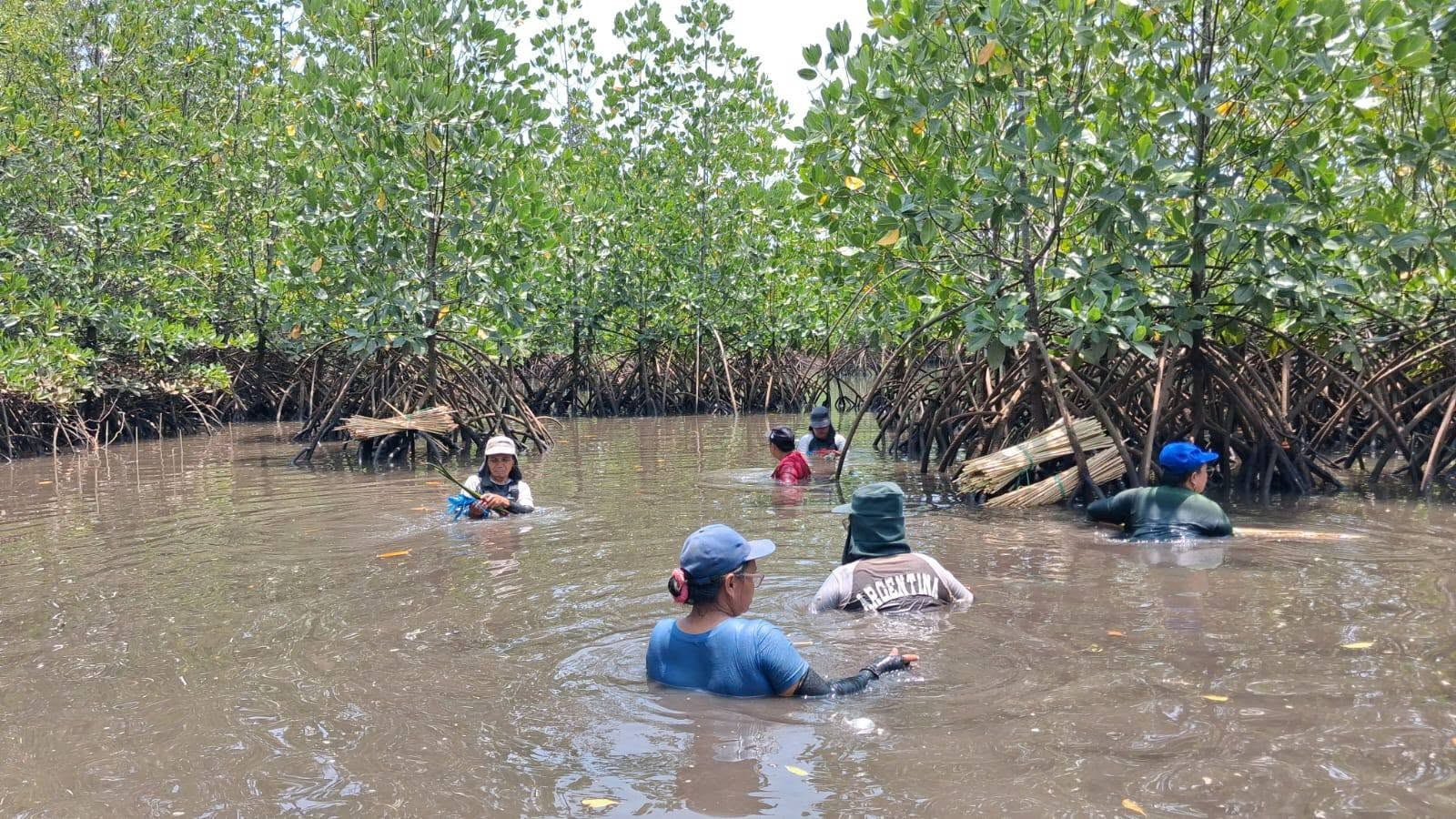
- Wisye Sahambangung, a fisher and mangrove conservationist from Sarawet, a village in Indonesia’s North Sulawesi province, has gone from receiving government assistance for low-income families to leading a women’s group restoring mangroves and creating livelihood opportunities.
- In 2022, she helped establish Rhizopora, which now collects mangrove propagules, supplies seedlings, monitors coastal areas, and supports restoration projects.
- Through mangroves-related businesses and a savings-and-loans scheme, Rhizopora members have found new sources of income.
JAKARTA — Wisye Sahambangung is a fisher, community leader, and mangrove conservationist from Sarawet, a coastal Indonesian village in North Sulawesi province.
Since 2022, the 45-year-old has led Rhizopora, a women’s group that restores mangroves and helps create economic opportunities for women in the village.
Rhizopora, named after the Rhizophora genus of mangrove trees, has become a community-based conservation movement. Its members collect mangrove propagules and seedlings, support restoration projects, monitor coastal areas, and teach other villagers how to plant mangroves. They revive the mangrove forest that is home to crabs and fish, which are their primary source of income.
In collaboration with the NGOs Yayasan Bumi Tangguh and CARE Indonesia, Rhizopora helped plant 30,000 mangrove trees during an eight-month restoration project this year.
For Wisye, protecting mangroves is about protecting the people who depend on the coast. The group sells seedlings, collects and sells mud crabs, and runs savings-and-loans activities that boost their incomes. Her work has taken her from Sarawet’s muddy coastal areas to an international forum in Australia, where she shared the women’s experiences of protecting their coastal environment.
“Since Rhizopora was established, Sarawet has become more widely known nationally and internationally,” she said proudly.
Wisye spoke with Mongabay via video call about how she leads Rhizopora in protecting coastal ecosystems while creating income opportunities for women in the community, the challenges of community-led conservation, and the impact on her village. The following interview has been translated from Indonesian and edited for length and clarity.
Mongabay: What made you step into a leadership role in mangrove conservation?
Wisye Sahambangung: In 2022, I was still a recipient of Program Keluarga Harapan (PKH), a government social assistance program, along with other women in Sarawet. Around the same time, the local fisheries and marine affairs office invited us to mangrove restoration training, aimed at improving our livelihoods while encouraging environmental conservation.
That was how the Rhizopora women’s group began. Nine women were selected [by CARE Indonesia and Yayasan Bumi Tangguh], and I later became a human development officer, taking a more active role in the group’s activities. What began as an opportunity to improve our livelihoods grew into a collective effort to protect our mangroves.
Mongabay: What was the biggest challenge when you first started Rhizopora?
Wisye Sahambangung: At first, we faced criticism and some jealousy from people outside the group. We also had limited resources. We built our own secretariat [office], while the fisheries office provided mentoring but no funding. The [mangrove restoration] work was physically demanding too; sometimes the mud in coastal areas and around fish ponds could reach my chest. But we kept going and built the group through our own efforts.
Mongabay: What does Rhizopora do on a daily basis?
Wisye Sahambangung: We plant mangroves, collect seedlings and propagules, and look for mud crabs.
We also supply mangrove seedlings in bulk for corporate environmental and social responsibility programs, including projects involving Alfamidi, a national retail chain; BPJS Kesehatan, Indonesia’s national health insurance agency; and PLN, the state-owned electricity company. Each mangrove seedling sells for 2,000 rupiah [about 11 U.S. cents], while each wooden stake [used to support the seedlings] adds another 500 rupiah [about 3 cents], bringing the total to 2,500 rupiah [14 cents].
The group also collects mud crabs. One kilogram can sell for around 350,000 rupiah [$19.40]. Some are sent to Manado [the provincial capital] before being exported to Singapore.
We are now also trying to make soap from mangrove materials. We are still processing the necessary business and product registrations, and we hope to eventually bring the product to market.

Mongabay: How are mangroves connected to women’s livelihoods in Sarawet?
Wisye Sahambangung: Mangroves give women opportunities to earn an income while protecting the coast. We sell [mangrove] seedlings, trees, and fruits, and we also run a savings-and-loans scheme for the group.
One of our members is a single mother. Through the group’s activities and savings-and-loans scheme, she was able to buy a house and build a small cake-selling business, giving her a more secure income source. For us, it is not only about planting mangroves but also about helping women build more secure livelihoods.
Mongabay: What changes have you seen in Sarawet since people became more involved in protecting the mangroves?
Wisye Sahambangung: The community is now more committed to protecting the mangroves, and we are seeing more fish in the area. Fishers have also told us they are catching more fish, showing how mangroves support both the environment and local livelihoods.
Our efforts have also earned the trust of the fisheries authorities, and we are now involved in a community-based mangrove monitoring group. Protecting mangroves cannot stop at planting; we need to keep monitoring and caring for them.

Mongabay: You recently traveled from Sarawet to Australia to speak at an international forum. What did that experience mean to you?
Wisye Sahambangung: It was very meaningful, especially as it was my first time traveling on an airplane. I traveled from Sarawet to Melbourne with [representatives from] Yayasan Bumi Tangguh and CARE Indonesia, plus a translator, to speak at Women Deliver 2026 about how women in our community restore mangroves and build livelihoods. Speaking in Indonesian to an international audience made me realize that our work in a small coastal village can reach far beyond Sarawet.
Mongabay: What message would you like to bring from Sarawet to the rest of the world about the future of our oceans?
Wisye Sahambangung: We need to protect and care for mangroves together, with continued support for their conservation. I hope these efforts can continue to benefit both the environment and the communities on the coast.
Banner image: Wisye Sahambangung, front, and other women from Rhizopora work in a muddy mangrove area in Sarawet on Sept. 2, 2026. Image courtesy of Wisye Sahambangung.
Cite this article
Annisa Dinulislam (2026). Indonesian women cash in on mangrove restoration: Interview with community leader Wisye Sahambangung. Mongabay Conservation news. DOI: https://doi.org/10.66709/news-332892

