


Africa boasts up to 25% of Earth’s animal and plant species. This diversity is driven by diverse habitats: harsh deserts, vast grasslands, dense forests, towering mountains, lush coastlines and teeming seas. It is also due to deep evolutionary roots, as many animal and plant groups originated here in the distant past. Paleontologists have been excavating this material for nearly two centuries.
Africa is most famous for spectacular hominid fossils that reveal our own ancestry. However, the continent boasts many fabulous fossil finds, including those of the most familiar extinct animals – dinosaurs.
The first African dinosaur fossils to be noted scientifically hailed from the Eastern Cape, South Africa and were described in the 1850s. Since then, the African dinosaur map has expanded, with rich fossil beds in South Africa, Lesotho, Tanzania, Egypt, Niger, Malawi, Madagascar and Morocco.
Zimbabwe is an important part of the African dinosaur puzzle, with dinosaur bones reported since 1916.
As a specialist on early dinosaurs who has worked on similar material from China, the UK and Africa, I’ve been drawn to these Zimbabwean fossils to see what they reveal about the first stages of their evolution.
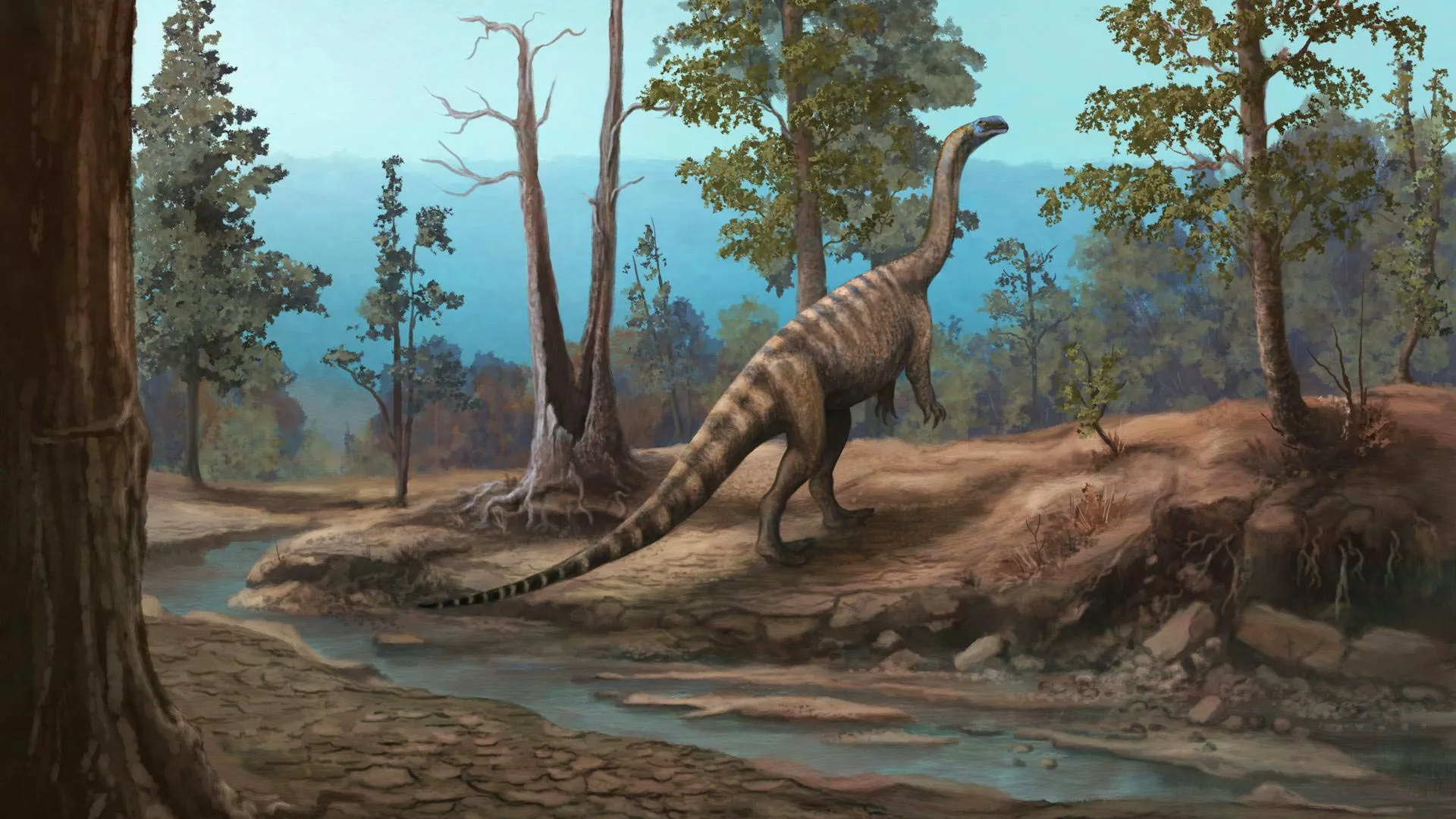
Our latest addition to the Triassic zoo, Musango matusadonaensis, is a sauropodomorph dinosaur. (That’s the dinosaur subgroup that eventually gave rise to four-legged, long-necked giants like Diplodocus.)
Its incomplete skeleton was found in the bank of the Nyamasango River close to Musango Island, as captured in the animal’s scientific name. Musango’s anatomy shows us that it was bipedal (walking on its hind legs only), reached about 4.5 meters in length, and weighed 220kg. Growth marks in its bones reveal that it was a subadult when it died. Sadly, the skull wasn’t preserved, so its diet is unknown, but its close relatives were largely herbivorous (plant-eating).
Our new work reveals something unexpected about Zimbabwean dinosaurs. They’re not simply an extension of better-known South African faunas but include an array of species unique to the region. We’re now trying to work out why these differences exist. We suspect that environmental conditions might be the key.
The search
Early fossil finds in Zimbabwe were overlooked by many scientists and it was not until the 1970s that they became more generally known. This was thanks to pioneering work by Zimbabwean paleontologists Geoffrey Bond and Michael Raath, who discovered abundant material in the hinterlands of Bulawayo (south-west Zimbabwe) and the lower Zambezi Valley (forming the border with Zambia). Most of these finds were identified as belonging to known species named from neighboring South Africa.
Paleontological work in Zimbabwe stalled for a few decades. However, a band of devoted fossil hunters kept searching. One of them, Steve Edwards, a local safari camp manager, found new, productive sites on the shore of Lake Kariba, the artificial lake which forms most of the border between Zimbabwe and Zambia. News of the discoveries eventually reached Jonah Choiniere at the University of the Witwatersrand, Johannesburg. Jonah, an expert on early dinosaurs, immediately recognized the importance of the material. He assembled an international team of South African, Zimbabwean and UK-based collaborators to explore them further.
This was a major task, as the sites on Late Kariba’s shoreline are deep inside Matusadona National Park. Our solution was to use one of the Kariba houseboats as a mobile hotel and laboratory, so that we could prospect the shoreline. We mounted two expeditions, in 2017 and 2018. We have been cleaning and studying this material ever since.
Both trips yielded a trove of material, collected from brick-red mudstones and sandstones that were laid down by ancient rivers around 210 million years ago, during the Late Triassic period (237-201 million years ago). Geological evidence and plant fossils show that the Triassic landscape of Kariba was dry and dotted with stands of large conifer trees, with green corridors of vegetation following permanent watercourses.
What’s unique
Sauropodomorphs are the most common Late Triassic dinosaurs. But what’s interesting about Musango and its relative Musankwa (which we described from the same beds in 2024) is that they are unique to Zimbabwe.
We’d expected to find South African dinosaur species in these beds, given their similar age and geographic proximity, but surprisingly all the material we’ve collected so far has revealed animals that are distinct from those elsewhere.
These Zimbabwean dinosaurs are not even the closest relatives of their South African neighbors. We’ve also found other fossil animals, including lungfish and aquatic reptiles called phytosaurs, which are rare or absent in South African sites.
Following this, we’ve started to reappraise the historical dinosaur collections in Bulawayo. It appears that many of these fossils can’t be referred to South African species either, contrary to earlier assumptions.
Then, as now, Zimbabwe was further north than South Africa and closer to the equator, so climatic differences might be responsible for these varied casts of characters (as climate is known to have a strong effect on the distributions of living animals). To probe this further, we’ll be going back to Kariba in search of more fossils.
We’ll also collect more information on the exact ages and environments of these dinosaur-bearing rocks, to compare them more precisely with sites elsewhere. Although the significance of these dinosaurs is only just coming to light, Zimbabwe is already taking a greater role in shedding much needed light on early dinosaur evolution.
