


- Indonesia faces criticism for its handling of forest and land fires that have sent hazardous haze into Malaysia and Singapore, with officials refusing to apologize and dismissing the crisis as largely a natural phenomenon.
- President Prabowo Subianto cited 639 hectares (1,579 acres) under active firefighting as evidence of progress, but experts warned the figure was misleading because it represented areas being tackled by firefighters, not the total area still burning.
- Environmentalists blame inadequate preparedness and decades of forest-clearing permits and peatland drainage, while Malaysia and Singapore have offered firefighting assistance that Indonesia has yet to formally accept.
- The haze is causing widespread health and environmental damage, with more than 283,000 acute respiratory illness cases recorded across seven affected Indonesian provinces, and dozens of orangutans rescued from fires in Borneo.
JAKARTA — Indonesia is facing growing criticism over its response to a forest and land fire crisis that has sent choking haze billowing into neighboring Malaysia and Singapore, but officials insist the government is not to blame.
The president has claimed that a drawdown in firefighting efforts means the number of fires has gone down, while one of his spokespersons trotted out a familiar rebuke that neighboring countries should be grateful for the oxygen they get from Indonesia’s forests and not complain only when they get “sent smoke.” Meanwhile, Malaysia said it was still awaiting a response to its offer of assistance fighting the fires, while Singapore raised the prospect of taking legal action against any Singapore-linked companies behind the burning.
Indonesian officials have acknowledged the fires’ effects on neighboring countries, but as of Oct. 16 had issued no public apology for the haze that pushed Kuala Lumpur and Singapore into the ranks of the most polluted cities in the world.
Instead, Syahganda Nainggolan, head of the government communications office, said Malaysia and Singapore should see the problem as being “beyond human error” and “truly nature.”
“We do not just send smoke; when there is no smoke, we send oxygen,” he said, echoing remarks made by previous administrations during similar fire crises.
The statement drew criticism in Malaysia, where Andrew Chen Kah Eng, a politician from Prime Minister Anwar Ibrahim’s Pakatan Harapan coalition, said it trivialized Malaysians’ health concerns.
“We Malaysians are suffering, yet you are making fun of our health,” Chen said as quoted by local media. “The health and lives of the people should never be treated as a joke.”
He called on Syahganda to apologize to the people in affected countries for exposing them to pollution.
During the 2015 haze crisis, Indonesia’s then-vice president, Jusuf Kalla, sparked a similar outcry when he criticized Singapore and Malaysia for complaining about smoke from Indonesia. “For 11 months, they enjoyed nice air from Indonesia and they never thanked us,” Kalla said. “They have suffered because of the haze for one month and they get upset.”
Critics have contrasted the government’s attitude with that of the Suharto regime in 1997, when the fire and haze crisis was much more severe. At the time, Suharto issued a public apology.
“Indonesia offers its sincerest apologies to the people of neighboring countries who have been affected by the forest fires in our territory,” he said at the State Palace in Jakarta on Sept. 16, 1997, according to state news agency Antara.
Nearly 30 years on, the new occupant of the State Palace is Suharto’s former son-in-law, Prabowo Subianto, under whom “nothing has changed significantly in addressing forest and land fires,” said Timer Manurung, executive director of environmental NGO Auriga Nusantara.
“It feels as though we have gone backward,” Timer told Mongabay in Jakarta.

How much land is still burning?
On Oct. 12, Prabowo said the total area still affected by fires had fallen sharply, and attributed the decline to what he claimed was large-scale government intervention.
“ Our natural conditions are challenging. But from hundreds of thousands of hectares a few weeks ago, we are now below 1,000,” he said at the State Palace. “I think this would not have been possible without our large-scale intervention. Moreover, we will be carrying out mitigation measures going forward.”
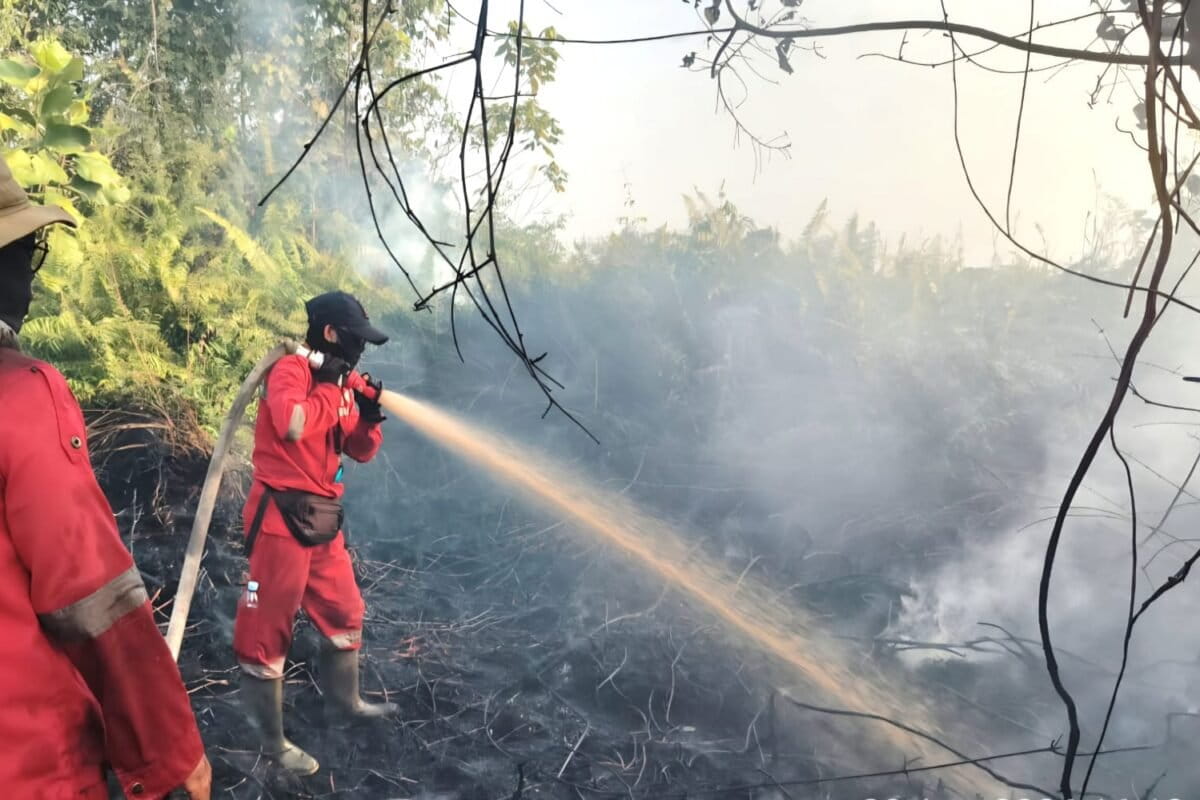
Prabowo said he’d received a report from the head of the National Disaster Mitigation Agency (BNPB), Suharyanto, that active firefighting efforts were underway in just 639 hectares (1,579 acres) across the six worst-hit provinces, suggesting this was the full extent of the burning.
That figure, however, was not an estimate of the total area burned, or all the fires still burning nationwide. On Oct. 14, two days after Prabowo’s statement, the BNPB and the Ministry of Forestry emphasized that these were areas where firefighters were currently at work.
In a separate development that same day, Indonesian anticorruption investigators raided the BNPB offices and charged five people in connection with the alleged embezzlement of emergency relief funds. Among those arrested was Suharyanto’s brother, employed as his adviser. Suharyanto himself was sacked as the BNPB head in a cabinet reshuffle the next day, Oct. 15.
While Prabowo called the fires a top priority and ordered further action, the Oct. 12 meeting at the palace didn’t discuss the offers of assistance from Malaysia and Singapore, according to Singaporean newspaper The Straits Times. Malaysia offered a firefighting aircraft, three helicopters, and 52 personnel, but said it was still awaiting a formal response. Singapore also offered assistance.
“We are still able to handle this,” Dudung Abdurachman, Indonesia’s coordinating minister for political and security affairs, said as quoted by Reuters.

‘Perpetuating this stupidity’
Environmentalists have questioned the government’s seriousness in addressing the crisis. Uli Artha Siagian, campaign coordinator at the Indonesian Forum for the Environment (Walhi), said in a TV interview that the government had failed to heed researchers’ prior warnings of a prolonged El Niño and very dry conditions.
Boy Jerry Even Sembiring, Walhi’s executive director, said in another interview that the fires were not simply a natural disaster. He pointed to decades of the government issuing permits allowing companies to clear forests and drain peatlands, leaving them tinder-dry and highly flammable.
Timer said the official remarks showed a lack of professionalism and urgency.
“I am worried that a lack of understanding of reality means the government does not realize that this is actually a crisis,” he said. “The government currently shows no sense of crisis at all, including in its response to offers of assistance from other countries. So let us not keep perpetuating this stupidity.”
Landscape ecologist David Gaveau, who runs the forest-monitoring platform Nusantara Atlas, said satellite imagery continued to show numerous smoke plumes, particularly over southern Borneo. Smoke plumes indicate smoke is present and spreading, although they don’t necessarily mean there’s an active fire in the area.

Sapta Ananda Proklamasi, a senior researcher and geographic information system expert at Greenpeace Indonesia, said the BNPB may have been correct when it said it was “handling” 639 hectares of burning. “But the president interprets that as meaning only 639 hectares remain burning,” he told Mongabay.
The figure risks creating a misleading impression when it isn’t accompanied by other information about the extent and duration of the haze, he added.
The government should therefore also report where the haze has spread, for how long it has persisted, and how many people have been affected, Sapta said. A Greenpeace analysis estimated that around 40 million people across Indonesian Borneo and Sumatra have been exposed to smoke haze over the preceding two months.
“People are not exposed to smoke for just one minute and then it ends. They are exposed every minute, every hour, and every day, for months,” Sapta said. “Does Prabowo not see the babies suffering from acute respiratory infections? Does he not see that information? If he does not, then there is a blockage in the flow of information.”

Haze and health impacts
The dispute over the 639-hectare figure comes as haze from Indonesia’s fires continues to affect public health and air quality at home and in neighboring countries. The crisis has been intensified by dry conditions associated with El Niño, while fires in peatlands can smolder below the surface and remain difficult to extinguish.
Levels of PM2.5 pollution — airborne particulate matter that’s so fine it can enter the lungs — hit the highest level in Singapore since 2015 on Oct. 14, , according to Channel NewsAsia. As on 1 p.m. on Oct. 16, the city-state ranked as the most polluted city in the world for its air quality index, according to Swiss-based monitoring service IQAir. Kuala Lumpur was second.
In parts of Indonesia, air pollution has also reached hazardous levels. Videos shared on social media showed thick yellow-orange haze in Central Kalimantan province, including the provincial capital, Palangkaraya. One video, shared by Indigenous Dayak rights activist Emmanuela Shinta on Instagram on Oct. 14, showed her wearing a gas mask as she walked through the haze.
“This video has no filter. This is exactly what it looks like right now, this city, a gas chamber, nowhere to hide, nowhere to escape,” she said. Shinta told Mongabay the city had been blanketed in a yellow-orange haze every morning for about a week.
IQAir recorded PM2.5 levels of 308.2 micrograms per cubic meter of air that afternoon, categorized as hazardous.
More than 11,000 acute respiratory illness cases have been recorded in Palangkaraya so far this year.
Across seven provinces affected by fires and haze, Ministry of Health data showed 283,270 acute respiratory illness cases as of Oct. 13, more than double the 113,336 recorded as of Sept. 9.
People and wildlife in danger
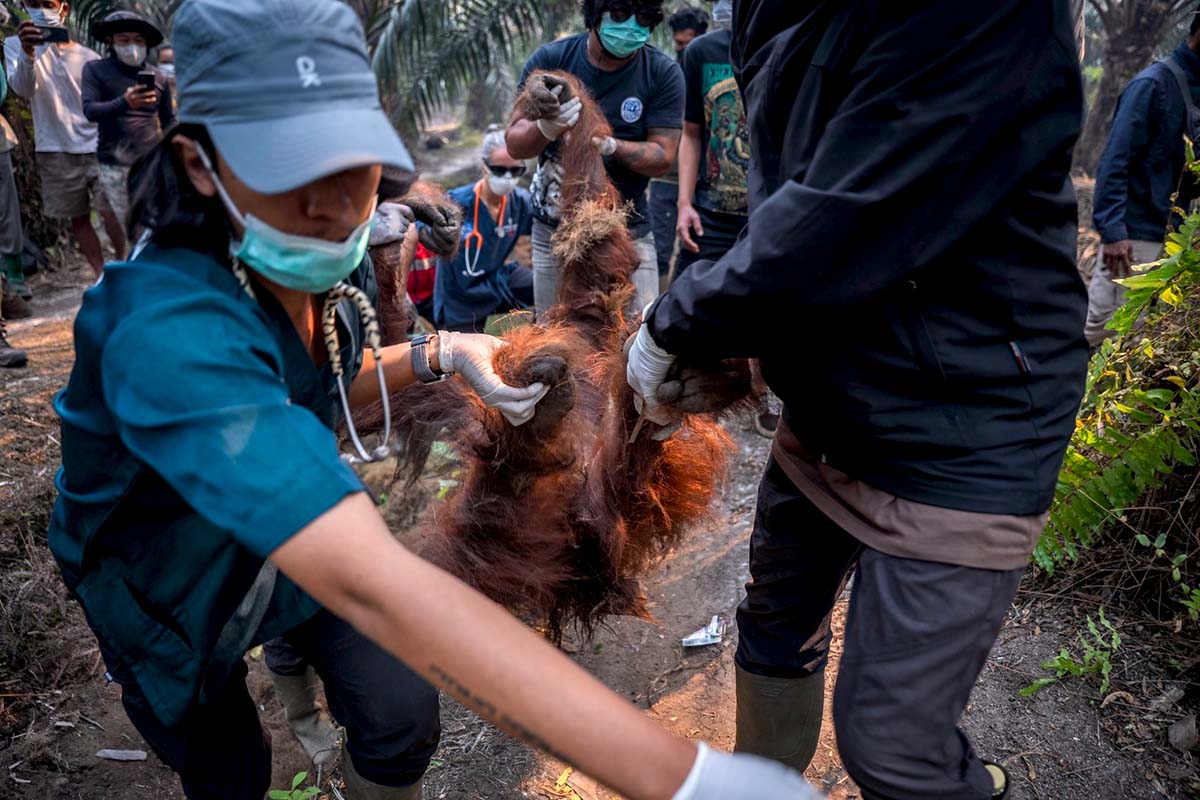
Conservationists are also rescuing wildlife from fire-affected forests. In West Kalimantan province, authorities and conservationists had rescued 46 orangutans threatened by fires as of Oct. 9, according to International Animal Rescue (IAR). That total exceeds the 40 orangutans rescued during the 2015 fires, IAR said.
The rescue count underscores the pressure on orangutans as fires damage their habitat.
“Sadly, we expect many more will need help in the months ahead,” IAR wrote on its website.
In Palangkaraya, 47 orangutans at a rehabilitation center were reported to be suffering from acute respiratory illness amid the haze.
“We are seeing a situation that has reached the level of a disaster, yet it is being treated as though the public can simply tolerate it,” Greenpeace’s Sapta said. He added international assistance should help not only with firefighting but also with people suffering from the haze.
“What we should do is help the people affected by the haze. That is more realistic and is what they actually need,” he said.
Banner image: Firefighters battling a blaze in Central Kalimantan in 2026. Image courtesy of Indonesia’s National Disaster Management Agency (BNPB).
FEEDBACK: Use this form to send a message to the author of this post. If you want to post a public comment, you can do that at the bottom of the page.
Cite this article
Hans Nicholas Jong (2026). ‘Perpetuating stupidity’: Indonesia comes under fire for response to burning and haze. Mongabay Conservation news. DOI: https://doi.org/10.66709/news-332817

