


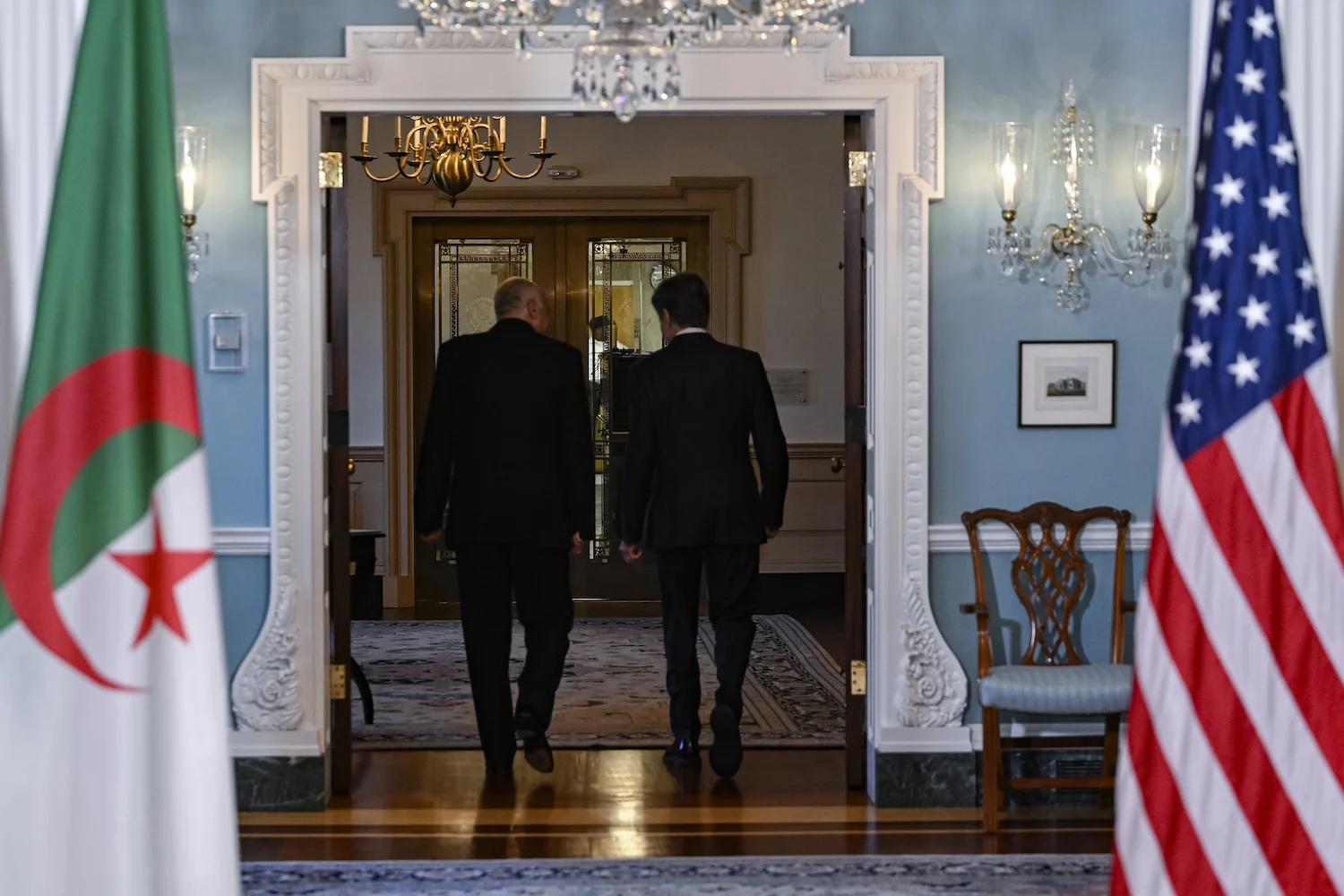
Years of simmering tensions between Algiers and Abu Dhabi boiled over last month when Algeria’s Ministry of Foreign Affairs announced that the country was severing diplomatic relations with the United Arab Emirates. The ministry did not cite a specific reason for the split, but the decision appeared to stem from Algeria’s frustration over Emirati support for armed groups in North Africa—including possibly inside Algeria—which Algiers considers destabilizing.
This diplomatic rupture reflects the increasingly assertive foreign policy Algeria’s current leadership has advanced since coming to power in 2019. Algiers long prided itself on being a mediator in the region but saw that role decline in recent decades on account of the country’s 1992-2002 civil war and the declining health of former President Abdelaziz Bouteflika. Now, under President Abdelmadjid Tebboune, things are changing: By pursuing foreign partnerships, recalibrating its relations with Washington and Moscow, and taking a decisive stance against Abu Dhabi, Algiers is demonstrating its intention to reclaim its regional and international influence after decades of absence.
Years of simmering tensions between Algiers and Abu Dhabi boiled over last month when Algeria’s Ministry of Foreign Affairs announced that the country was severing diplomatic relations with the United Arab Emirates. The ministry did not cite a specific reason for the split, but the decision appeared to stem from Algeria’s frustration over Emirati support for armed groups in North Africa—including possibly inside Algeria—which Algiers considers destabilizing.
This diplomatic rupture reflects the increasingly assertive foreign policy Algeria’s current leadership has advanced since coming to power in 2019. Algiers long prided itself on being a mediator in the region but saw that role decline in recent decades on account of the country’s 1992-2002 civil war and the declining health of former President Abdelaziz Bouteflika. Now, under President Abdelmadjid Tebboune, things are changing: By pursuing foreign partnerships, recalibrating its relations with Washington and Moscow, and taking a decisive stance against Abu Dhabi, Algiers is demonstrating its intention to reclaim its regional and international influence after decades of absence.
This shift has its limits, though. Algeria has shown little willingness to mend ties with longtime rival Morocco or abandon support for Western Saharan independence. For Washington, helping to manage this tense regional relationship is crucial to keeping the U.S.-Algerian opening on track.
In 2020, several factors converged to push Algerian foreign policy in this new direction. Tebboune had just taken office following domestic protests demanding the removal of the political, military, and business elites who had ruled Algeria since 1962. This movement, known as the Hirak, united broad segments of Algerian society and ultimately pushed Bouteflika out of office after 20 years in power. However, the military and the established political leadership nonetheless secured the election of Tebboune, a former prime minister, as Bouteflika’s successor.
Under Tebboune, the Algerian government has sought to prevent future challenges to its rule through a combination of internal repression and a more active foreign policy that aims to both facilitate its economic agenda and reassert its regional and global influence.
Tebboune has advanced a vision of a “new Algeria” built around a more diversified—and therefore self-reliant—economy. His government has worked to “localize” industries that once heavily depended on foreign goods, such as medicine, which Algeria now mostly produces at home and has even begun exporting elsewhere in Africa.
As part of this effort, Algeria has sought to increase its influence in international institutions through bids for membership in international forums. Its bid to join BRICS in 2023 was unsuccessful, but it won a three-year seat on the African Union Peace and Security Council and served a two-year term on the U.N. Security Council in 2024 and 2025.
More concretely, Algiers’s push for diversification has also motivated bilateral partnerships, including with the United States, to bring foreign investment in sectors such as agriculture. In April, Algeria secured a much-touted deal to import 30,000 cows from the United States for a massive dairy farm in Algeria’s south, and Algiers is actively looking to establish more commercial partnerships.
The United States also invests heavily in Algeria’s oil and gas sector, which forms the foundation of the country’s economy. Two pending agreements with Chevron and ExxonMobil to tap Algeria’s vast natural gas reserves would secure development opportunities for U.S. businesses while also increasing the amount of gas Algeria has available to export (particularly to Europe) and meet its ballooning domestic demand.
Algiers is also investing in deepening its diplomatic ties with Washington. In 2024, the Algerian government hired a U.S. lobbying firm to make the case for Algeria’s importance to U.S. policymakers and this year purchased an office building near the White House in Washington. Meanwhile, the two countries have made commitments to cooperate on defense. Historically, though, there have been limits to such progress on account of both countries’ relationships with one another’s rivals. Algeria is fiercely insistent in its opposition to Israel and maintains long-standing relations with Russia, while the United States has maintained strong ties to Morocco.
Inside Africa, Algiers is working to restore the country’s position as a stable, reliable regional actor. In 2015, for example, Algiers helped broker the Agreement on Peace and Reconciliation in Mali, which halted fighting between Tuareg insurgents and the Malian government engaged in a civil war.
Algiers has also recalibrated its relationship with Moscow out of concerns that Russian-backed forces are fomenting extremism and instability at Algeria’s borders. Private Russian paramilitary groups have operated in the Sahel since 2021, propping up military juntas and unconstitutional regimes. This activity poses a problem for the Algerian government, which partly draws domestic legitimacy—and attracts foreign investment—on the record of stability it established in the 1990s. Now, Algerian officials insist that their relations with Moscow focus on military equipment sales, as Algeria remains one of Russia’s largest buyers of military equipment, according to officials familiar with the matter.
Splitting with the UAE is an extension of Algeria’s effort to project its stabilizing influence in North Africa, positioning itself directly against an Emirati foreign policy that Algiers sees as fueling regional turmoil. Abu Dhabi has been exacerbating conflicts in Sudan, Libya, and elsewhere by funding or directly sending weapons, mercenaries, and other supplies to armed groups that it believes can help further its objectives in Africa. In Libya, for instance, the UAE has supported forces led by Gen. Khalifa Haftar to topple the internationally recognized government in Tripoli, likely due to his anti-Islamist agenda. Algeria has in response expressed concern about fighting in western Libya, calling Tripoli a “red line” that no one should cross.
Algiers has made it clear that it intends to secure its backyard. In August, Tebboune sent four fighter jets to Niamey, Niger, in response to an attempted internal coup against the ruling junta there, enacting its 2020 constitutional provision allowing foreign military deployments for the first time.
By taking this firm stance on the UAE, Algiers can also address grievances at home. Relations with the UAE may not be top of mind for most Algerians, but severing them may appeal to public frustrations. Abu Dhabi maintains close relationships with France and Israel, two countries toward which many Algerians harbor a sense of anger and injustice—the former due to more than a century of colonial exploitation and the latter due to Algerians’ identification with the Palestinian cause.
As its new foreign policy emerges, Algeria appears to be attempting to deepen ties with the United States without compromising on its support for the Polisario Front, which represents the people of the disputed territory of Western Sahara (known as Sahrawis) in their quest for independence from Morocco.
Washington has made recent efforts to advance an alternative solution to the dispute, where Western Sahara would have autonomy under Moroccan sovereignty. Despite Algeria’s deepening relations with the United States, the leadership in Algiers is unlikely to pressure the Polisario Front to concede to this plan. Algerian Foreign Minister Ahmed Attaf effectively stated as much at the U.N. General Assembly last month when he warned that any attempt to bypass self-determination would “exacerbate tensions in a region that is in dire need of tranquility, stability, cooperation, and development.”
From Algeria’s point of view, helping to facilitate an agreement between Morocco and the Polisario Front is not necessary for it to continue to deepen its ties with the United States. This year, Algiers has already enjoyed two visits from Trump advisor Massad Boulos, who underscored the importance of deepening bilateral commercial and security ties. Boulos also recently stated that Algeria has been playing a constructive role on the Western Sahara issue and that the country “cannot impose” anything on the Polisario Front. The threat of U.S. congressional sanctions on Algeria for its arms purchases from Russia may have contributed to Algerian willingness to cooperate on the most recent Western Sahara negotiations. But the two sides are already discussing direct commercial sales of U.S. military equipment, suggesting that Washington is tolerant of Algiers’s current relationship with Moscow.
In this context, the United States can continue to try to balance its longtime partnership with Morocco with its burgeoning relationship with Algeria. Indeed, growing ties between Algeria and the United States in recent years have not disrupted relations between Washington and Rabat. Washington should also use its position of influence with both countries to encourage modest steps toward improving relations, such as resuming direct commercial flights and avoiding hostile public rhetoric.
The Western Sahara issue will be more challenging. Algerians insist that they will support any resolution on the status of the territory that reflects the will of the Sahrawi people. The United States should therefore build on the negotiations it facilitated early this year—in which Algeria crucially participated—to achieve such a resolution. This can include encouraging all sides to meet again and supporting U.N. High Commissioner for Refugees Barham Salih, who has called for “practical solutions that give Sahrawi refugees genuine agency over their future.” Such solutions in turn can help reduce the heavy costs of the conflict, which extend beyond the compromised livelihoods of the Sahrawi refugees living in Algeria. The ongoing dispute fuels a costly arms race between Morocco and Algeria and stands in the way of cooperation on cross-border issues in the Maghreb.
