


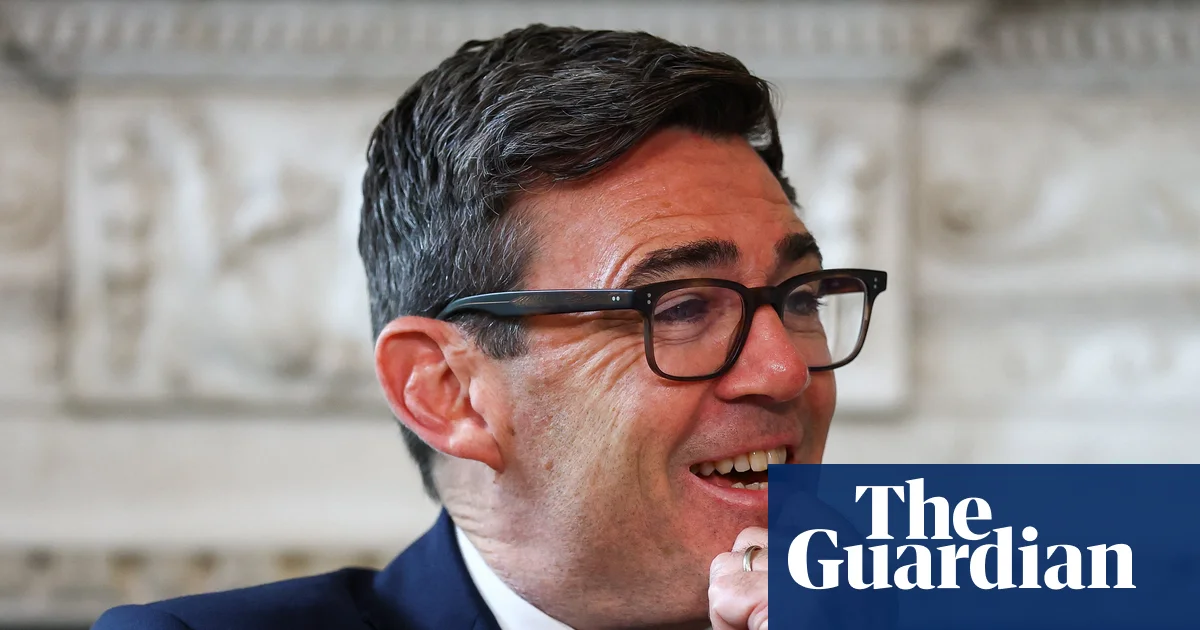
This year, even Andy Burnham is invited to the Scottish National party conference. But by the time John Swinney stands up to address members on Saturday afternoon in Aberdeen to reinvigorate the case for a second independence referendum, his party may regret giving the UK prime minister so much prominence in the conference buildup.
Burnham is expected to visit Scotland on Friday – the middle of the event – in a thinly veiled attempt to overshadow the SNP gathering. While he will be in a different venue, the former Manchester mayor’s presence in Scotland will loom large over the event. Since taking over at No 10 in July, Burnham has largely avoided direct confrontations with his political rivals, rarely attacking Nigel Farage or Kemi Badenoch. But he has taken a different approach with the Scottish first minister.
The SNP leader was the only politician from a rival party, apart from Margaret Thatcher, that Burnham mentioned in his keynote address to the Labour party conference last month. He reflected on Swinney’s prediction that he would be the last prime minister of the UK at a meeting of separatist parties Wales, Scotland and Northern Ireland to mark the first time all three devolved parliaments were governed by nationalists. Swinney inadvertently did so on the day Burnham’s father died.
“I quote that not to seek sympathy,” Burnham said, holding back tears. “Nor to criticise John Swinney. I relay it because I want you to know how it made me feel. Utterly determined to prove him wrong.”
Beyond ruling out a second independence referendum, recent British prime ministers have often paid little attention to Scottish internal affairs. Burnham has already said there is “no clear consensus” for another vote. But unlike his predecessors, he has decided to take on the SNP by loudly make the case for the union on Scottish soil.
Burnham presents a new challenge for the SNP as they seek to re-energise the case for Scottish independence. Swinney has said he wants a new vote before 2031. The separatists have grown used to facing off against rightwing, pro-Brexit governments in London during two decades in power in Holyrood, making it easier to argue that Scotland’s interests have been dismissed. Burnham’s devolution agenda, openness to exploring a return to the European Union and £2 bus fares are harder to confront.
Even among SNP voters, he is popular. Polling by PF Global found that 46% of Scots have a favourable view of Burnham, far higher than the Labour party itself, and double Keir Starmer’s when he left power. Only Swinney is more popular than the prime minister among SNP voters who supported yes in 2014, reaching a level not seen for a Labour leader since Jeremy Corbyn. Despite this, SNP figures have sought to capitalise on Burnham’s stance on the EU in their quest for a second independence vote.
“We are in a situation where Andy Burnham is actively and unilaterally opening up the conversation about whether we are able to go back to results of referendums and relitigate those decisions while saying that that same democratic principle does not apply to the people of Scotland,” said Lara Bird, the MP for Arbroath and Broughty Ferry. “The idea that the union can continue to exist in its current form is absolutely farcical.”
In Aberdeen, the SNP is hoping to draw a line under a bruising few years after Nicola Sturgeon’s resignation and the subsequent fraud conviction of her estranged husband and former SNP chair Peter Murrell, who is serving a five-year prison sentence for embezzling £400,000 from the party. A proceeds of crime case against Murrell is scheduled for early December.
In May, the SNP won a fifth successive election, but only enough to form a minority government in Holyrood. Despite the victory, Sturgeon criticised a “lack of vision or big picture thinking” in the campaign in the opening to her memoir. Swinney has said they were still good friends. Some SNP figures wonder how much they owe to the unpopularity of Starmer. The party also faces challenges on multiple fronts: Reform has as many MSPs as Labour in Holyrood with 17, while the Scottish Greens won a record 15 seats. The Tories have showed that they can still win seats, defeating the SNP in Aberdeen South in June.
Despite the potential for a standoff between Swinney and Burnham, there is growing appetite in Scotland for collaboration between Westminster and Holyrood. Since the May elections, there has been a sharp rise in Scots who support a closer working relationship between the UK and Scottish governments. Polling by Ipsos has found that 42% of Scots would feel happy about the SNP-led Scottish government working with London, up 12 points since Starmer was in charge in May. Just over half of Scots believe that the country is going in the wrong direction, up six points in the same time period.
This conference, the SNP has invited speakers from other separatist and pro-independence parties. Sioned Williams, deputy first minister of Wales, will give a fraternal address on Friday. Gillian Mackay, a Scottish Green party MSP, will speak at a panel about the right pathway to independence on Saturday.
“We understand, and members of the SNP know, that this is bigger than the SNP. Obviously, I fundamentally believe that the SNP will be the party who secures independence for Scotland. But that runs so much deeper throughout the Scottish population than just those who vote for the SNP. I do think that it is important at this moment to harness and to build on that support as broadly as we can,” said Bird.
