


- Marine conservation has attracted ambitious commitments, including vast new protected areas and international agreements. But declaring an area protected does not necessarily mean marine life is recovering.
- Fully protected marine reserves can produce substantial biodiversity gains when fishing restrictions are enforced. Adequate staffing, funding, and political support are often what separate effective reserves from “paper parks.”
- Conservation can also succeed outside protected areas. Secure fishing rights, community-led management, and practical changes to fishing gear can reduce pressure on marine species while supporting local livelihoods.
- Restoration projects face similar challenges. Replanting mangroves or corals achieves little if the conditions that damaged the ecosystems remain. Across marine conservation, lasting gains depend on sustained management and addressing the underlying causes of biodiversity loss.
In recent years, there has been a steady stream of ocean conservation pledges, from French Polynesia extending marine protection across its nearly 5 million-square-kilometer exclusive economic zone, including more than 1 million square kilometers of highly or fully protected waters, to the Eastern Tropical Pacific Marine Corridor (CMAR), where Colombia, Costa Rica, Ecuador, and Panama agreed to establish a contiguous, transboundary safe passage of more than 500,000 square kilometers (193,000 square miles) for migratory species. There is also much greater recognition of the contributions made by traditional stewards, including Indigenous communities, artisanal fishers, and other coastal communities. On paper, at least, this would seem to bode well for progress toward protecting 30% of the ocean by 2030.
Yet at the same time that these announcements are being made, we also hear about “paper parks” — those protected in name only — industrial fishing vessels entering protected areas, boats turning off their transponders, and abandoned fishing gear drifting through supposedly protected waters.
Over the summer, looking across academic literature and Mongabay’s multilingual coverage, I tried to pin down what the evidence actually shows about marine conservation outcomes in the Americas.
Merging peer-reviewed datasets with field reporting has its limitations, but it helps bridge a common divide: studies document broader ecological trends, while journalists track the political compromises and enforcement lapses that shape what happens on the water.
Unsurprisingly, the central takeaway is that marine conservation is most likely to succeed when commitments translate into actual changes in human behavior. When interventions fail, it is rarely because nobody understands the ecology. More often, the rules are not enforced, budgets are insufficient, local people have little reason to support them, or management fails to be sustained.
Marine protected areas
Ecologically, the case for fully protected no-take reserves is well established: where fishing stops, populations recover. Yet legal designation often gets conflated with actual protection. According to the Sea Around Us Paper Park Index, less than 30% of nearly 200 assessed marine areas in the hemisphere still experience extraction levels incompatible with their conservation mandates.
The failure rarely stems from a lack of surveillance technology. Buying hardware like boats, radar tracking systems, and drones tends to be the easiest part of conservation.
But detection alone is not enforcement. People need to actually do the work. Someone still has to run the patrol, secure evidence that survives judicial review, and follow infractions through to an actual penalty. None of that matters if the effort isn’t sustained year to year.

Mexico’s Revillagigedo National Park is one example. The enormous, remote offshore reserve is famous for its populations of manta rays, whales, sharks, and large schools of fish. It is North America’s largest fully protected marine reserve, created with considerable political ambition. But Mongabay’s reporting found repeated suspected incursions, while complaints over alleged illegal fishing were unresolved or archived.
Across a much larger sample, research led by David Gill and published in Nature found that MPAs with adequate staffing had ecological effects nearly three times greater than those without it. Staff and budgets were among the strongest predictors of conservation impact.
Beyond protected areas
Nearshore fisheries produced a somewhat different set of examples. In many places, the people making daily decisions about a resource are fishers, Indigenous peoples, traditional communities, tourism operators, and local authorities.
In Chile, artisanal fisher associations hold territorial use rights over benthic shellfish grounds. Some have established their own voluntary no-take reproductive refuges within those areas to help depleted species recover. In Costa Rica, responsible-fishing marine areas give small-scale fishing organizations a formal role in managing local waters.
Where fishers have secure rights to a fishing ground, they also have more reason to protect its productivity.
Much of marine conservation, however, has to happen where fishing continues. Sharks, rays, turtles, and seabirds encounter fishing gear outside reserves, and closing a particular site may protect only part of the waters they use.

Along the Pacific coast of Baja California Sur, researchers working with local fishers compared ordinary gillnets with nets fitted with green LED lights. The experiment, published in Current Biology in 2022, found a 63% reduction in the rate of discarded bycatch biomass. For sharks, skates, and rays, the reduction was 95%.
Fishers also spent much less time retrieving and untangling the illuminated nets, which saved them time and money. That is probably an even bigger motivator than the conservation benefit.
Corridors
For animals that travel long distances, even well-managed national fisheries and reserves can leave gaps. Tracking has documented scalloped hammerheads moving among the Cocos, Galápagos, and Malpelo islands. The Eastern Tropical Pacific Marine Corridor brings together Costa Rica, Ecuador, Panama, and Colombia in an effort to coordinate conservation across those waters and other important sites.

The idea makes sense: protect species across the waters they actually use, rather than treating national borders as ecological ones. But there is not much evidence yet that the corridor mechanism itself has consistently reduced fishing mortality or increased animal abundance.
The new “High Seas Treaty,” also known as the agreement on biodiversity beyond national jurisdiction (BBNJ) may eventually extend this approach to international waters. It allows countries to establish protected areas on the high seas, where governance has long been fragmented. But here, too, designation will only be part of the story.
Restoring the damage
Marine biodiversity conservation can also mean trying to repair ecosystems that have already been damaged.
Mangrove and coral restoration have become two prominent areas for ocean funding because the work is easy to document. A project can count how many seedlings were planted or how many coral fragments were attached to a reef. Those are much easier numbers to report than whether an ecosystem has actually recovered.
Mangrove projects often fail because recovery depends on restoring hydrology, like unblocking tidal channels, correcting salinity, and ensuring the elevation is right, more than planting. Once the water flows, nature handles much of the planting on its own.

Coral outplanting faces an even harsher reality. It is extremely expensive, difficult to scale, and the corals are still exposed to the same conditions that damaged the reef in the first place. If fishing pressure remains high, water quality is poor, or repeated bleaching events continue, planting more coral does not solve the underlying problem.
Across these cases, the formal policy was rarely the decisive factor on its own. A reserve functions when patrol boats have fuel and courts follow through on fines; an artisanal fishery stabilizes when users hold secure tenure; a mangrove swamp recovers because tidal hydrology was restored before any saplings went into the mud. The durability of a project almost always rests on these less visible administrative realities.
The less visible parts of conservation can matter just as much. Staffing, enforcement, tenure, maintenance, and long-term management are what keep a reserve functioning or a restoration project going after the initial announcement.
The next part of this series will look more closely at where family foundations may be able to support that work.
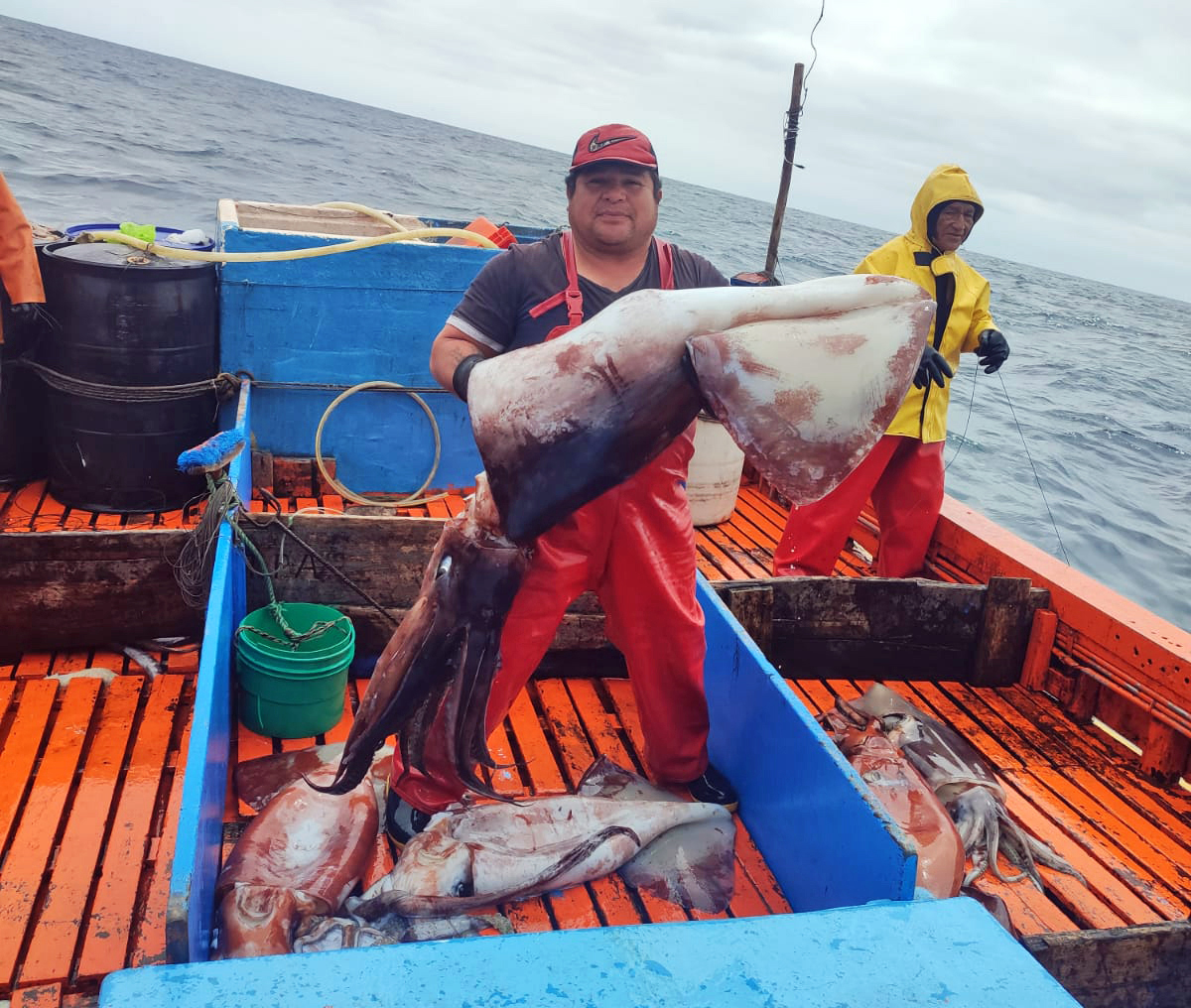
Header image: A Peruvian artisanal fisher poses with a jumbo flying squid. Image courtesy of National Society of Artisanal Fishing of Peru (SONAPESCAL).
References
- Brown, K. (2022, March 28). ‘Marine conservation talks must include human rights’: Q&A with biologist Vivienne Solís Rivera. Mongabay.
- Butler, R. A. (2026, February 18). Why so many mangrove restoration projects fail. Mongabay.
- Carrere, M. (2023, February 16). Fishing communities create marine refuges to protect Chile’s biodiversity. Mongabay.
- Convention on Biological Diversity. Target 3: Conserve 30% of land, waters and seas.
- Gill, D. A., Mascia, M. B., Ahmadia, G. N., Glew, L., Lester, S. E., Barnes, M., Craigie, I., Darling, E. S., Free, C. M., Geldmann, J., Holst, S., Jensen, O. P., White, A. T., Basurto, X., Coad, L., Gates, R. D., Guannel, G., Mumby, P. J., Thomas, H., … Fox, H. E. (2017). Capacity shortfalls hinder the performance of marine protected areas globally. Nature, 543(7647), 665–669. https://doi.org/10.1038/nature21708
- Gómez Durán, T. (2026, April 23). México: Denuncias por presunta pesca ilegal en el Parque Nacional Revillagigedo están en el aire o archivadas. Mongabay Latam.
- International Union for Conservation of Nature. (2025, June 9). Major breakthrough in marine conservation unveiled at UN Ocean Conference [Press release].
- Nalesso, E., Hearn, A., Sosa-Nishizaki, O., Steiner, T., Antoniou, A., Reid, A., Bessudo, S., Soler, G., Klimley, A. P., Lara, F., et al. (2019). Movements of scalloped hammerhead sharks (Sphyrna lewini) at Cocos Island, Costa Rica and between oceanic islands in the Eastern Tropical Pacific. PLOS ONE, 14(3), e0213741. https://doi.org/10.1371/journal.pone.0213741
- Sea Around Us. (2023, March 23). Paper Park Index helps identify 49 unprotected marine protected areas. University of British Columbia.
- Senko, J. F., Peckham, S. H., Aguilar-Ramirez, D., & Wang, J. H. (2022). Net illumination reduces fisheries bycatch, maintains catch value, and increases operational efficiency. Current Biology, 32(4), 911–918.e2. https://doi.org/10.1016/j.cub.2021.12.050
- United Nations. (n.d.). Becoming a party. Agreement on Marine Biological Diversity of Areas Beyond National Jurisdiction.
- U.S. Department of State. (2022, March 22). U.S. government support for the Eastern Tropical Pacific Marine Corridor [Media note].

