


- “Protected areas are protected areas,” says Nadège Nzoyem, the regional director of WWF for the Congo Basin, in reference to new studies showing the pressure from mining on protected and conserved areas in Central Africa and globally.
- A new analysis published on Oct. 8 finds that oil and gas blocks overlap with nearly 62 million hectares (153 million acres) of protected and conserved areas across the tropical countries examined, while WWF’s own report finds an average 80% decline in the size of monitored wildlife populations in Africa between 1970 and 2022.
- In an exclusive interview with Mongabay following the release of WWF’s “Living Planet Report 2026,” Nzoyem points to conservation gains in some landscapes but acknowledges continued wildlife declines, insufficient funding, and gaps in monitoring.
- Ahead of a global biodiversity summit in Armenia this month, the interview examines whether conservation commitments translate into effective protection, and seeks Nzoyem’s perspective on WWF’s influence over conservation funding and whether Indigenous peoples and local communities have meaningful decision-making power.
“Protected areas are protected areas,” says Nadège Nzoyem, WWF’s regional director for the Congo Basin. For her, mining has no place in landscapes that governments have committed to conserve. Yet keeping extractive industries out and ensuring effective protection remain major challenges across the region.
A recent analysis by U.S.-based Earth Insight highlights the conflict between conservation commitments and extractive interests. Across the tropical countries examined, the report says, oil and gas blocks overlap across nearly 62 million hectares (153 million acres) of protected and conserved areas. Mining concessions overlap with another 43 million hectares (106 million acres). In the Congo Basin, 29% of identified terrestrial Key Biodiversity Areas remain unprotected. The findings raise questions about where protection is needed and how effective it is against industrial pressures.
WWF’s “Living Planet Report 2026” adds to those concerns. It reports an average 80% decline in monitored wildlife population sizes across Africa between 1970 and 2022. The figure is continent-wide, not specific to the Congo Basin.
Next week, the global community will meet for the biodiversity COP17 in Armenia, where the urgency of meeting the global 30×30 target puts protected areas under greater scrutiny. Conserving 30% of land and waters by 2030 means more than drawing boundaries, the Earth Insight report argues. It requires effective management, equitable governance, and respect for Indigenous peoples’ and local communities’ rights.
Nzoyem argues that sustained funding and government partnerships can deliver results. She points to gains in some WWF-supported landscapes. In an interview with Mongabay’s David Akana, Nzoyem also addresses WWF’s record in the Congo Basin, its influence over conservation funding, and whether communities have a meaningful say in decisions affecting their lands.
The following interview has been edited for length and clarity.
Mongabay: The latest WWF “Living Planet Report” finds an average 80% decline in monitored wildlife populations in Africa since 1970. Looking specifically at the Congo Basin, what does it tell you about conservation in the region?
Nadège Nzoyem: The Congo Basin is a great reservoir of biodiversity. It is clear that forest elephant populations, for example, have declined by more than 60% over recent decades. These are monitored populations, of course.
But we also have some hope. In Lobéké National Park [in Cameroon], we estimate that elephant numbers remained broadly stable between 2015 and 2025, while estimated gorilla numbers increased by approximately 23%.
At the same time, results from other landscapes are concerning. For example, in Campo Ma’an National Park in Cameroon, or the Messok Dja Forest in the Republic of Congo, recent estimates indicate substantial declines in monitored gorilla populations. So, we have a contrast. In some places we notice an increase and in others, a decline.
Mongabay: The region has protected areas, environmental laws, financial investments, and numerous conservation organizations. Why hasn’t this institutional architecture been sufficient to stop biodiversity decline?
Nadège Nzoyem: We have different structures and government engagement, but the overall funding available for biodiversity is still to reach the Congo Basin. There are many drivers of biodiversity loss. If we take investment alone, the “Living Planet Report” estimates an annual global biodiversity finance gap of approximately $942 billion. These are global numbers. In Central Africa, we are still to mobilize even 5% of these amounts. Despite those regional institutions and engagement from our states, there is a need for more investment to protect the Congo Basin forests and the biodiversity living in them.

Mongabay: If you had to identify the biggest challenges, would they be inadequate funding, weak governance, poor enforcement, or the conservation models themselves?
Nadège Nzoyem: The first element remains the lack of funding. To improve wildlife monitoring, you need funds. To ensure that the forest is conserved, you also need funds. Antipoaching brigades and the equipment needed to ensure that areas are effectively conserved require investment. Take Dzanga-Sangha in the Central African Republic. When you visit Dzanga Bai, you see hundreds of elephants coming to drink salty water. This is because of 30 years of conservation by WWF and partners in that area. For us, the big challenge in the Congo Basin is really investment. How much are we investing to conserve this second home for biodiversity in the world?
Mongabay: Beyond Dzanga-Sangha and Lobéké, where can you point to concrete evidence of recovery?
Nadège Nzoyem: In Lobéké, [gorillas] are coming back. We have clear evidence. In Salonga National Park [in the Democratic Republic of Congo], they are also coming back. Where we are working hand in hand with governments and partners, we are seeing a difference. That is why we say in our “Living Planet Report” that there is hope: concerted action and the involvement of different stakeholders, including governments and local communities, are important for a lasting conservation impact.
Mongabay: Designating a protected area is not the same as protecting it. How serious is the problem of parks that lack funding, personnel, enforcement, or political support?
Nadège Nzoyem: For 30×30, governments have committed to conserve at least 30% of their national territory by 2030 … but we are still to see measurable, local action to ensure that this is done. Where protected areas are effectively protected, as in Salonga National Park, we are seeing progress. One concrete example is Salonga’s removal from the List of World Heritage in Danger in 2021.
We cannot ignore that protected areas face increasing pressure from different land uses, including mining and oil development. Reserving an area for protection is good, but it is time for action: translating commitments into funding and concrete support to protect biodiversity.

Mongabay: Do we have “paper parks” in the Congo Basin — legally designated parks that are effectively occupied by mining or undermined by insecurity?
Nadège Nzoyem: Protected areas in the Congo Basin, as elsewhere in the world, face increasing pressure from mining, oil development, infrastructure, and other activities. Development is legitimate and necessary, but it should not destroy the ecological systems we have in the region. UNESCO has, for example, called for mining permits affecting the Sangha Trinational World Heritage property [straddling the Republic of Congo, Central African Republic, and Cameroon] to be prevented, and for impact assessments of projects proposed in its buffer zone.
Mongabay: In a few weeks, the global community will gather to assess progress in the implementation of the biodiversity targets; what will WWF be asking for at COP17?
Nadège Nzoyem: We ask for decisions and clear, specific recommendations to strengthen ambition and urgently speed up and scale up implementation. That means increasing action to address the drivers of biodiversity loss and transform relevant economic and financial systems and sectors. It also means ensuring adequate, predictable, and easily accessible means of implementation, and strengthening whole-of-society approaches, including different stakeholders in implementation.
We also ask for decisions on resources and investment: delivering on resource mobilization commitments and scaling up biodiversity finance, including increasing international biodiversity finance to at least $30 billion by 2030. The gap is still huge, and we need to improve the effectiveness of biodiversity finance.
A third point is strengthening implementation of the different targets, developing national nature-positive transition pathways in key sectors, and ensuring that business and financial institutions embed nature in their transition plans.
Our fourth point is rights, equity, and governance: fully embedding a human rights-based approach across COP decisions and implementation of the Convention on Biological Diversity.
Finally, there is a need for climate-nature synergies, strengthening cooperation with other multilateral environmental agreements, and aligning biodiversity and climate implementation strategies. These are the five key recommendations we would like to push for at COP17.

Mongabay: Nadège, if you do not mind, let’s return to conservation in the region. What counts as a successful park for WWF: the hectares designated, or the conservation outcomes?
Nadège Nzoyem: Conservation lasts when the rights of people depending on forests, including their economic and territorial rights, are maintained. When conservation results are reconciled with development, we can say conservation is working. We need species conservation, and we need the participation of communities and respect for their rights.
Mongabay: Central African countries have environmental laws, yet mining, logging, oil, and infrastructure projects continue to enter important landscapes. Is the problem inadequate law, or the willingness to enforce it against powerful interests?
Nadège Nzoyem: We have different laws in Central Africa. Our governments are engaged in protecting biodiversity, and there is a need for law enforcement. That is one reason we are engaged with governments in Cameroon, the Republic of Congo, the Democratic Republic of Congo, the Central African Republic, and Gabon: to enforce these laws and achieve the different objectives.
Mongabay: Where has that engagement worked, where hasn’t it, and what needs to change?
Nadège Nzoyem: What has worked most is this engagement itself. In all the protected areas where WWF is involved, we work in partnership with governments. We cannot work in protected areas without government engagement. There are concrete examples. In these countries, governments recruit and pay eco-guards for the antipoaching brigades. These are government staff. Recruiting them and paying them monthly shows that governments are putting money into conservation.
It is true that more enforcement is needed. The number of eco-guards is really, really low. We call on governments to increase their numbers in national parks. In the Congo Basin, the ratio is very low compared with what we need to ensure effective law enforcement.

Mongabay: Is there any place for mining or oil extraction in protected areas?
Nadège Nzoyem: We cannot say there is a place for mining. Protected areas are protected areas. Governments have committed to protect those landscapes for biodiversity conservation. We really encourage governments to do what they promise in their international and national commitments.
Mongabay: Has conservation been tougher on poor people involved in poaching, bushmeat or charcoal than on mining companies, logging interests, and politically connected actors?
Nadège Nzoyem: No, we cannot say that. I will say it again: conservation lasts when it works for people as well as wildlife. We cannot talk about sustainable or long-term conservation without people’s engagement. We see how communities are engaged in our work in protected areas. Without them, we cannot work effectively. We are not tougher on local communities than on mining.
We work with governments because they issue permits. We also work at the regional level on guidelines to protect our forests. There is a lot we are doing in advocacy, strategic development, and engaging different actors to keep biodiversity alive. We work with Indigenous peoples and local communities to improve livelihoods, incomes, and rights.
Mongabay: When governments issue companies licenses that threaten conservation landscapes, who should WWF confront: the company, the government, or the investors?
Nadège Nzoyem: First, we work at the regional level on strategy, policy, and advocacy. This is the entry point, because lands and forests in Central Africa belong to the states. They are our main partners in reconciling the needs for economic development, the needs of local communities, and the need to conserve forests and the species living in them. The next steps may involve working with those companies to ensure that impacts on biodiversity and forests are limited.

Mongabay: Can you give examples of companies you are working with?
Nadège Nzoyem: We are just starting our engagement in the sector. For now, we are starting the process.
Mongabay: What does it tell you when a government supports conservation while also issuing mining permits? How do you reconcile conservation and development?
Nadège Nzoyem: We do not see conservation and development as contradictory. Reconciling them requires transparent land-use planning, robust environmental and social assessments, consideration of cumulative impacts, avoidance of critical habitats, respect for the free, prior, and informed consent of local communities, and genuine participation by affected communities.
That is our position. We continue working with governments to ensure this reconciliation happens.
Mongabay: WWF has worked in the region for decades. What has it gotten right, and what has it gotten wrong?
Nadège Nzoyem: WWF is one of the first conservation organizations to work in the Congo Basin, since the 1990s. There has been a lot of progress, and WWF has contributed to it. We do not claim sole credit. Progress achieved in the Congo Basin belongs to governments, protected areas, communities, and Indigenous peoples. In Lobéké, recent monitoring indicates that elephant numbers have remained broadly stable. We work there in partnership with the government of Cameroon.
In Salonga, where we have worked with the government for at least two decades, sustained conservation and monitoring have contributed to stable bonobo populations, emerging recovery among forest elephants, and the park’s removal from the List of World Heritage in Danger in 2021.
Our primate [gorilla] habituation program started in Dzanga-Sangha. We showed that it was possible to habituate gorillas in Central Africa, and it is working today in many national parks, including with other organizations.
In Dzanga-Sangha, WWF has supported surveillance, gorilla habituation, research, tourism, and sustainable rural development. We have been there for 30 years. It is the first example of co-management of a protected area between a government and an NGO in Central Africa, and we have concrete evidence that it is working. Ecotourism is developing, and local communities and Indigenous peoples participate and gain benefits.
We can also mention the Sangha Trinational landscape and the dialogue between Cameroon, the Central African Republic, and the Republic of Congo. WWF has contributed to developing a shared framework for protecting and connecting habitats in the three countries.
We have done a lot. But we must also be honest: there is still a lot to do. Conservation results are not always what we want. Wildlife continues to decline in some landscapes. Conservation financing is often short term. That is one of the big problems when we need lasting results. We need more than short-term projects. There are also monitoring efforts still to undertake so that we and other conservation organizations have a good overview of what is happening.
Mongabay: Smaller organizations sometimes say WWF has too much power in shaping conservation priorities and receiving funding in the Congo Basin. What is your response?
Nadège Nzoyem: When you are a pioneer in an area of intervention, your network is huge. You have broad knowledge of what is happening and you know a large number of donors. But we have worked with local organizations and trained them. Some local conservation organizations exist because we started working with the people who created them and involved them in conservation.
Today, we work hand in hand with local organizations through our environmental and social safeguard framework and programs. Recently, we had a partnership with the network of Indigenous peoples, providing support, including financial support. It is not always easy to manage a large amount of conservation funding. Donors also need to trust that the money they give is effectively going to conservation. There is a need to work with local organizations and strengthen their fiduciary capacity. That is what we are doing.
We contribute to strengthening organizations so they can mobilize and manage their own funds for conservation and local and Indigenous communities.
Mongabay: What is the model driving WWF’s work in the region?
Nadège Nzoyem: We are doing inclusive conservation at WWF. We work with local communities, involve them in designing our programs, and involve them in the different activities.
Mongabay: If communities attend meetings, work as rangers, or are involved in livelihood projects, but have no authority over land or conservation decisions, can that really be called inclusive?
Nadège Nzoyem: We are working on inclusive conservation, as I said. We also work on free, prior, and informed consent. Our environmental and social safeguard framework applies in all our programs and projects to ensure communities are aware of what we do and are engaged in it. We also have grievance mechanisms, working in partnership with local organizations, to enable communities to bring forward grievances about conservation activities where we are involved.
Mongabay: Is there power that WWF is prepared to give up so that Indigenous organizations or other local groups can implement conservation themselves?
Nadège Nzoyem: We do not have a monopoly on managing conservation areas with governments. Our grievance mechanisms in the region are supported by local organizations. They receive funding to implement those activities. We do not keep the power. We contribute to strengthening civil society organizations in conservation, and our hope is that they all participate. Conservation works when all partners are involved.

Mongabay: Why does so much conservation funding still pass through international NGOs and governments before reaching Indigenous peoples and local communities? Is having an intermediary the only way?
Nadège Nzoyem: I cannot say that. I do not see it as being an intermediary. We work with Indigenous peoples and local communities. They receive subgrants to implement activities, and we build their fiduciary capacities. It is not for us to decide where the money goes. More and more donors engage directly with local civil society organizations. There is no donor giving money directly from their bank account in the U.S. or Switzerland to individual communities’ bank accounts. This is not conservation.
But we are seeing a growing number of organizations working with local civil society organizations. We are proud when an organization we have supported and trained receives this type of funding. For us, it shows that WWF is not working alone in the Congo Basin. We engage with local civil society, communities, and Indigenous peoples’ organizations to make a significant impact.
Mongabay: Is there anything you have seen work in the Amazon that could work — or might not work — in the Congo Basin?
Nadège Nzoyem: The first thing is that we really need to receive more than just 4-5% of the funding the Amazon receives, for example. We have shown that when support is available, we can make a significant difference in the Congo Basin.
Mongabay: Do you hope to see greater recognition of territorial rights in the Congo Basin?
Nadège Nzoyem: It is already happening. In the DRC, for example, they have community forestry. Local communities and Indigenous peoples have perpetual rights to manage their community forest once it is allocated. This is big progress in the region.
We really hope other countries will move toward those perpetual rights. In Cameroon, they have a management agreement. It is not yet perpetual rights, but we are moving toward them.
Mongabay: Three years from now, what would you most like to be remembered for?
Nadège Nzoyem: That WWF has continued to be a leader of conservation in the Congo Basin, delivering positive impacts for people and wildlife in our region.
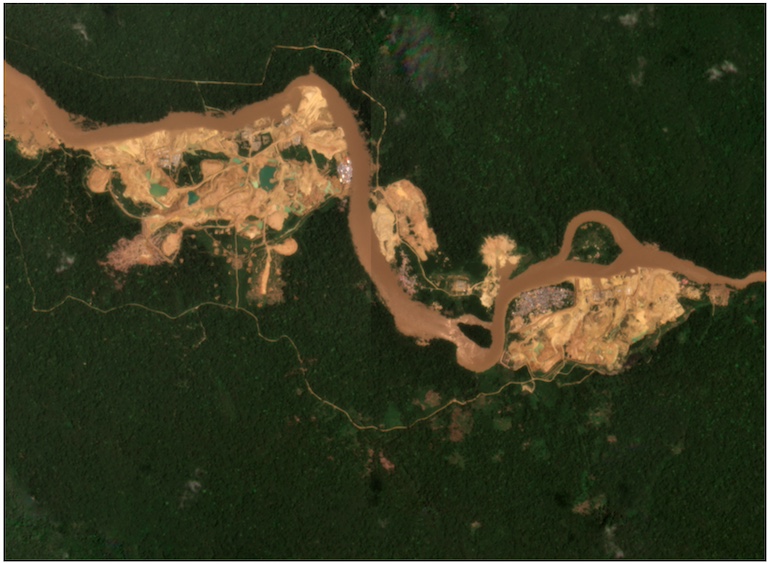
Banner image: Satellite imagery from Planet Labs captured October 2024 shows gold mining-related deforestation along the Ituri River in the DRC that runs through the southern portion of Okapi Wildlife Reserve.
Central African Republic’s Dzanga-Sangha tests the promise of wildlife tourism
The little-known story of emerging ecotourism in the Central African Republic
Feedback: Use this form to send a message to the author of this post. If you want to post a public comment, you can do that at the bottom of the page.

