


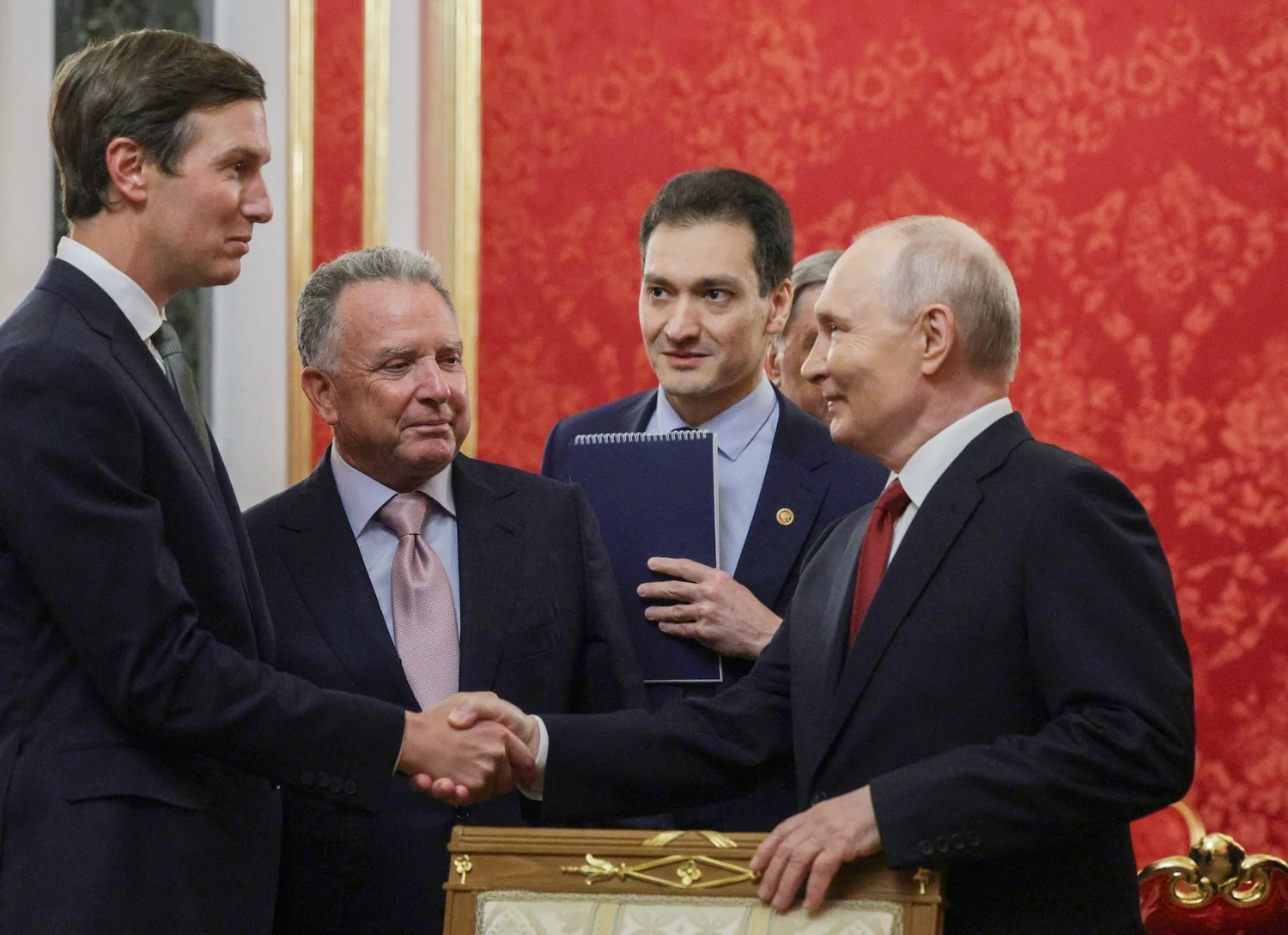
On Oct. 6, the ranking member of the U.S. House Oversight Committee, Robert Garcia, opened a new investigation into Jared Kushner’s possible conflicts of interest. The president’s son-in-law holds dual roles, as a “volunteer” diplomatic negotiator for President Donald Trump, and the owner of the increasingly lucrative investment firm Affinity Partners, financed overwhelmingly by Saudi Arabia and other Persian Gulf monarchies. The investigation came on the heels of startling revelations by CNN that Affinity Partners had become the largest shareholder in an Israeli conglomerate, Phoenix Financial, that in turn holds shares in at least nine Israeli military suppliers—all while Kushner was tasked with helping to negotiate a peace deal between Israel and Hamas.
This wasn’t the first time that there had been warnings about Kushner’s conflicts of interest. In April 2022, the nonprofit organization DAWN urged the U.S. Justice Department and Congress to investigate revelations that Saudi Arabia’s Public Investment Fund had invested $2 billion in Kushner’s newly launched fund. Kushner had established Affinity Partners just six months earlier, on Jan. 21, 2021—one day after the first Trump administration ended and Kushner left his formal White House position. Riyadh’s investment fund was initially by far Affinity’s largest investor and possibly remains its largest.
On Oct. 6, the ranking member of the U.S. House Oversight Committee, Robert Garcia, opened a new investigation into Jared Kushner’s possible conflicts of interest. The president’s son-in-law holds dual roles, as a “volunteer” diplomatic negotiator for President Donald Trump, and the owner of the increasingly lucrative investment firm Affinity Partners, financed overwhelmingly by Saudi Arabia and other Persian Gulf monarchies. The investigation came on the heels of startling revelations by CNN that Affinity Partners had become the largest shareholder in an Israeli conglomerate, Phoenix Financial, that in turn holds shares in at least nine Israeli military suppliers—all while Kushner was tasked with helping to negotiate a peace deal between Israel and Hamas.
This wasn’t the first time that there had been warnings about Kushner’s conflicts of interest. In April 2022, the nonprofit organization DAWN urged the U.S. Justice Department and Congress to investigate revelations that Saudi Arabia’s Public Investment Fund had invested $2 billion in Kushner’s newly launched fund. Kushner had established Affinity Partners just six months earlier, on Jan. 21, 2021—one day after the first Trump administration ended and Kushner left his formal White House position. Riyadh’s investment fund was initially by far Affinity’s largest investor and possibly remains its largest.
In June 2022, Rep. Carolyn Maloney opened an investigation into whether Kushner had traded on his government position to secure the Saudi billions and whether his financial interests had influenced U.S. policy. Sen. Ron Wyden followed with another investigation launched in 2024, examining Affinity’s foreign-government payments, alleged disclosure loopholes, and possible circumvention of the Foreign Agents Registration Act (FARA).
As a result of these investigations, Congress learned a great deal about Affinity, including the fact that as of March 2024, at least 99 percent of Affinity’s then-$3 billion under management came from foreign sources, principally Saudi Arabia and the United Arab Emirates. These were both governments that Kushner had strongly supported while working in the first Trump administration, and they were now paying his firm tens of millions of dollars annually in investment advisory fees.
During Trump’s first term, Kushner had pushed for approvals of massive weapons sales to Saudi Arabia and the UAE. He also promoted his close friend Saudi Crown Prince Mohammed bin Salman in Washington as a reformer, helped to rehabilitate the crown prince’s tattered reputation following the murder of Jamal Khashoggi, and reportedly even provided Mohammed bin Salman with the identities of Saudi political exiles who had met with the State Department (Kushner has denied this accusation). To critics, the Saudi investment in Affinity in particular appeared to be a naked reward for services well-rendered.
The investigations not only identified the glaring conflicts of interest at play but also exposed serious loopholes in federal ethics and disclosure laws. Nothing prohibited Kushner from doing business with foreign governments after leaving office; private investment funds enjoyed sweeping disclosure exemptions; and foreign governments could pay politically connected former officials millions for “investment advisory services” without triggering FARA disclosure.
Unfortunately, beyond gathering information, Congress did absolutely nothing to amend the laws that could have prevented what Kushner is now getting away with. It didn’t enact a meaningful “revolving door” law prohibiting senior U.S. officials from doing business with foreign governments for a certain period after leaving office. It didn’t amend the FARA rules to require the same disclosure of former officials acting as “investment advisors” of foreign governments as they do for other foreign agents.
The irony of these failures is now difficult to miss: Saudi sovereign wealth entrusted to Kushner has ended up invested, through Affinity’s ownership of Phoenix, in an Israeli conglomerate with substantial holdings in companies supplying Israeli forces with weapons used in the very war in Gaza that Saudi Arabia publicly condemns.
But the problem for Americans is broader. The same man managing billions of dollars for foreign governments is once again helping to make U.S. foreign policy affecting those governments and his investments. Today, Kushner can receive advisory fees from foreign governments, indirectly invest in Israeli weapons companies profiting from the Gaza war, and even help broker a potential multibillion-dollar sale of Russian oil assets to investors with ties to his family and that of and fellow Trump envoy Steve Witkoff while simultaneously shaping U.S. policy, representing U.S. interests, and negotiating peace deals as an unsalaried negotiator for the Trump administration.
There’s sadly zero prospect that Congress can or will enact meaningful reforms in the next two years to curb the extraordinary conflicts of interest now embedded in the country’s government. Kushner has tried to defend his dealings by arguing that he did not direct Phoenix’s investments in Israeli weapons firms, and that there’s no evidence that his business dealings have shaped his political dealings. But with Republicans controlling Congress, Democratic investigators do not have the subpoena power to compel Kushner to produce the records necessary to test those claims.
Thankfully, Congress can still take steps to demand accountability. In February, Trump formally named Kushner a “special envoy for peace.” This raised an immediate question about his obligations under existing federal ethics laws. Under U.S. legal code, even unpaid appointees can qualify as special government employees. This makes them subject to the conflict-of-interest restrictions of a federal statute that generally requires their recusal from particular government matters that would have a “direct and predictable effect” on their financial interests. On its face, this law suggests that Kushner should be recused from negotiations involving Israel-Palestine, Russia-Ukraine, Saudi Arabia and the UAE, given his financial interests and business relationships tied to these countries.
An April investigation by the Atlantic found that the administration had not designated Kushner as a special government employee, allowing him to conduct U.S. diplomacy without the financial disclosures and ethics scrutiny imposed on government officials. But this should not be the end of the matter. Already, the watchdog group Citizens for Responsibility and Ethics in Washington has demanded that Kushner be subject to those requirements, including filing a public financial disclosure report, just as fellow special envoy Witkoff, who also serves without a White House salary, has done.
At a minimum, Congress should now demand that the White House explain why Kushner has not been designated a special government employee despite his formal appointment and diplomatic responsibilities, and ask whether he has submitted any confidential financial disclosures, received any ethics waivers, or agreed to any recusals. If the administration insists that existing conflict-of-interest laws do not apply to him, then it should be required to explain its legal justification.
When there are again a Congress and an administration willing to enact meaningful legislative reforms, their work will be cut out for them. First, they will need to use their subpoena powers to uncover whom Kushner solicited to launch his fund, when, and in exchange for what. They should also find out what he knew about his firm’s holdings in Phoenix and how he could stand to profit from the policy decisions regarding Israel-Palestine, Saudi Arabia and the UAE, and Russia-Ukraine.
Congress should also finally close the loopholes identified four years ago. This means imposing a meaningful cooling-off period barring senior U.S. officials from doing business with foreign governments after leaving office, requiring disclosure when foreign governments invest in businesses owned by former senior officials, and closing the investment-advisor loophole in FARA.
They should also eliminate any ambiguity about the application of federal disclosure and conflict-of-interest rules to anyone exercising U.S. diplomatic authority, whether they are called an employee, advisor, special envoy—or merely a “volunteer.”
