

Close Menu
NCIJ Network NCIJ Network
    What's Hot

    How some Indigenous artisans are rethinking their craft as ash trees die

    November 26, 2026

    10 key faces of Spain’s next (likely) right-wing government – POLITICO

    November 26, 2026

    UK reservists contacted as ‘threat environment’ rises, Streeting says

    November 26, 2026
    Facebook X (Twitter) Instagram
    Trending
    • How some Indigenous artisans are rethinking their craft as ash trees die
    • 10 key faces of Spain’s next (likely) right-wing government – POLITICO
    • UK reservists contacted as ‘threat environment’ rises, Streeting says
    • US gains foothold in race for Africa’s critical minerals in Kenya’s Mrima Hill project
    • Spain Election: For Sánchez, Housing Crisis Could Be Blessing or Curse
    • US warns EU leaders against Big Tech tax – POLITICO
    • IBM quantum computer solves problem classical computers can’t in just 15 minutes
    • Relearning how to live with wolves in Europe
    • About
      • Our Team
      • Editorial Policy
      • Editorial Independence
      • International Support
    • Trust & Standards
      • AI Usage Policy
      • Conflict of Interest Policy
      • Corrections Policy
      • Ethics Policy
      • Fact-Checking Policy
      • Source Protection
    • Get Involved
      • Guide for Sources
      • Support Independent Journalism
    • Legal
      • Cookie Policy
      • Privacy Policy
      • Terms of Use
    Facebook X (Twitter) Instagram
    NCIJ Network NCIJ Network
    Thursday, November 26
    • Home
    • World
    • Ai
    • Business
    • Politics
    • Health
    • Crypto
    • Science
    • Technology
    • Cybersecurity
    • Defense & Security
    • Economy
    • Energy
    • Europe
    • More
      • Fact Check
      • Investigations
      • Opinion & Analysis
      • Environment
    NCIJ Network NCIJ Network
    Home»Science

    Antarctic Sea Ice Grows to Its 2026 Maximum

    NCIJ NETWNCIJ NETWORKBy NCIJ NETWNCIJ NETWORKOctober 12, 2026 Science No Comments3 Mins Read
    Share
    Facebook Twitter LinkedIn Pinterest Email

    This story is an update to the Antarctic sea ice feature in our World of Change series tracking long-term change on Earth’s surface through satellite imagery.

    Unlike the Arctic—an ocean basin surrounded by land—the Antarctic is a large continent surrounded by an ocean. Because of this geography, sea ice has more room to expand during the winter. However, that ice also stretches into warmer latitudes, leading to more melting in the summer. Antarctic sea ice usually peaks in September, around the end of the Southern Hemisphere’s winter, and retreats to a minimum in February.

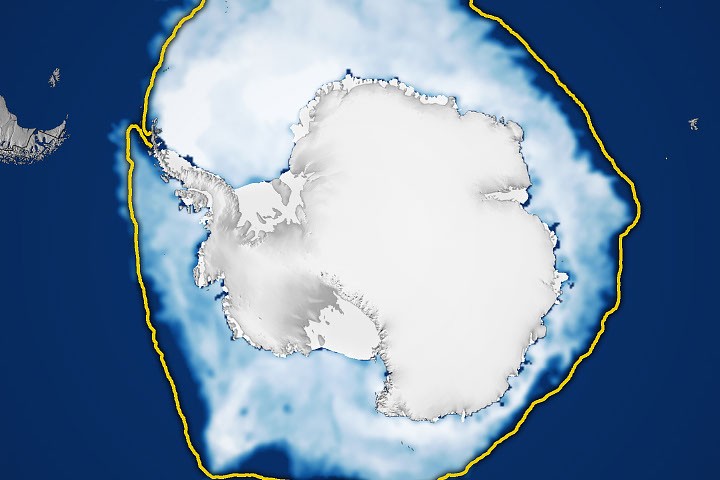
    According to NASA and the National Snow and Ice Data Center (NSIDC), Antarctic sea ice in 2026 likely reached its annual maximum extent on September 14 (above). On that date, the ice covered an estimated 17.59 million square kilometers (6.79 million square miles), making it the third-lowest maximum on record.

    The maps below show the average concentration of Antarctic sea ice for the month of September (left) and the following February (right) from 1990 to 2026. Opaque white areas indicate the highest concentrations, and dark blue areas are open water. The images include only areas where ice concentration was at least 15 percent, a threshold scientists commonly use to count an area as ice-covered in satellite data. Scientists refer to the total area of these regions as the “sea ice extent.”

    From 1979 until 2014, total Antarctic sea ice increased by about 1 percent per decade. Whether the increase was a sign of meaningful change is uncertain because ice extents vary considerably from year to year around Antarctica. For three consecutive years, from 2012 to 2014, satellites observed new record highs for winter sea ice extent. These highs occurred while Arctic ice was in steep decline.

    The climb came to an end in 2015, and significant decreases in sea ice around Antarctica started to occur in 2016. There have since been years with small rebounds, but overall, Antarctic sea ice coverage has largely remained lower than normal. Both the record low minimum and record low maximum occurred in 2023. Scientists will continue to observe the area each year to find out if the decline is part of a long-term change or a statistical fluctuation.

    To determine sea ice extent, scientists rely on satellites with passive microwave sensors that measure the microwave energy Earth naturally emits. Sea ice emits more of this energy than open water, so it stands out in microwave images. Because microwaves pass through clouds, the satellites can observe sea ice regularly, regardless of weather.

    The record began in late 1978 with data collected by NASA’s Nimbus-7, followed by Defense Meteorological Satellite Program (DMSP) satellites starting in 1987, and by NASA’s Aqua satellite between 2002 and 2011. In 2025, scientists began using observations from the Japan Aerospace Exploration Agency’s GCOM-W satellite. 

    NASA Earth Observatory images by Michala Garrison, using data from the National Snow and Ice Data Center.

    • NASA Earthdata (2026, October) Sea Ice. Accessed October 8, 2026.
    • NASA Earth Observatory (2026, October 6) World of Change: Antarctic Sea Ice. Accessed October 8, 2026.
    • NASA Earth Observatory (2016, September 16) Sea Ice. Accessed October 8, 2026.
    • NASA Earth Science (2026, September 23) Arctic Sea Ice Reaches 2026 Annual Minimum Extent. Accessed October 8, 2026.
    • National Snow and Ice Data Center (2026, September 23) Arctic sea ice has reached minimum extent for 2026; Antarctic sea ice maximum most likely reached as well. Accessed October 8, 2026.
    • National Snow and Ice Data Center (2026, March 9) Antarctic sea ice extent arrives at a near-average minimum. Accessed October 8, 2026.
    Antarctic grows ICE Maximum Sea
    NCIJ NETWNCIJ NETWORK
    • Website

    Keep Reading

    IBM quantum computer solves problem classical computers can’t in just 15 minutes

    Scientists discover a hidden gut defense that could prevent colon cancer

    Einstein’s 120-year-old theory may be missing something big about the Big Bang

    Physicists just sent an unblockable message through a brick wall using gravity

    Seeking Refuge on Resolution Island

    Scientists discover a surprising twist in how the body burns calories

    Add A Comment
    Leave A Reply Cancel Reply

    Editors Picks

    How some Indigenous artisans are rethinking their craft as ash trees die

    November 26, 2026

    10 key faces of Spain’s next (likely) right-wing government – POLITICO

    November 26, 2026

    UK reservists contacted as ‘threat environment’ rises, Streeting says

    November 26, 2026

    US gains foothold in race for Africa’s critical minerals in Kenya’s Mrima Hill project

    November 26, 2026
    Latest Posts

    Fed Study Finds Investor Beliefs Help Drive Crypto Volatility

    August 23, 2026

    The best small tablets of 2026: Expert tested and reviewed

    August 23, 2026

    Drill, Burnham, drill? The oil basin that is a totem for Trump – and a headache for Britain’s new PM | Fossil fuels

    August 23, 2026

    Subscribe to News

    Get the latest sports news from NewsSite about world, sports and politics.

    NCIJ Network is an independent digital news platform delivering trusted investigative journalism, European and global news, in-depth analysis, and fact-based reporting with accuracy, transparency, and integrity.

    Facebook X (Twitter) Instagram Pinterest YouTube

    How some Indigenous artisans are rethinking their craft as ash trees die

    November 26, 2026

    10 key faces of Spain’s next (likely) right-wing government – POLITICO

    November 26, 2026

    UK reservists contacted as ‘threat environment’ rises, Streeting says

    November 26, 2026

    Subscribe to Updates

    Get the latest creative news from FooBar about art, design and business.

    Type above and press Enter to search. Press Esc to cancel.