


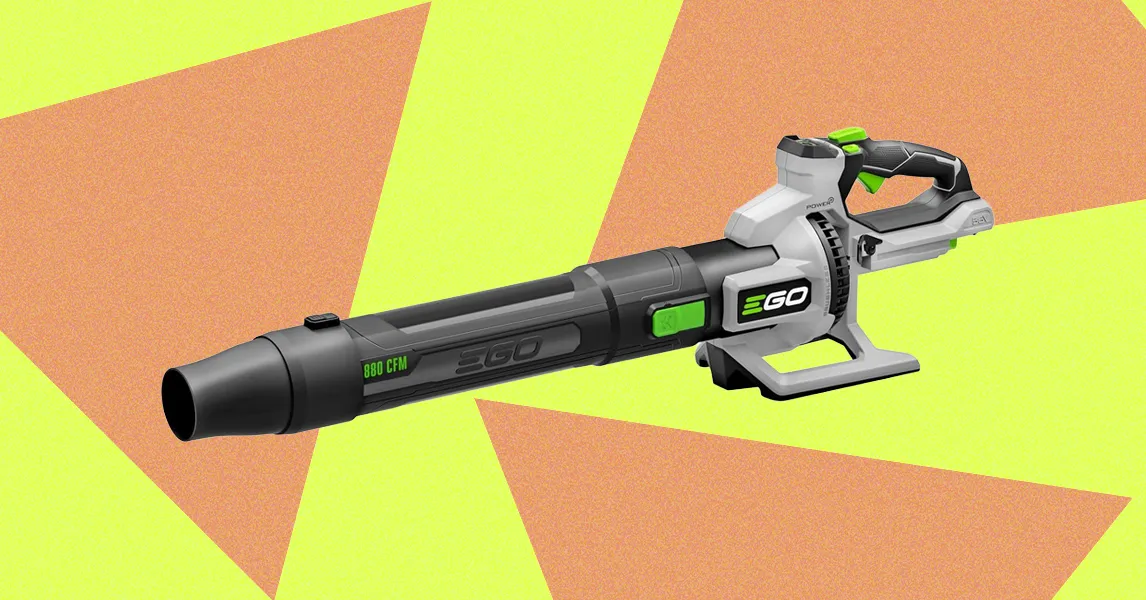
Here’s what I’d focus on when buying a blower for leaf cleanup:
Volts: In the cordless power-tool arms race, leaf blower batteries range from 18 to 80 volts. Some of that difference is marketing trickery: an advertised 20-volt max battery or tool delivers essentially the same power as an 18-volt model, and the same goes for 36- and 40-volt options. But, unless you’re a minimalist who wants one battery to power everything from a drill/driver to lawn and garden gear, you’ll probably be happier with a leaf blower that uses at least a 36-volt battery. A few capable 18-volt blowers use two batteries—either simultaneously to mimic the power of a 36-volt tool or in succession to increase the run time—but they tend to cost more and only make sense if you already own the batteries. For smaller jobs, though, a standard, single-battery 18- or 20-volt blower may be all you need to clear a patio, clean out the garage or shed, or dry a car.
Amps: Volts get most of the marketing attention on the box, but a battery’s amp-hour rating tells you more about how long a blower runs. Think of voltage as the car’s engine and amp-hours as the size of the gas tank—you want to know both. Batteries with higher amp-hour ratings cost more than otherwise-similar battery voltages, and they tend to be heavier. For leaf blowers, manufacturers typically pair kits with batteries rated from 4 to 8 amp-hours. You can buy higher-capacity batteries separately, and it pays to know the range of options a manufacturer has. A battery with a higher amp-hour typically takes longer to charge.
Systems: Underestimating the range of tools a battery can power in pursuit of “the best” is, in my opinion, a mistake. Often, the difference between two top-performing tools is negligible, and with cordless power tools, that difference often comes down to run time, which you can address with a higher-capacity battery. If your garage is already stocked with one brand’s outdoor power equipment (OPE), it makes sense to stay within that platform and buy the blower as a bare tool, leveraging the batteries you already have. Switching brands just to buy “the best” probably isn’t worth it to introduce a whole new battery and charger.
If you’re new to OPE—and a leaf blower is a common first purchase—the breadth of tools that share the battery matters. Some manufacturers stick to the lawn and garden basics, so one battery can power a blower, mower, string trimmer, and hedge trimmer, while others offer a much wider range of tools, from log splitters to snow blowers, and even some handy lifestyle products like portable power stations. Before buying, consider what else you can power with the battery that comes with your leaf blower because, chances are, lording over leaves won’t be your only lawn and garden chore.
Traditional 18-volt power tool manufacturers—the ones who make drill/drivers and circular saws—all offer leaf blowers and the simplicity of a one-battery platform, but they’re not powerful enough to replace a gas unit. Ryobi, for example, uses 18-volt batteries across its traditional power tools, and some outdoor equipment, but its most capable gas alternative options run on 40-volt batteries.
Detent clasp: Blowers have two or more connection points: where the tube meets the housing and where the nozzle attaches to the tube. Look for models with a detent at those junctions—a small, often brightly colored spring-loaded clip that snaps into place with a satisfying click when the parts connect. I find these connections hold more securely and last longer than simple friction-fit attachments.
Stubby nozzle: Recently, blowers aimed at car detailers, with short tubes and sometimes a pistol grip, have become popular. Manufacturers responded by adding a stubby, 3- to 6-inch tube that the main blower attachment slides over. When you remove the longer tube, this short one works to direct the volume of air with an overall shorter tool length that’s easier to use around cars or in tight spots (the blower’s nozzle doesn’t fit on this stubby tube, though, so you lose some velocity).
What I’d Worry Less About:
Weight: Across the board, regardless of voltage, a good battery-powered blower will weigh about 10.5 pounds with the battery attached. If you need a lighter option, look for an 18-volt powered blower. Some have better balance than others, meaning that when you hold them without squeezing the trigger, as you would while walking around, the tool stays mostly level or the nozzle end tips down a bit. These models will cause less fatigue than one that forces you to rotate the nozzle upward. With the former, you only need to make a slight horizontal twisting motion to spread the stream of air. Most modern leaf blowers also draw air in a straight line through the rear of the tool, unlike gas-powered models with intakes mounted to the left or right of the engine. Those offset intakes can create a twisting motion that increases hand fatigue and may even suck in your pant leg.
CFM, MPH, and Newton: This sounds counterintuitive, considering how much marketing goes into boasting about a leaf blower’s cubic feet per minute (CFM) and MPH, but these figures are a guide, not necessarily the only reason to buy a specific model. A blower needs both to be useful: CFM tells you how much air it moves, while MPH tells you how fast that air is moving. But there’s no universally adopted testing method for these specifications when it comes to battery-powered blowers (ANSI/OPEI B175.2, the standard test on the books, applies only to internal combustion engines). That means brands can test their units differently — for example, measuring MPH where the motor meets the tube rather than at the end of the blower tube, which gives you a better sense of the airspeed you’ll actually get in use. Some CFM numbers are also measured with the unit running in its max, boost, or turbo setting, rather than on high speed.
Newtons, a unit of force, is a rating that’s appearing more frequently on the spec sheets of higher-voltage, battery-powered leaf blowers and is the best apples-to-apples comparison of blowing power. However, because there’s no testing code for battery-powered leaf blowers, reporting newtons is optional and, like CFM and MPH, consumers have no way of knowing whether the test is standardized. Generally speaking, a good midrange blower will produce around 20 newtons, while models that produce more are typically higher-performing units. Treat newtons as a guide rather than a definitive specification while buying.
Wide nozzles: Some blowers come with a wide-tip nozzle, which can be useful for clearing paved surfaces like patios and driveways or blowing water off flat surfaces. But in practice, it’s not enough of a game changer to be a deciding factor. The narrower nozzle is typically what you’ll use, and you can twist your hand back and forth to create a wider pattern when needed.
Photograph: Sal Vaglica
