


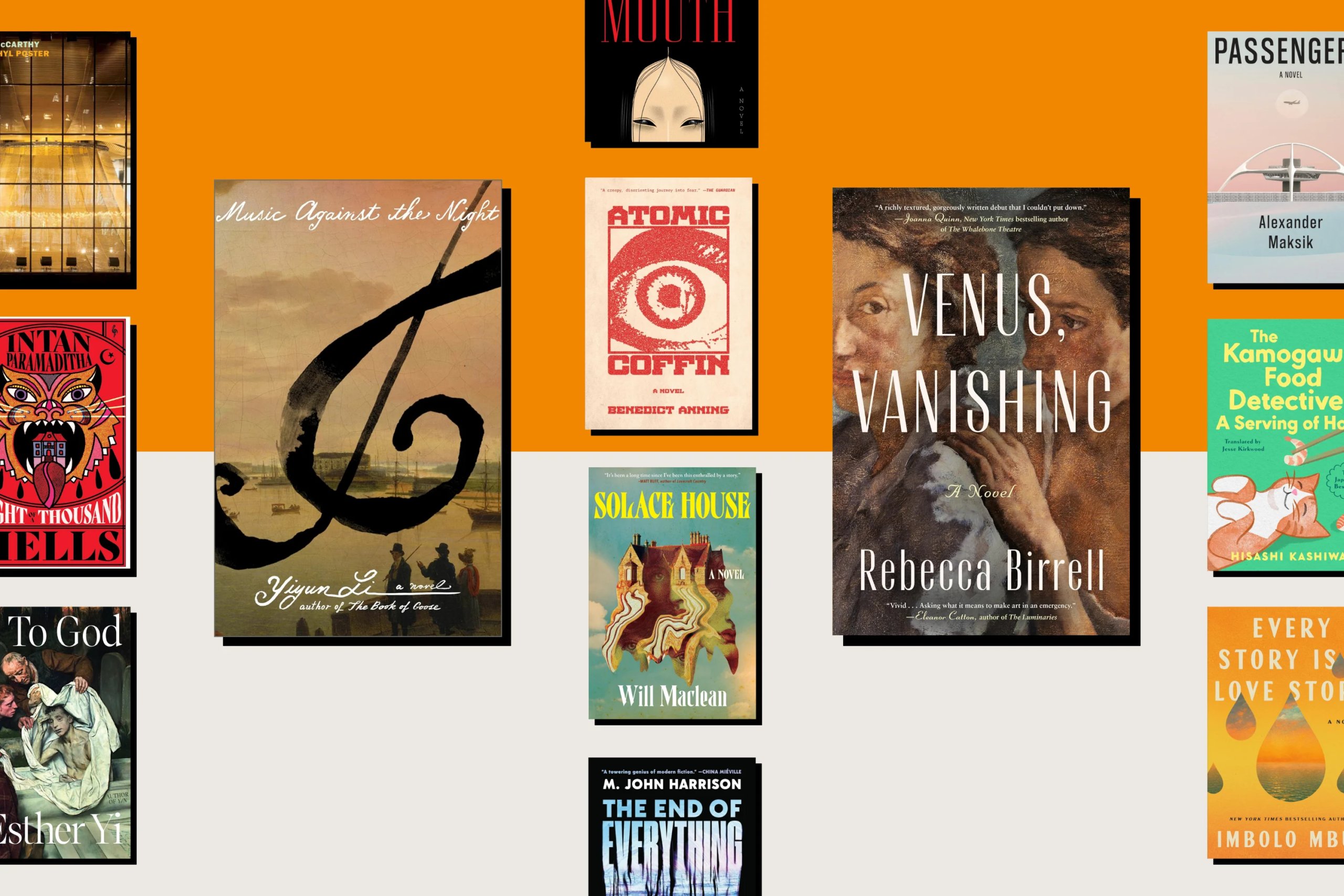
This month, we’re reading two tales of artistic daring set in epochal moments, from Napoleonic France to Weimar-era Germany.
Music Against the Night: A Novel
Yiyun Li (Farrar, Straus and Giroux, 352 pp., $29, October 2026)
This month, we’re reading two tales of artistic daring set in epochal moments, from Napoleonic France to Weimar-era Germany.
Music Against the Night: A Novel
Yiyun Li (Farrar, Straus and Giroux, 352 pp., $29, October 2026)
You’d be forgiven for not recognizing the name John Field—even more so his wife, Adelaide Percheron, who, as the writer Yiyun Li has pointed out, appears in no more than five paragraphs in a biography of the Irish composer. Field, the inventor of the nocturne, would end up a “footnote in the life of Frédéric Chopin,” who popularized the form. But in her latest novel, Li, a prolific Chinese-born author and creative writing professor at Princeton University, reimagines the life of this “forgotten master” alongside that of Percheron, a musician in her own right.
Music Against the Night, the first installment of a new trilogy, is set at the turn of the 19th century, that era when the “whole globe was a playground for would-be conquerors.” Across decades, Li follows Field and Percheron, known as “Percherette,” as they come of age and discover their prodigious talents: Field in Dublin, and then London, where he trains under a virtuoso and piano manufacturer; and the orphaned Percherette from Pondicherry, a colonial settlement in India, to Paris and the French countryside.
Though we catch glimpses of the couple’s fate—including their estrangement and deaths—through short interludes and codas, the pair do not meet in this volume. Instead, the chapters are filled with their childhood preoccupations: their deeply felt connections with their peers, their fraught ties to their families and guardians, and, of course, their near-maniacal relationship with music, which is variously an albatross and—for both characters—equal to life itself. None of this is to say that the book feels childish. One of Li’s great gifts as a writer is her ability to render the lives of children as entire and worthy in themselves.
The novel’s private dramas are contraposed with the sweep of history. Field and Percherette lived through a time of epochal change, of the French Revolution and Napoleonic Wars that reordered the continent. A sense of contingency, even futility, runs through the narrative. Field “might think someone born with gifts enjoyed some measure of grace, divine favor, as kings do,” Li writes. “But even a king could lose his head, as had happened the year before in France.” In another section, she notes: “A nation’s fate is as treacherous as an artist’s: many things go wrong, leading to disappointment and disillusion. It requires the courage of suspending one’s disbelief to be an artist or a revolutionary.”
If this sounds like bleak reading, know that at the heart of the novel is a child so full of life that, even recognizing the hardship and obscurity that will befall Percherette later in life, you can’t help but feel stirred by her presence on the page or moved by her uncanny ability to “stay enchanted with a disenchanting life; to dream in a world that is keen to judge and punish the dreamers.”—Chloe Hadavas
Venus, Vanishing: A Novel
Rebecca Birrell (Henry Holt and Co., 352 pp., $28.99, October 2026)

Venus, Vanishing should be historical fiction. But at a time of Kennedy Center takeovers and far-right resurgence, Rebecca Birrell’s debut novel reads much more like a cautionary tale about what can happen when hate-driven autocrats try to capture the arts.
Birrell, an art historian at the University of Cambridge, sets Venus, Vanishing in the interwar period in Germany. Protagonist Hannah Sherman escapes the clutches of her traditional Jewish mother to experience the hedonism of Weimar-era Berlin—think Babylon Berlin but with a focus on the visual arts. Trained as a seamstress—her family’s trade—Hannah spends her free time self-studying to become a painter. She also courts several lovers, men and women.
When a wealthy client—Elke—notices Hannah’s artistic talent, she offers to become her patron, providing Hannah eye-popping sums of money so that she can stop working as a seamstress and focus exclusively on painting. Hannah’s specialty is nudes, and Elke soon commissions portraits of herself and her friends: “Italian Renaissance examples except for the backgrounds, which would be German landscapes,” Birrell writes. As Hannah completes these assignments, the two women become “infatuated” with one another, crossing countless boundaries.
Their relationship develops a political dimension, too. Elke’s husband is an important figure in Germany’s culture ministry. When the couple displays Hannah’s paintings at a gallery, they list—without her consent—the artist as a fictional, non-Jewish man: Answald Dietrich. (“In the current market, a German man is far more appealing an investment than a woman,” Elke writes to Hannah as an explanation.) The newly appointed Führer—Birrell never mentions Adolf Hitler by name—takes a liking to “Dietrich’s” paintings, choosing to make them the artistic face of his “new Germany.” Little does he know that “the star of the Great German Art Exhibition is a Jew.”
Thus begins a fast-paced tale of deception, forgery, sex, and escape—all set to the backdrop of rising antisemitism over several years in 1930s Berlin. Much as Hannah resents the fact that her paintings “would help [Elke’s] husband ascend in the government,” she is trapped, for Elke “knew that I was Jewish and my humanity was at stake.” Since moving out of her parents’ house, Hannah had concealed her Jewish background, going by Schmidt rather than Sherman. But Elke is a longtime patron of the Sherman family business and knows Hannah’s secret. Her husband, however, does not. Elke could end up either as Hannah’s protector—or her biggest threat.
As the plot progresses, Hannah’s Jewishness moves from marginal to central to her identity; Germany’s changing politics leaves her no other choice (“a Jew’s a Jew, even a Mischling,” her neighbor tells her). When Hannah marries Saul—a fellow Jewish communist—they only become more marginalized.
Interestingly, at a time of fierce debate over Israel-Palestine within the Jewish community, Birrell explicitly notes that Saul is anti-Zionist; as he and Hannah seek to leave Berlin, Saul rejects some of his friends’ flight to Palestine—instead adhering to his Bundist principles. “Saul insisted [Palestine] was someone else’s homeland that the English had declared was ours,” Hannah says. “We already had a homeland, he said, and we were already living in it.”
Although Venus, Vanishing is a work of fiction, Birrell writes in a “Historical Notes” chapter at the end of the book that Hannah is a “composite figure” of several little-known European Jewish women artists from the interwar period, including Charlotte Salomon, Frania Hart, and Alice Haarburger. The Nazis murdered all three of them. In a literary genre dominated by stories of the Holocaust, Birrell wanted Hannah to offer a “counternarrative,” she writes: “I hoped to write a novel primarily about Jewish life, not Jewish death.”—Allison Meakem
October Releases, in Brief
A promising legal theorist at the European Union’s Court of Justice unravels in The Rhyl Poster, a philosophical thriller by Tom McCarthy. Intan Paramaditha’s work of contemporary political horror, Night of a Thousand Hells, is translated from the Indonesian by Stephen Epstein and Tiffany Tsao. Esther Yi probes the absurdities and contradictions of contemporary life in her short-story collection, To God. Benedict Anning makes his debut with Atomic Coffin, a Cold War-era thriller in which a hidden Soviet submarine harbors unexpected terrors. A coming-of-age tale meets folk horror in K-Ming Chang’s Needlemouth.
In Will Maclean’s Secret History-esque Solace House, a decaying English manor is home to dark secrets. Veteran sci-fi stylist M. John Harrison returns with The End of Everything, a post-apocalyptic tale set along the English Channel. A detective duo turns to food to help their clients recover lost memories in Hisashi Kashiwai’s A Serving of Hope, translated from the Japanese by Jesse Kirkwood. Cameroonian American novelist Imbolo Mbue’s Every Story Is a Love Story explores the unlikely bonds between those affected by grief and remorse. And in Alexander Maksik’s Passengers, a flight gets endlessly delayed.—CH
