


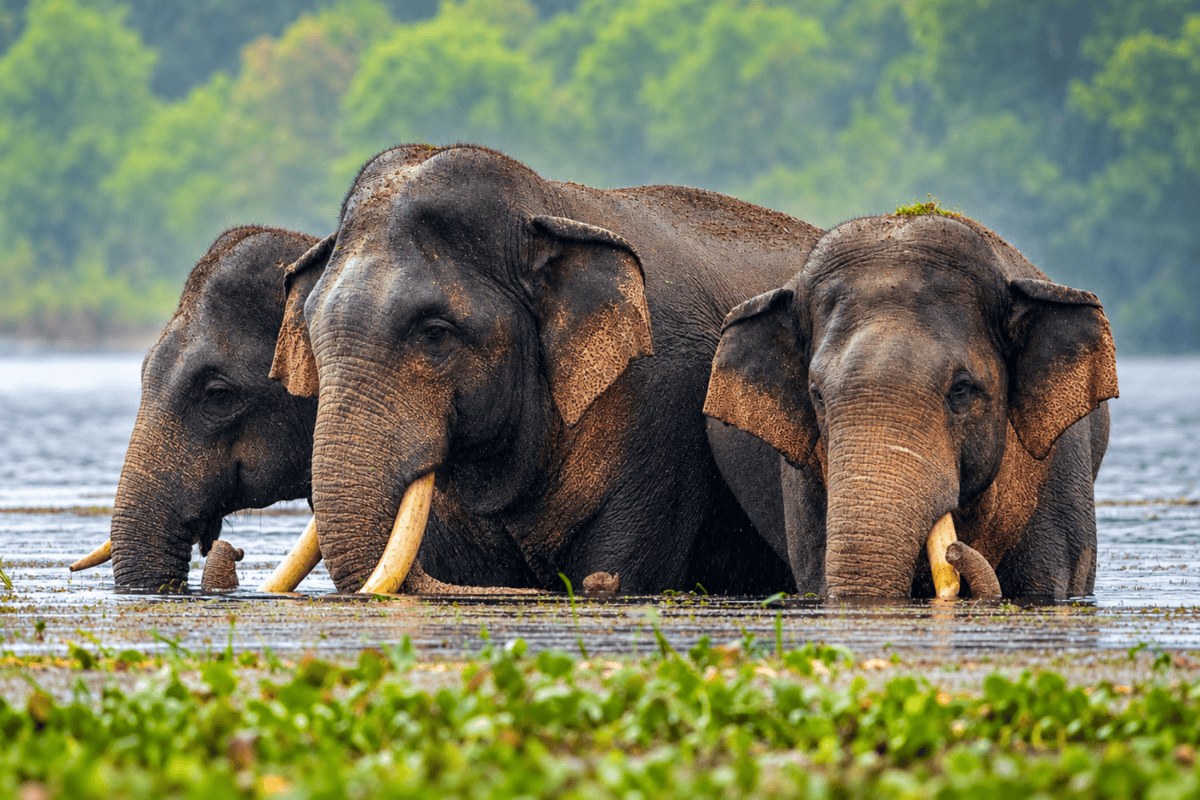
- Sri Lanka’s tallest living tusker Kavantissa was recently found with a gunshot wound on the right foreleg, prompting urgent veterinary treatment.
- The recent incident has renewed calls for armed protection of iconic tuskers such as Kavantissa, Agbo and Mahasen, echoing Kenya’s measures to protect famous elephants such as Ahmed and Craig.
- Conservationists caution that Africa’s individual-elephant protection models may not be easily translated to Sri Lanka’s densely settled, human-dominated landscapes.
- A recent assessment valued an individual wild elephant in Sri Lanka to be around 3.8 billion rupees ($11.5 million), highlighting the ecological, cultural and economic significance of elephants.
COLOMBO –- Wildlife enthusiast Pathum Bandara watched Kavantissa, believed to be Sri Lanka’s tallest living tusker, moving gently through the landscape on Sept. 20 around Galgamuwa in the island’s northwestern dry zone, a well-known human-elephant conflict zone. The following day, Bandara noticed that the elephant was limping. A closer look revealed a gunshot wound on his right foreleg, close to the knee.
The discovery was alarming because an untreated gunshot wound could become infected and cause severe trauma, potentially threatening an elephant’s ability to walk, feed and survive.
The Department of Wildlife Conservation (DWC) dispatched a team to treat the elephant. DWC’s veterinary surgeon Isuru Hewakottage said Kavantissa was sedated to enable the cleaning and treatment of the wound. He received several rounds of powerful antibiotics and remains under observation.
Following treatment, Kavantissa has begun moving between small forest patches, sometimes crossing human settlements and the well-known elephant passage near Galgamuwa. The tusker appeared to be recovering but became aggressive after the gunshot injury, sometimes even chasing villagers and wildlife officers, exposing the tusker to renewed threats including the possibility of being fired at, Bandara told Mongabay.
Bandara recalls the plight of another young tusker once closely associated with Kavantissa. Sankha, a young tusker, was about half Kavantissa’s age and was often seen together during certain periods of the year. Sankha had a stiff right leg caused by a gunshot injury. The elephant died in 2022 after falling into a pit, likely due to its mobility restrictions, following the injury, he said. Now Kavantissa has also been shot in the right leg, and experts are closely monitoring his condition to ensure he receives proper treatment, Bandara said.
In recent years, several iconic Sri Lankan tuskers died from a variety of factors including gunshot injuries and electrocution. The series of deaths raised the question of Sri Lanka’s capacity to conserve and manage wildlife, in particular, individual iconic tuskers where they share the landscape with people.
Increasing tusker deaths
There are more examples of tusker deaths, and the death of Sri Lanka’s last cross-tusker in a Kumana National Park in the Eastern province being one. “On Jan. 17, 2007, I received the heartbreaking news that the cross tusker had been shot. We immediately contacted wildlife officials and others to seek help, eventually prompting efforts to send a veterinary team by helicopter,” said Nayanaka Ranwella, an environmental activist and writer who managed to organize a helicopter through a request to the then president of Sri Lanka.
“We traveled to Panama that night with medicine and food for the injured elephant, but despite the tremendous effort of both veterinarians and wildlife officers, the tusker succumbed to its injuries. The bullet had shattered the bones of his front leg and the fall after being shot had severely damaged his spine. The cross tusker was more than a magnificent tusker; he had become a symbol of pride for Sri Lanka,” Ranwella told Mongabay.

The recent news of Kavantissa’s injury sparked concern among wildlife enthusiasts and rekindled memories of the cross-tusker’s death as well as the 2025 death of Bhathiya, another majestic tusker that suffered gunshot injuries and subsequently became severely debilitated.
Some enthusiasts have called for special protection for elephants such as Kavantissa, Agbo and Mahasen including armed protection, similar to the protection provided to famous African elephants.
Kenya offers a striking example of protecting super tuskers like the legendary elephant Ahmed, later declared a “living monument” by President Jomo Kenyatta in the early 1970s and received round-the-clock protection from armed wildlife officers. He lived to be about 55 and died of natural causes in 1974.
More recently, Craig, one of Amboseli’s famous “super tuskers,” became an international symbol of elephant conservation. He lived for 54 years and died of natural causes in January 2026. His protection was part of a broader landscape-based conservation system involving community rangers, conservation organizations and wildlife authorities.
As tusker deaths continue, the Society for Conservation of Wild Elephants in Sri Lanka (SCWE) recently made public a list of recommendations including a special protection program for the island’s unique tuskers and cited Ahmed and Craig as international examples to follow.

Call for special protection
The recommendations include declaring selected elephants as “living national heritage,” establishing dedicated protection units involving wildlife authorities and the civil defense force, fitting selected tuskers with GPS collars, providing additional protection when they use elephant corridors, and establishing community intelligence networks involving people living in areas frequented by the animals, according to Saranga Deva De Alwis, organizer of SCWE.
The same proposal also estimates the value of a living wild elephant to be approximately around 3.8 billion Sri Lankan rupees (approximately $11.5 million), when its ecological, cultural, tourism and other contributions are considered. The figure highlights that an elephant’s value extends far beyond any immediate economic benefit, with each individual contributing to the functioning of ecosystems and to Sri Lanka’s nature-based tourism and cultural heritage, specifically highlighting the importance of protecting the iconic tuskers.
But Ravi Corea, president of the Sri Lanka Wildlife Conservation Society (SLWC), cautions against simply transplanting an African model into Sri Lanka. “I think the discussion about Kavantissa raises a much larger and more fundamental issue about how we approach wildlife conservation in Sri Lanka,” Corea said.

Sri Lanka’s most celebrated tuskers are often not confined to large, protected areas. They move through a densely settled landscape where forests, farms, roads and villages overlap. “As for providing armed protection to individual tuskers such as Kavantissa or Agbo, I do not think this is feasible on the suggested scale,” Corea said.
“Elephants are wide-ranging animals that move through forests, agricultural landscapes, villages and other difficult terrain. Providing continuous physical protection to every important tusker — or even reliably protecting a single free-ranging tusker — is far more complicated than assigning a couple of armed guards to follow an animal,” he said.
Corea noted that the discussion should move beyond individual tuskers. People living alongside elephants often receive few direct economic benefits from having wildlife nearby, while bearing potentially enormous costs through crop destruction, property damage, injuries and deaths.
Alternative livelihoods
“It is unreasonable to expect one state institution to shoulder responsibility for safeguarding the country’s wildlife without a strong policy framework through which communities, conservation organizations and the corporate and mercantile sectors can become genuine partners,” he told Mongabay.
For Corea, alternative livelihoods are central to the solution. Communities in areas with severe human-elephant conflict need economic opportunities that are less vulnerable to elephant depredation. Private-sector investment, he noted, could help create sustainable, non-agricultural livelihoods in these landscapes.

“We cannot expect a farmer who has lost his entire crop overnight to an elephant to look at that same elephant and see only its majesty, cultural importance or conservation value,” Corea said. “He instead sees ruin, debt and that he can’t feed his family. This is why armed guards alone cannot solve Sri Lanka’s elephant problem”.
“The real conservation challenge is to reach a point where living alongside elephants provides people with tangible opportunities rather than imposing an intolerable economic burden upon them,” Corea added.
For now, Kavantissa will continue to move through the dry zone, sporting a gunshot wound — and a much larger question about how Sri Lanka values, protects and lives alongside its elephants.
Banner Image: A rare photograph of three tuskers, with Kavantissa at the middle, Raghu to the right and Chandi to the left. The famous one-tusked Chandi died in 2024 due to fatal injuries sustained during a fight with another tusker. Image courtesy of Pathum Bandara.
Cite this article
Malaka Rodrigo (2026). Sri Lanka elephant found with a gunshot wound. How can tuskers be protected?. Mongabay Conservation news. DOI: https://doi.org/10.66709/news-332143

