


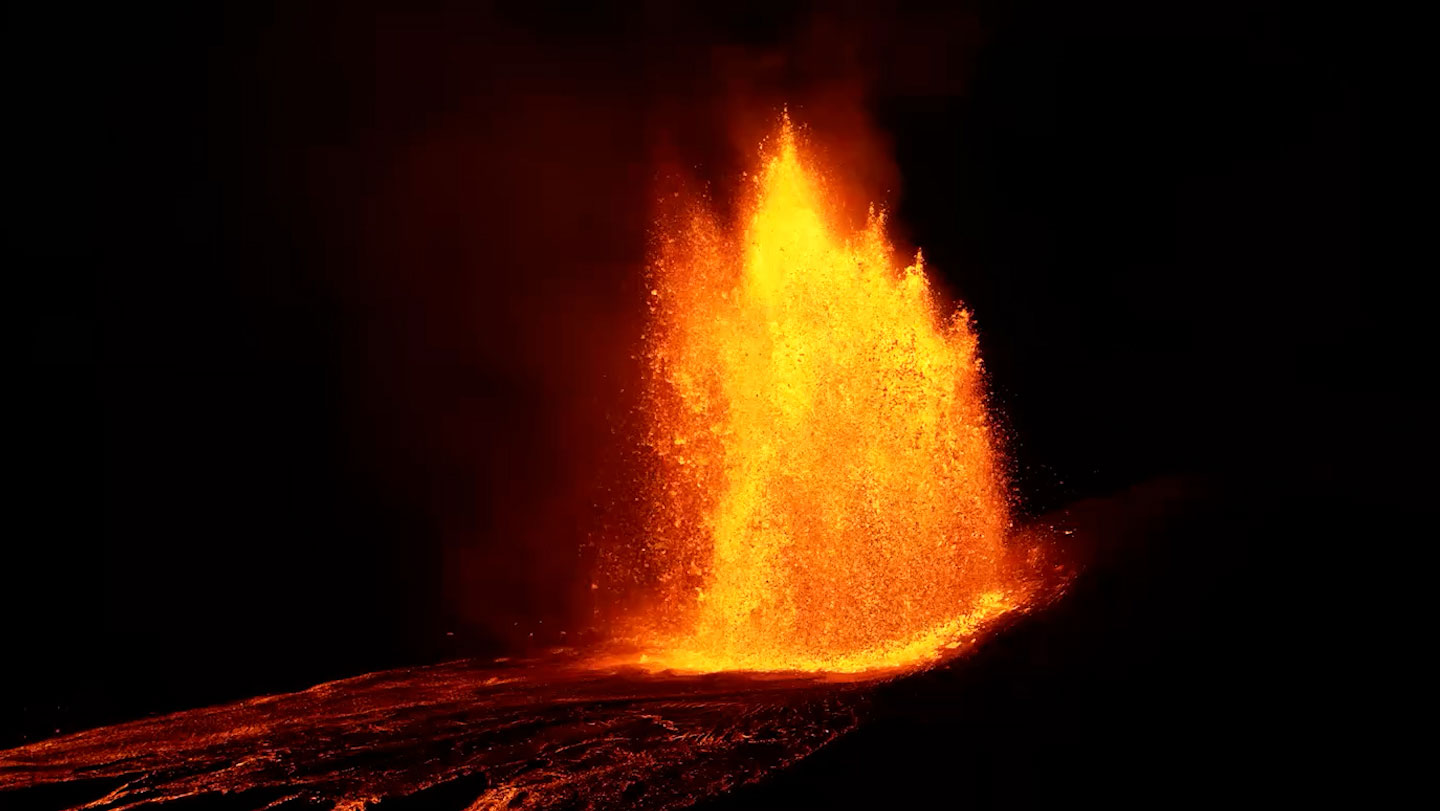
Kilauea has been erupting almost continuously for nearly 200 years, and volcanologists have seen a lot of sides to Hawaii’s most active volcano. But in the last year, Kilauea started doing something new: firing up frequent fountains of lava.
The volcano’s fountain era kicked off at dawn on December 23, 2024, with an eruption inside the summit crater of Halema’uma’u. Since then, Kilauea has put on a recurring pyrotechnic display of lava fountains, researchers report October 8 in Science. It produced 54 different lava fountains by September 2026, some of which shot as high as 457 meters into the sky.
During an eruption, which can last from hours to days, months or even years, occasional lava fountains aren’t unusual. But it’s rare to see repeated fountains — distinct bursts separated by minutes to weeks — during a single eruption. At Kilauea, these clustered spurts have only occurred three times since 1823, and never with such frequency.
Thanks to their rarity, researchers have known relatively little about what initiates, sustains and ends these episodic fountains, say Ashton Flinders, a research geophysicist at the U.S. Geological Survey’s Hawaiian Volcano Observatory, based in Hilo, and colleagues. There have been two prevailing ideas: Water dissolved in magma — the underground, molten mix of rock and gas — rising from deep inside the volcano suddenly escapes as the pressure changes, leading to a burst of pyrotechnics; or a carbon dioxide–rich foam atop the trapped magma, like the pressurized froth over a shaken bottle of soda, suddenly and violently expands.
Kilauea is the perfect laboratory in which to assess these hypotheses, the researchers say. It has been intensely studied by scientists and monitored by instruments for decades. Scientists continuously collect data on its seismic activity, temperature, low-frequency acoustics, how much the ground swells or deflates and the gases that escape. Using these data, researchers have begun to form a picture of what’s causing the relentless spewing.
Before each fountain, the team found, the floor of the bowl-shaped caldera would swell and tilt, suggesting magma was gathering beneath. As the eruption matured and the fountains continued, a pattern emerged, first appearing before the fourteenth fountain. Just before that eruption, the team detected a repetitive sequence of minutes-long bursts of seismic energy and low-frequency acoustics.
Those signals, the researchers say, are linked to the buildup and release of trapped gases in magma, which make it rise and fall through narrow volcanic vents in the rock like a piston in a car. The team also noted that while the volcano burped some sulfur dioxide gas, there was relatively little carbon dioxide, suggesting that the foam hypothesis wasn’t at work.
This is just a preliminary glimpse into this phenomenon, and a lot of questions remain, Flinders and his colleagues say.
