


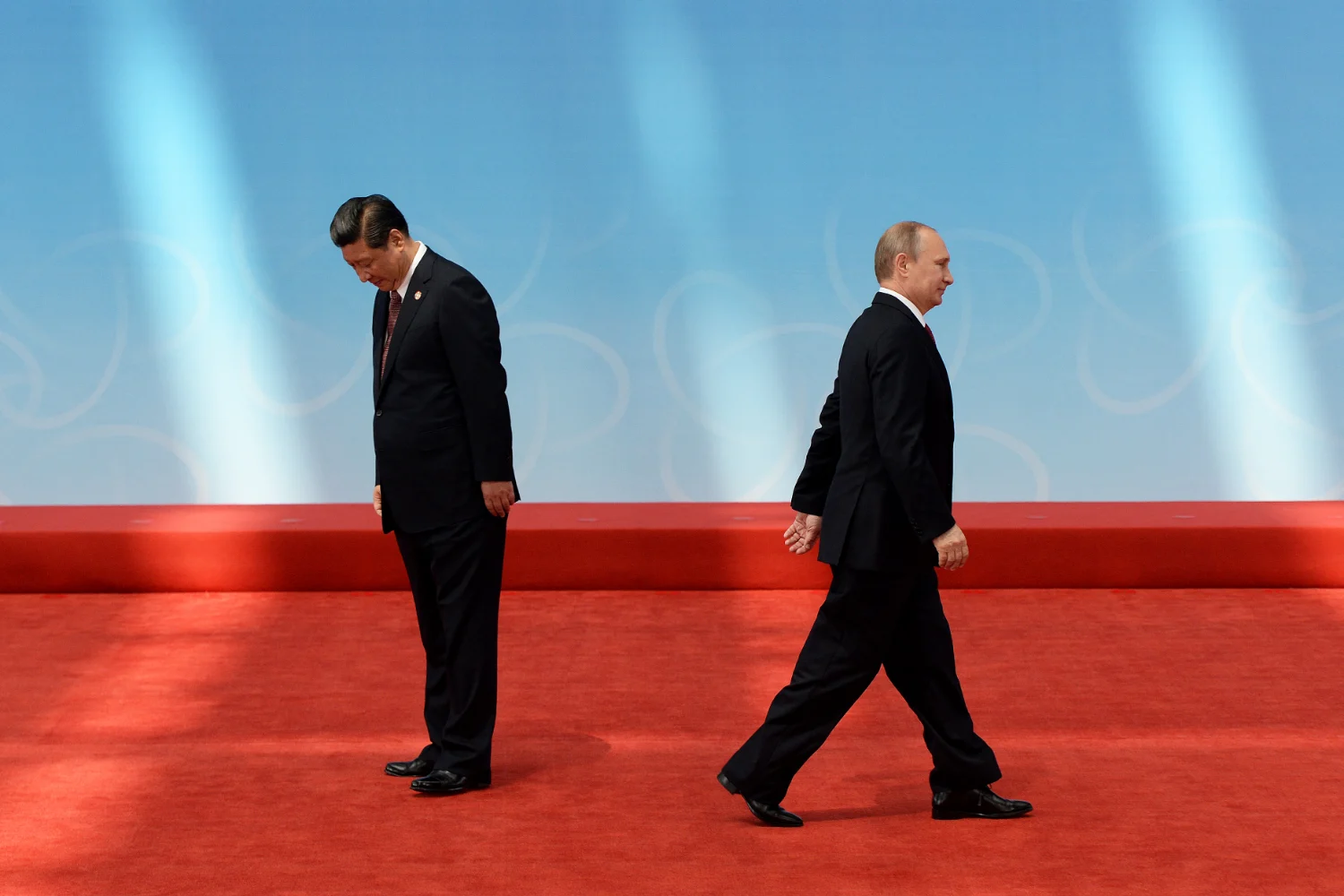
When Chinese President Xi Jinping enjoyed an elaborate state dinner at the White House in September, one of the most important items—China’s relations with Russia—was not on the menu. It was an odd omission by his American host: Both China and Russia are supporting Iran, and Beijing is the key enabler of Moscow’s war against Ukraine.
More broadly, Beijing and Moscow have united to oppose American primacy and replace it with a “post-West” order, a joint goal that they touted yet again at the recent BRICS summit in New Delhi. Xi’s “no-limits” partnership with Russian President Vladimir Putin damages U.S. interests and constrains U.S. global influence. Their alliance enables both Xi and Putin to deal with U.S. President Donald Trump from a position of greater strength.
Early in Trump’s second term, the White House defended its desire to improve ties with Russia because it hoped to engineer a so-called reverse Nixon and pry Moscow away from Beijing. That argument disappeared because the strategy failed. Despite the president’s vow to “un-unite” Moscow and Beijing, his administration seems to have concluded that there is little it can do. In fact, Trump’s tariffs, sanctions, and war against Iran have pushed Russia and China even closer together.
It is time for the United States to reassess its passive approach to the two powers that most threaten U.S. interests and values. Given the depth and breadth of the Russia-China alliance and its centrality to both Putin and Xi, Washington cannot easily drive wedges between its two main antagonists, much less pit them against each other like the reverse Nixon argument suggests. Washington should avoid the false choice between a grand realignment on the one hand and a solidified China-Russia partnership at the United States’ expense on the other.
Instead, the United States should work to make the relationship more costly and difficult to operate. By exacerbating points of mutual friction, Washington could cause Moscow and Beijing to doubt each other more, help third countries avoid excessive dependence on either, and tap the vast potential of its own alliances and partnerships to generate leverage and counterpressure. The realistic goal is to put pressure on the relationship rather than trying to blow it up or simply being transfixed by it.
At first glance, even this approach may appear questionable, given that Russia and China have never been closer. Political, military, technological, and economic ties are growing. Together, they contest key norms and principles underpinning the Western-led international order. They promote organizations that exclude the West, such as the expanding BRICS bloc and the Shanghai Cooperation Organization. They are engaged in attempts to “de-dollarize” the global financial system and conduct almost all trade between them in Chinese yuan.
Even as Beijing claims to be neutral in the Kremlin’s war against Ukraine, it has been Russia’s main supporter, enabling Putin to continue pummeling Ukraine for the past four and a half years. China provides more than 90 percent of the sanctioned technology imports that keep Russia’s war economy afloat and sustain its aggression against Ukraine. China’s deepening commercial and financial connections have also allowed the Kremlin to access critical technological capabilities.
Meanwhile, China has solidified its position as Russia’s top trading partner, accounting for roughly 30 percent of Russia’s total exports and 57 percent of its imports. It has also benefited from cheap Russian hydrocarbons. Russian shipments currently represent 17 percent of China’s crude oil imports and 30 percent of its natural gas imports.
A closer look, however, reveals the Russia-China partnership as opportunistic and transactional, driven more by common grievances and overlapping ambitions rather than shared values. It is an alliance of convenience, not conviction. It is also lopsided: Russia’s dependence on China grows by the day.
Beijing values its partnership with Moscow as key to challenging the United States and rewiring international rules to suit its interests. Xi knows that Russia is not China’s equal, but he keeps up appearances so Putin can present himself as the respected leader of a great power. Meanwhile, Chinese decision-makers do whatever they can to exploit Russian dependencies, block Russian development, and limit Chinese risks.
Xi and Putin speak during the BRICS summit in Kazan, Russia, on Oct. 24, 2024.Maxim Shemetov/AFP/Getty Images
Cooperation with Moscow has not prevented Beijing from engaging in extensive espionage and reverse-engineering efforts against Russia. China is also building entire ecosystems that cement Russian dependence, from supply chains, militarily-relevant technologies, transport corridors, and financial architecture to artificial intelligence and rare-earth mining, processing, and refining.
Beijing takes advantage of discounted Russian energy but limits its investments in Russia’s energy infrastructure and broader economy. It remains cautious about secondary Western sanctions. China’s refusal so far to greenlight the Power of Siberia 2 gas pipeline while pushing Russia for lower prices shows the leverage that it holds. Putin is desperate for this pipeline because he needs new revenue sources from natural gas exports after losing most of the European market.
The Chinese are also wary of Putin’s risk-taking behavior. The Kremlin’s threats to use nuclear weapons against Ukraine and other European countries have drawn Chinese rebukes. His military adventurism challenges Beijing’s position that borders are inviolable, which is key to its claims over Taiwan. Beijing has refused to recognize Russia’s annexations of Crimea in 2014 and four additional Ukrainian regions in 2022, even if it has not condemned Putin’s full-scale invasion.
Since 2022, China has publicly endorsed the territorial integrity and independence of Central Asian countries. Similarly, it has not recognized the independence of Abkhazia and South Ossetia, two regions whose Kremlin-aligned puppet regimes broke away from Georgia following Putin’s invasion of that country in 2008.
Beijing supports a resolution of the Ukraine war on terms that are favorable to Moscow and keep Putin in power. It fears that a Russian defeat could bring to power a new Kremlin leader who might rethink the alliance with China. At the same time, it is wary of the war ending with a resounding Russian triumph. That could embolden Putin to challenge the territorial integrity and sovereignty of other neighboring countries, particularly Kazakhstan, whose northern regions have a large Slavic population. Putin has previously hinted at a future Slavic state consisting of Russia, Belarus, Ukraine, and northern Kazakhstan.
Kremlin propagandist and television talk-show host Vladimir Solovyov has publicly stated that Russia may expand its so-called “special military operation” in Ukraine to countries in Central Asia. Putin could try to annex Abkhazia and South Ossetia or use the Russian military presence in the Moldovan breakaway region of Transnistria to reinvigorate political interference in Moldova and assaults on its sovereignty.
Multiple European intelligence services have warned that he is likely to ramp up his hybrid warfare of sabotage, cyberattacks, and election interference against NATO countries in order to test the alliance’s borders and political resolve. These activities would present China with uncomfortable choices between its support for Russia, its interest in stable relations with Europe and Central Asia, and its public commitment to noninterference and the inviolability of borders.
Russian decision-makers have their own qualms about their “no-limits” partnership with China, despite Putin’s public claims that the relationship has reached an “unprecedented level” of trust. They chafe at Beijing’s dominance of the relationship, which is historically unparalleled. They worry that China is outpacing Russia in artificial intelligence and cybersecurity and that Russia is losing its historical advantage in advanced weapons, spacecraft, and nuclear technologies.
A leaked report from Russia’s FSB security agency that appears to have been written in late 2023 or early 2024 expressed deep concerns about China’s long-term goals, calling China “the enemy” and warning that its spying activities pose a serious threat to Russian security.
Russia and China engage in cyber activities against each other even though they have agreed not to. They favor rival connectivity routes across Eurasia and compete in Central Asia, Africa, and in the Arctic. Both favor a “post-West” world—but whereas Russia is a spoiler and disrupter, China wants a global order with rules, even as it reshapes the rules to its preferences and challenges basic security arrangements in East Asia.
Doubts over and competition within their alliance have not yet generated the type of mutual hostility between Beijing and Moscow that could present Washington with a reverse Nixon option. Despite their concerns, Russian and Chinese decision-makers have learned to operate within the shifting parameters of their relationship. Both carefully manage their differences, understand each other’s red lines, and recognize the boundaries of possible agreement.
For example, although the Russian FSB report labeled China an “enemy,” intelligence officers were instructed to contain risks posed by Chinese intelligence without causing “negative consequences for bilateral relations.”
However, as China’s structural advantages mount and pressures build within Russian society, Russian decision-makers are finding it harder to sustain this unequal equilibrium. And as an embattled Putin turns to riskier behavior, uneasy Chinese leaders are placing more limits on the “no-limits” partnership.

Xi and U.S. President Donald Trump at a state dinner hosted at the White House in Washington on Sept. 24. Kevin Dietsch/Getty Images
Here lies opportunity for the United States and its allies to throw some sand into the gears.
As a quick first step, Washington can and should make China pay more for supporting Russia’s war on Ukraine. The Lindsey O. Graham Sanctioning Russia and Iran Act of 2026, passed in September, gives the administration the authority to impose tariffs of up to 100 percent on China and other countries that buy large amounts of Russian crude oil or natural gas or help evade sanctions. If such an escalation threatens to disrupt energy markets, the law lets the administration adjust tariff rates if China reduces its imports of Russian energy over time. The United States previously used a similar approach to cut Chinese purchases of Iranian oil.
The United States can also exacerbate the concerns that Beijing and Moscow have about each other. Xi is uneasy about Putin’s risk-taking. Washington and its allies should be vocal with Chinese interlocutors and in their interactions with Chinese society about Russia’s reckless behavior, including violating internationally recognized borders; using threatening nuclear language, engaging in aggressive hybrid warfare; and selling advanced weapons to China’s rivals, such as India.
As Russians worry about becoming China’s supplicants, Washington and its partners can highlight a host of divisive issues with their Russian counterparts: Russia’s loss of economic, financial, and technological sovereignty; its growing deindustrialization at the hands of Beijing; its loss of influence to China in Central Asia and the Middle East; creeping Chinese economic colonization of Russia’s Far East; Chinese efforts to bypass Russia via the “Middle Corridor” transport route across southern Eurasia; Chinese attempts to steal Russian military secrets; and China’s refusal to share many advanced technologies or invest in the Russian economy.
Tensions between Russia and China in the Arctic can also be exploited. The two countries work together in the region, but Russia resents Chinese encroachments on what it considers Russian territory and is concerned that Beijing may take advantage of Moscow’s isolation to advance its polar interests at Russia’s expense. It has arrested some of its Arctic researchers on suspicion of spying for China. Competition is growing over access to and ownership of resources and control over the flows of goods, services, and data that are the lifeblood of Arctic commercial activities. And some Chinese maps include Russia’s Far East as a historic part of China.
Africa is another area of China-Russia tension. Despite similar rhetoric about creating a “post-West” African continent, there is little real collaboration. The Chinese, who have worked hard to cultivate stable economic connections across the continent, are alarmed by disruptive Russian behavior, particularly the Wagner Group’s and Africa Corps’s subversive activities as well as the Kremlin’s support for several military coups.
Russia, in turn, presents itself as a hedge for African countries that fear Chinese domination. While Russo-Chinese differences in Africa are unlikely to disrupt the broader alliance, they are a reminder that relations outside the strictly bilateral framework can cause frictions in the “no-limits” partnership.
Finally, and most importantly, the United States and its allies can deter, contain, and pressure the Russia-China alliance by harnessing their own immense potential. The United States won the Cold War as much by organizing the West as by containing the East. Washington created a vibrant, wealthy set of interlocking Western alliances and networks that over time simply overwhelmed the Soviet empire. Today, a revived coalition of the United States and its key allies and partners would dwarf the economic might, technological acumen, defense capability, and diplomatic clout of Russia and China.
Critics will charge that the Trump administration has so eviscerated any sense of allied solidarity that rebuilding and extending what Kurt M. Campbell and Rush Doshi call “allied scale” is no longer feasible. Yet the underlying rationale for renewed cooperation remains, and go-it-alone strategies are likely to be much less effective.
Russia and China have tied Indo-Pacific and North Atlantic security in ways that the United States and its allies have not. Beijing and Moscow conduct joint exercises and military patrols in both regions. Russian-Chinese defense-industrial cooperation on militarily relevant technologies presents significant challenges for NATO and Asian allies alike. China contests maritime passages through which most of Europe’s trade with Asia flows. It is sustaining Russia’s war in Europe while learning from it to prepare potential aggressive action against Taiwan. The Chinese and Russian militaries have secretly proposed a plan to degrade and destroy the Starlink satellite system that supports Ukraine, and they are both creating alternatives to Starlink. The United States and its allies admit that they are not prepared for the very real prospect of simultaneous conflicts in East Asia and Europe.
Addressing the Russia-China challenge would best harness allied efforts rather than divide them. Trump administration efforts to compartmentalize allied defense by confining Europe’s strategic focus to its own continent and Asian allies to their region ignore these realities. This approach also weakens both European and Asian alliances by signaling that U.S. commitments are limited and conditional.
Russia and China have built a formidable partnership while the United States and its allies passively looked on. Yet acknowledging these deep ties does not mean having to accept the terms that Beijing and Moscow have set. Washington and its allies have agency—and they can leverage the inherent weaknesses of the Russia-China alliance.
