


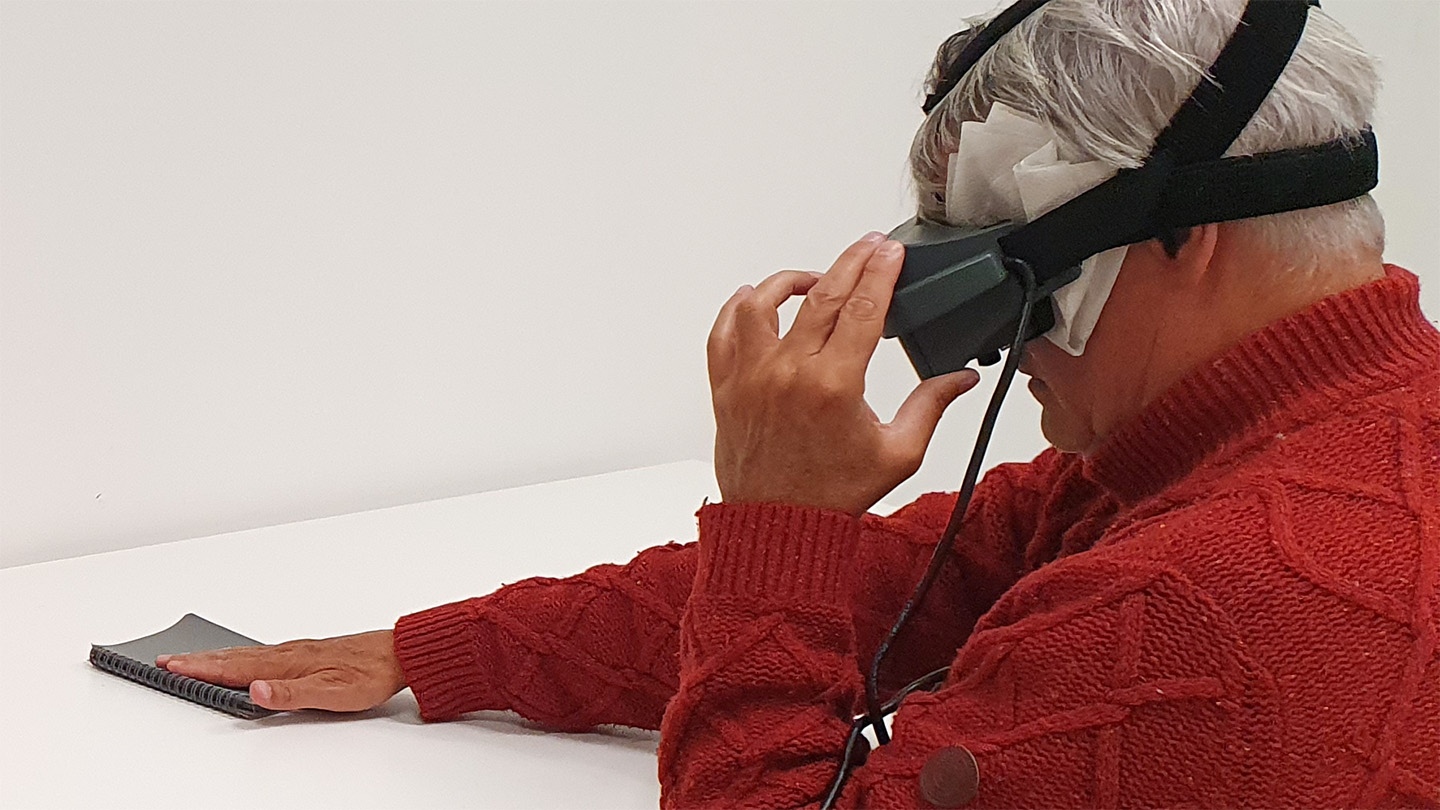
Some blind people can now find a doorway or spot an object with the help of an experimental treatment and custom goggles.
Participants in a new study had blindness caused by a genetic disease called retinitis pigmentosa, which progressively kills off light-sensing cells in the retina. The treatment improved seven of 10 people’s light sensitivity, researchers report October 7 in New England Journal of Medicine. The findings build on a 2021 report that the same approach helped one blind man see and count objects.
The treatment is based on optogenetics, a technique that uses genetic instructions to make cells respond to light. Rather than repair the retina’s damaged light detectors, it gives that ability to retinal ganglion cells that normally relay visual signals to the brain.
“This is a proof of concept that optogenetics can bring back some visual activity [and] object sensitivity,” says Botond Roska, neuroscientist at the Institute of Molecular and Clinical Ophthalmology Basel in Switzerland.
Pioneering work on optogenetics snagged the 2026 Nobel Prize in Physiology or Medicine on October 5.
Scientists have been experimenting with optogenetic therapies to rewire the eye and restore vision to people with degenerative eye diseases for more than a decade. Just as in the 2021 study, in the new work Roska and his colleagues injected genetic instructions for ChrimsonR, a light-sensitive protein derived from algae, into participants’ worse-seeing eye. The treatment made retinal ganglion cells in that eye sensitive to amber light. A camera in the custom goggles detected changes in brightness in what was in front of a study participant, and the goggles projected those changes onto the retina as pulses of amber light, activating the treated cells.
Four of the eight study participants who completed behavioral testing after treatment were able to find a doorway or follow a line while wearing the goggles. No patient gained the ability to read visual words or see faces, but Roska and his colleagues hope to tackle that next.
But there’s a limitation to this work. The approach requires a working optic nerve to carry signals to the brain, says study coauthor José-Alain Sahel, an ophthalmologist at the University of Pittsburgh. It relies on cells in the retina communicating to the brain, so it cannot restore vision when that connection is damaged.
