


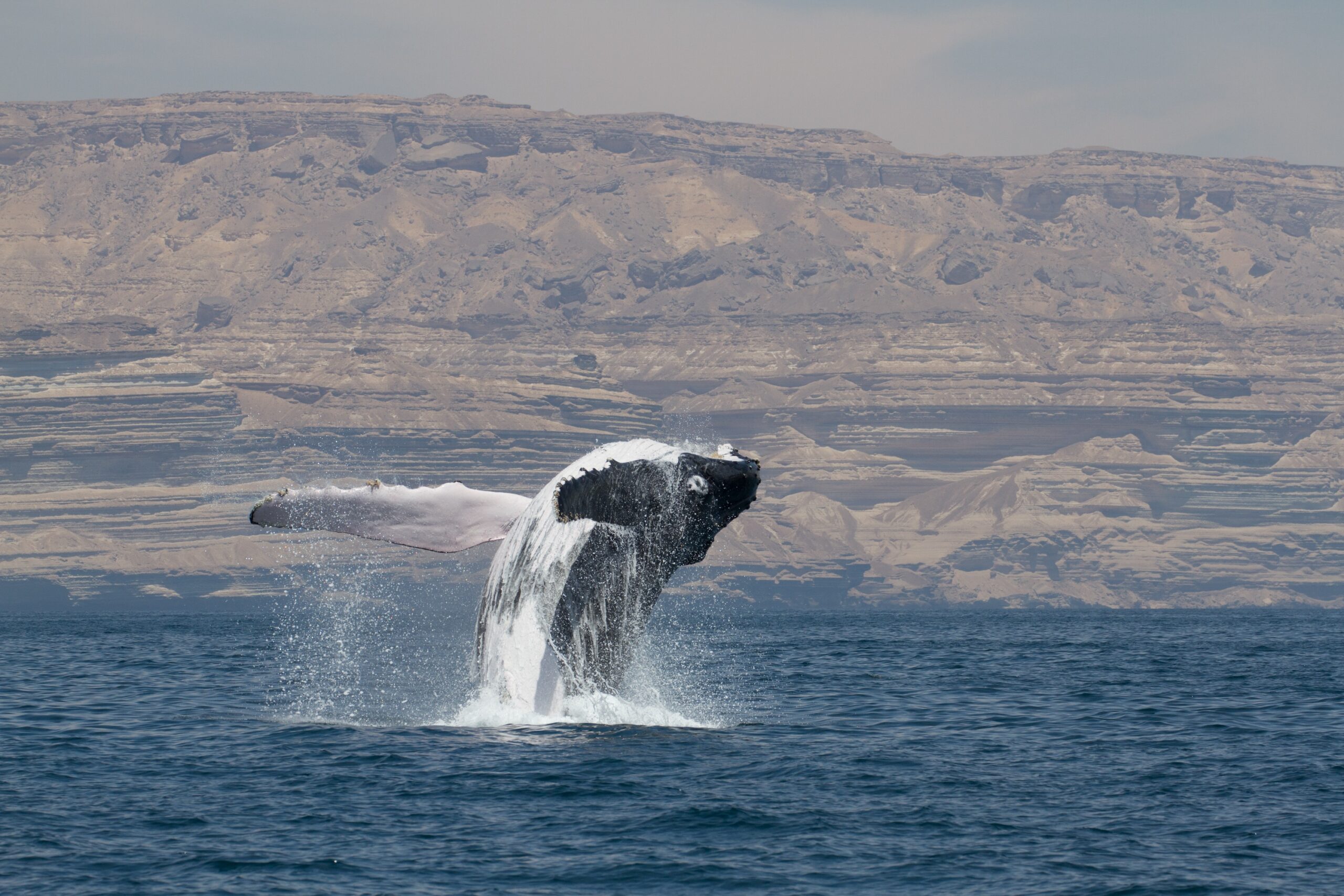
Humpback whales found in the Arabian Sea are likely a distinct subspecies, having evolved in isolation for tens of thousands of years, according to a newly published genetic analysis.
“Arabian Sea humpback whales have long been an enigma to the scientific community,” lead author Rita Amaral, from the Wildlife Conservation Society (WCS), said in a press release. “Their ecology is unlike that of any other known humpback whale population, and this new genetic work represents an important milestone in understanding how that uniqueness developed.”
Humpback whales (Megaptera novaeangliae) are found throughout the world’s oceans, typically migrating from warm waters near the equator, where they breed, to the colder poles, where they feed. To date, scientists recognize three subspecies: the North Atlantic (M. n. novaeangliae), Southern Hemisphere (M. n. australis), and North Pacific (M. n. kuzira) humpback whales.
Unlike most humpbacks, however, the population living in the Arabian Sea doesn’t migrate, remaining in tropical and subtropical waters all year.
Researchers compared mitochondrial DNA, which mothers pass to their babies, collected from 2,285 humpback whales globally, including those from the Arabian Sea coast of Oman.
The analysis showed considerable genetic differentiation between the latter population and the other subspecies. The researchers also found the Arabian Sea population had the lowest genetic diversity observed across any global ocean basin.
The study estimates humpback whales in the Arabian Sea diverged from the other populations between roughly 43,000 and 113,000 years ago, suggesting a long history of isolation. Such isolation also makes them vulnerable to extinction, the authors say.
“The recently published genetic study adds to the growing body of evidence that this population is discreet, isolated, unique and in urgent need of conservation efforts,” study co-author Gianna Minton, who co-chairs the Cetacean Specialist Group at the IUCN, the global wildlife conservation authority, told Mongabay by email.
Minton added that strong seasonal coastal upwelling allows the Arabian Sea whales “to find both the cold nutrient rich waters associated with feeding grounds, and the warm protected waters associated with mating, calving and nursing, within the Arabian Sea.”
The IUCN Red List recognizes the Arabian sea humpback whales as an endangered subpopulation. This population remains small with no evidence of an increase over the past two decades, the authors write.
Two-thirds of whales photographed off Oman bear scars consistent with fishing gear entanglement. Expanding shipping corridors also present severe risks from vessel strikes and increasing underwater noise, they add.
The International Whaling Commission recently endorsed a regional Conservation Management Plan (CMP) to coordinate cross-border protection of Arabian Sea humpbacks across all range nations, Minton said.
“The CMP will facilitate regional collaboration among a wide range of relevant stakeholders — including the fishing and shipping industries, government agencies, NGOs and universities — to more effectively monitor the population and mitigate threats it faces,” Minton added.
Banner image: An Arabian Sea humpback whale breaches following interaction with another whale. Image courtesy of Robert Baldwin via Wildlife Conservation Society.
