


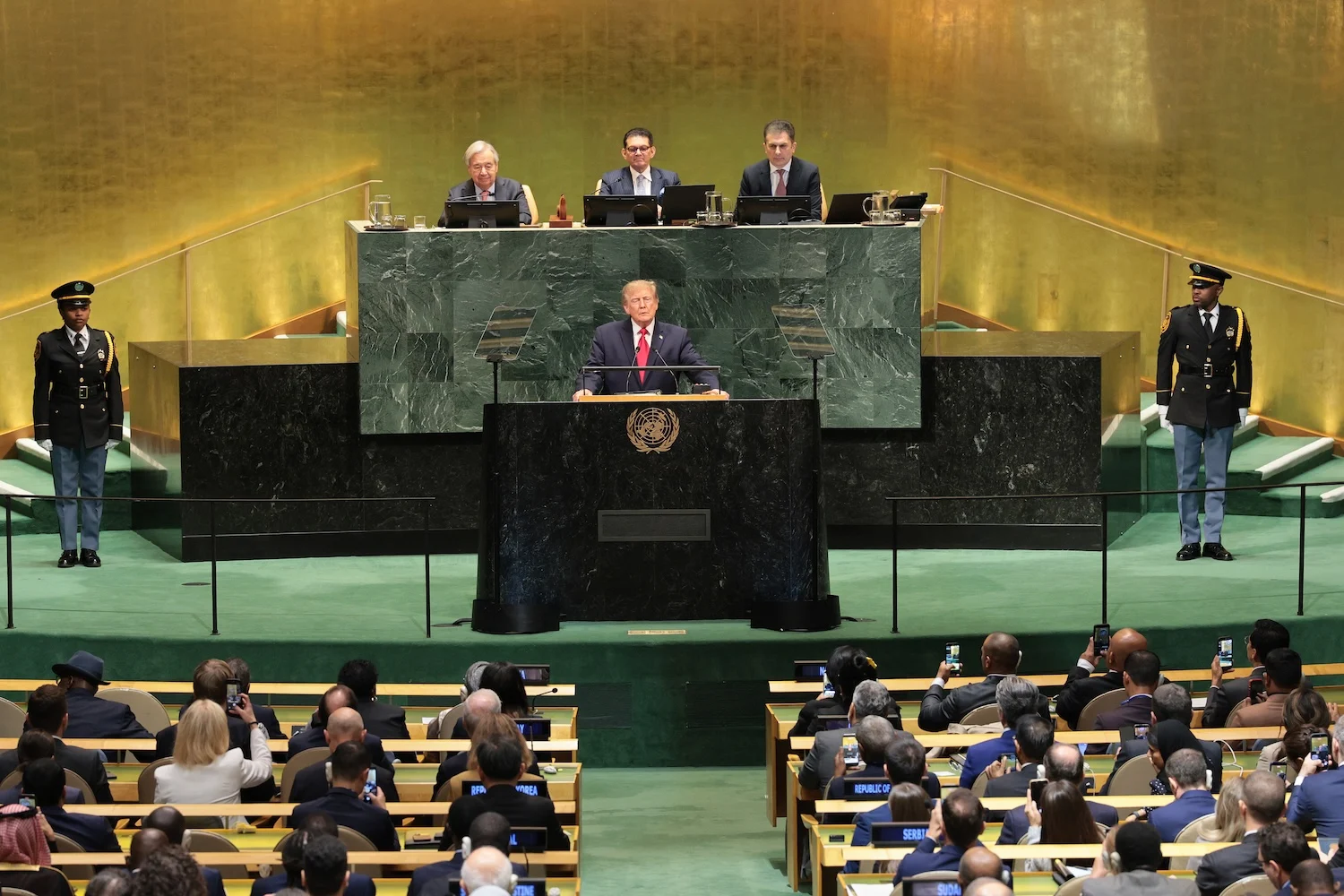
U.S. President Donald Trump stood in front of the United Nations General Assembly on Sept. 22 and made two explicit threats. He threatened to use military force in Latin America in service of U.S. interests, and he threatened annihilation for both the Iranian government and the Iranian people. The actions he proposed contravene both the international laws prohibiting war and the international humanitarian law that protects civilians in conflict. What’s more, the U.N. Charter prohibits even threats of aggression, while the laws of war, themselves part of U.S. law, prohibit indiscriminate threats against a civilian population. Accordingly, Trump’s public deliberations about who to invade and who to annihilate were themselves crimes, committed in full view of thousands of diplomats and heads of state.
Trump is accustomed to asserting the primacy of force over law and clearly anticipates no punishment for doing so in front of a body dedicated to saving humanity from the scourge of war. Indeed, his administration is bent on shrinking the U.N. and dismantling the International Criminal Court (ICC)—“brick by brick, if necessary,” in the words of U.S. Secretary of State Marco Rubio.
U.S. President Donald Trump stood in front of the United Nations General Assembly on Sept. 22 and made two explicit threats. He threatened to use military force in Latin America in service of U.S. interests, and he threatened annihilation for both the Iranian government and the Iranian people. The actions he proposed contravene both the international laws prohibiting war and the international humanitarian law that protects civilians in conflict. What’s more, the U.N. Charter prohibits even threats of aggression, while the laws of war, themselves part of U.S. law, prohibit indiscriminate threats against a civilian population. Accordingly, Trump’s public deliberations about who to invade and who to annihilate were themselves crimes, committed in full view of thousands of diplomats and heads of state.
Trump is accustomed to asserting the primacy of force over law and clearly anticipates no punishment for doing so in front of a body dedicated to saving humanity from the scourge of war. Indeed, his administration is bent on shrinking the U.N. and dismantling the International Criminal Court (ICC)—“brick by brick, if necessary,” in the words of U.S. Secretary of State Marco Rubio.
The administration’s hostility to the principle and mechanisms of international legal accountability makes eminent if cynical sense in light of its many transgressions. These include, but are not limited to, the crime of enforced disappearance by Immigration and Customs Enforcement (ICE) against both U.S. citizens and foreign nationals; the deaths of people in ICE custody via neglect; the rendition of refugees and asylum-seekers to foreign prisons and hostile third countries; the bombing of civilian targets in Iran; the United States’ ongoing campaign of murder on the high seas against unspecified and unknown individuals in Latin America and the Caribbean, at least some of whom have been identified as civilians, most of whom have not been identified at all; and the dismantling of the U.S. Agency for International Development and its downstream consequences, which, according to epidemiological models, “has already caused the deaths of six hundred thousand people, two-thirds of them children,” and by 2030 is projected to result in more than 14 million additional deaths, a figure that includes between 4 million and 5 million deaths among children under the age of 5.
Many in the United States and around the world are desperate to see Trump and his top advisors held accountable for all this lawlessness but are at a loss for how to do so. Both the domestic power that accrues to the American president and an international balance of power dominated by U.S. military and economic might obstruct easy pathways toward justice. But there are still meaningful steps that both America’s domestic opposition and the international community can take. These steps include supporting the ICC, enabling international investigations into enforced disappearances and civilian deaths, and rebuilding America’s foreign aid architecture.
For the U.S. domestic opposition, the clearest pathway toward accountability is pledging to join the ICC when the Democratic Party takes office and vocally supporting the ICC as it is repeatedly targeted for destruction by the Trump administration. Joining the ICC, as scholars Beth Simmons and Allison Danner argue, allows states moving through violent periods to make credible commitments that human rights violators will be prosecuted. This is a strategy that helps build trust with both foreign governments and with domestic publics reeling from abuses, who do not have to trust that the government itself will hold perpetrators to account if it has bound itself to an institution that will undertake investigations and prosecutions if it does not.
A frequent U.S. argument against joining the ICC has been that U.S. domestic institutions are strong enough to impose accountability on American officials. But while lower courts in the U.S. have demonstrated their fidelity to the law, the U.S. Supreme Court has established presidential immunity as the law of the land. Joining the ICC is no bar against domestic prosecutions, since the court operates on the principle of complementarity, only beginning its work if domestic courts have indicated they cannot or will not pursue accountability.
Another common concern is that joining the ICC would increase the risk that U.S. nationals would face prosecution. But the ICC can already investigate crimes committed by Americans against foreign nationals regardless of whether the U.S. is a party to the ICC. Accordingly, joining the ICC and cooperating with its investigations would be an extra measure of good faith, and a strong way for the domestic opposition to signal it will not hold the U.S. above international law.
Foreign governments play a key role here as well. Last month, U.S. Sen. Chris Van Hollen argued European countries and other signatories to the ICC should sanction Rubio and Trump for obstructing the ICC’s investigations into Israeli Prime Minister Benjamin Netanyahu. This is a classic pathway for enforcing international law: domestic opposition calling on other countries to help discipline their governments into compliance.
The Trump administration is reportedly preparing an extensive sanctions regime against the ICC, ramping up the measures that have thus far only targeted individual court officials, and ultimately forbidding most transactions with the ICC for companies, banks, and individuals. These actions would effectively collapse the court and even potentially set free those standing trial for or already convicted of war crimes and crimes against humanity.
A formal coalition of countries has emerged to challenge Israeli violations of international law. A similar coordinated effort to diplomatically isolate the U.S. officials attempting to break the ICC will be necessary to ensure the international community’s continued ability to prosecute the highest crimes against humanity.
Pursuing prosecutions at the ICC is not the only international tool available to Americans who object to the Trump administration’s actions. The U.N.’s human rights bodies also provide avenues toward subjecting state treatment of civilians to scrutiny. Panels of independent experts and researchers operating under a multilateral mandate can investigate how governments treat those within their borders or at the receiving end of their actions. The U.S. domestic opposition can draw on these tools, and foreign governments can support them.
In 2016, for example, the U.N. General Assembly established the International, Impartial and Independent Mechanism. Its mission was to “assist in the investigation and prosecution of persons responsible” for the most serious crimes against the Syrian people beginning in 2011 and gather evidence at a standard designed to facilitate thousands of prosecutions at any court that has standing to bring a case, and it was established without the involvement of the Syrian government at the time. Beyond laying the groundwork for legal accountability, investigations of this kind can also simply help people learn what happened to loved ones, with truth serving as a kind of remedy in the absence of any other.
An investigative mechanism like this one might help U.S. opposition leaders and concerned foreign governments in their quest to learn who is being murdered in the United States’ boat-bombing campaign in the Caribbean. U.N. experts have condemned the killings; highlighted the complex, multilayered nature of the violations; and said they are in touch with the U.S. government on the issue. If Democrats take the House, investigations into the campaign and the decision-making process that produces will be vital. But even absent that, congressional Democrats can partner with international experts to help determine who was killed and for what ostensible reason. Support from the international community could provide vital access and funding, as victims might be of many nationalities, and regional governments might be less likely to undertake independent investigations themselves.
The U.N.’s standing committees on human rights can also help U.S. domestic actors to track down and repatriate the people ICE has disappeared. Civil society groups, nongovernmental organizations, reporters, and individual elected officials are doing remarkable work to try to find those who have vanished into ICE’s detention facilities. Reporters have tracked individual removal flights. Elected officials have attempted oversight of nearby detention facilities at sometimes great personal cost, and Rep. Joaquin Castro has tried to find those who have disappeared into the Dilley detention center in his district in Texas and secure their release. Some U.S. groups are already working with the U.N.’s Committee on Enforced Disappearances as part of an effort to locate those kidnapped by ICE. A coordinated effort by elected Democrats to back these tools would signal their substantive interest in addressing the harms the United States’ immigrant apparatus has inflicted.
Indeed, we can gauge the importance of these multilateral mechanisms from the steps criminal actors take to escape their oversight. When the Committee on Enforced Disappearances requested information about Venezuelan migrants the U.S. sent to CECOT in El Salvador, for example, the government of El Salvador took great pains to argue that the chain of responsibility under international law implicated only the U.S. government in crimes.
The Trump administration cannot carry out its plans without the assistance of other willing governments. These other leaders may be able to envision a world where there will be repercussions for their actions, even if Trump can’t. This makes these U.N. committees important. Both international and U.S. domestic human rights advocates can work with these international experts to build bodies of evidence that might later help establish justice or facilitate repatriation.
Finally, recommitting the U.S. to meaningful foreign aid is a mode of accountability. Nothing can bring back the lives cut short when the U.S. suddenly slashed foreign aid. The people Elon Musk and the Department of Government Efficiency betrayed weren’t passive recipients of U.S. charity, however—they were active partners in implementing international programs addressing HIV/AIDS, infant mortality, maternal mortality, food insecurity, cholera, and conflict-related death, among others. Their work warrants renewed support.
Foreign aid is not a winning electoral issue, but most voters do not make their decisions based on foreign aid, either. Accordingly, there is ample space for Democrats to build new, more just pathways for projecting power in the world. Future iterations of foreign aid will have to be more just, less sensitive to changes in U.S. leadership, and even more anchored in community-led projects and partnerships. In practice, this may mean the U.S. funding and supporting programs that are designed, led, and facilitated by local experts through long-range, multilaterally managed funds that cannot be easily terminated.
Accountability is core to building the world these partnerships promise. The Trump administration has been proceeding as though there will never be justice for its crimes and making foreign-policy decisions as though military power can substitute for reliability, consistency, and credibility. U.S. opposition leaders should act now to embrace a different path. This means pledging to join the ICC, cooperating with U.N. bodies investigating war crimes, and making plans to restore U.S. foreign aid. These measures will signal that the United States still seeks to be a good international partner and hold the Trump administration accountable for slashing foreign aid, abusing human rights, and threatening war.
