


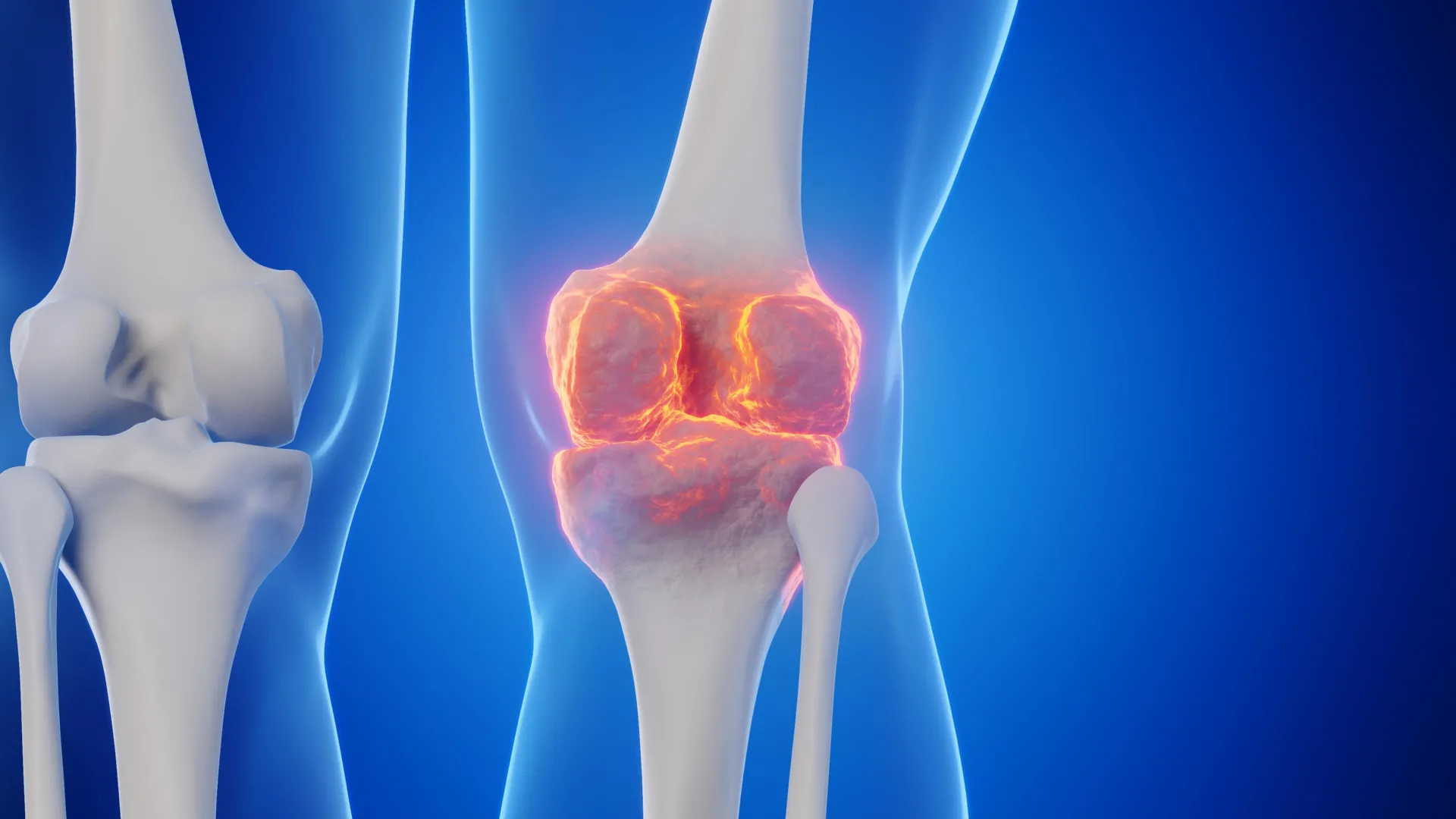
Scientists have identified a way to restore cartilage in aging knee joints, at least in mice, by blocking a protein whose levels rise with age. The approach not only reversed naturally occurring cartilage loss in older animals, but also protected mice from developing arthritis after knee injuries similar to ACL tears in people.
The findings also showed promise in human tissue. Cartilage samples collected during knee replacement surgeries responded to the treatment by beginning to produce new, functional cartilage.
Together, the results suggest that cartilage damaged by aging or arthritis may be more capable of repair than previously thought. If the strategy ultimately works in people, researchers believe it could potentially lead to an oral medicine or injection that regenerates cartilage and reduces the need for knee or hip replacement surgery.
Targeting the damage behind osteoarthritis
Osteoarthritis is a degenerative joint disease in which cartilage gradually breaks down, leaving joints painful, swollen and increasingly difficult to move. It affects about one in five adults in the United States and is estimated to account for roughly $65 billion in direct health care costs each year.
Current treatments mainly focus on controlling pain and other symptoms. Once the disease becomes severe, replacing the damaged joint surgically may be the only remaining option. There is currently no drug that can reliably slow or reverse osteoarthritis itself.
The Stanford Medicine-led study instead focused on a protein called 15-PGDH. The researchers have described it as a gerozyme, a term for enzymes that become more abundant with age and contribute to the gradual loss of tissue function.
Previous work by the same group showed that 15-PGDH acts as an important regulator of aging in multiple tissues. Blocking the protein with a small molecule increased muscle mass and endurance in old mice. Doing the opposite, increasing 15-PGDH in young animals, caused their muscles to shrink and weaken. The protein has also been linked to the regeneration of bone, nerve and blood cells.
In many of those tissues, healing depends on tissue-specific stem cells multiplying and developing into specialized cells. Cartilage turned out to behave differently. Instead of relying on stem cells, existing cartilage cells called chondrocytes changed their patterns of gene activity and shifted toward a more youthful state.
“This is a new way of regenerating adult tissue, and it has significant clinical promise for treating arthritis due to aging or injury,” said Helen Blau, PhD, professor of microbiology and immunology. “We were looking for stem cells, but they are clearly not involved. It’s very exciting.”
Blau, who directs the Baxter Laboratory for Stem Cell Biology and is the Donald E. and Delia B. Baxter Foundation Professor, and Nidhi Bhutani, PhD, associate professor of orthopaedic surgery, are the senior authors of the research, which was published in Science. Instructor of orthopedic surgery Mamta Singla, PhD, and former postdoctoral scholar Yu Xin (Will) Wang, PhD, are the lead authors of the study. Wang is now an assistant professor at the Sanford Burnham Institute in San Diego.
“Dramatic regeneration” of cartilage
“Millions of people suffer from joint pain and swelling as they age,” Bhutani said. “It is a huge unmet medical need. Until now, there has been no drug that directly treats the cause of cartilage loss. But this gerozyme inhibitor causes a dramatic regeneration of cartilage beyond that reported in response to any other drug or intervention.”
Cartilage is not all the same. The human body contains three major types, each designed for a different job.
Elastic cartilage is soft and flexible and helps form structures such as the outer ear. Fibrocartilage is tougher and better suited to absorbing force, including in areas between the vertebrae of the spine. Hyaline cartilage is smooth and slippery, allowing bones to move against one another with very little friction in joints such as the ankles, hips, shoulders and parts of the knee.
In joints, hyaline cartilage is also known as articular cartilage. It is the type most commonly damaged by osteoarthritis.
Osteoarthritis can develop as joints experience stress from aging, injury or obesity. Chondrocytes begin producing inflammatory molecules while also breaking down collagen, a structural protein that gives cartilage much of its strength.
As collagen disappears, cartilage becomes thinner and softer. Inflammation adds swelling and pain, creating the familiar symptoms of osteoarthritis.
The problem is that articular cartilage normally has very little ability to repair itself. Researchers have identified possible stem or progenitor cells capable of forming cartilage in bone, but efforts to find similar cell populations within articular cartilage itself have not been successful.
An aging protein becomes a target
Earlier research from Blau’s laboratory found that a molecule called prostaglandin E2 is important for the function of muscle stem cells. The protein 15-PGDH breaks down prostaglandin E2.
Blocking 15-PGDH, or otherwise raising levels of prostaglandin E2, has been shown to support regeneration in damaged muscle, nerve, bone, colon, liver and blood cells in young mice.
That raised an important question for Blau, Bhutani and their colleagues: Could the same biological pathway contribute to the deterioration of cartilage as animals age or recover from injury?
The researchers compared 15-PGDH levels in knee cartilage from young and old mice. They found that the amount of the gerozyme roughly doubled with age.
They then gave older animals a small molecule drug designed to inhibit 15-PGDH. In one experiment, the drug was injected into the abdomen so it could have effects throughout the body. In another, it was delivered directly into the knee joint.
Both approaches produced striking results.
Cartilage in the knees of older animals had been noticeably thinner and less functional than cartilage in young mice. After treatment, however, it became thicker across the surface of the joint.
Importantly, the cells were making hyaline cartilage, the smooth articular cartilage needed for healthy joint movement, rather than the less suitable fibrocartilage.
“Cartilage regeneration to such an extent in aged mice took us by surprise,” Bhutani said. “The effect was remarkable.”
Protecting knees after ACL injuries
The researchers also tested whether the treatment could help after traumatic knee injuries.
ACL tears are particularly common in sports such as soccer, basketball and skiing, where athletes frequently pivot, stop abruptly or jump. Surgery can repair the torn ligament, but fixing the immediate injury does not necessarily prevent long-term joint damage.
About 50% of people who experience these injuries go on to develop osteoarthritis in the affected joint within approximately 15 years.
In the mouse experiments, researchers administered the gerozyme inhibitor twice a week for four weeks after injury. The treatment dramatically reduced the likelihood that the animals would develop osteoarthritis.
Mice that received a control drug had 15-PGDH levels twice those of animals whose knees had not been injured, and they developed osteoarthritis within four weeks.
The treated mice also moved more normally and placed more weight on the paw attached to the injured leg than untreated animals did.
“Interestingly, prostaglandin E2 has been implicated in inflammation and pain,” Blau said. “But this research shows that, at normal biological levels, small increases in prostaglandin E2 can promote regeneration.”
Making old cartilage cells act younger
To understand what was happening inside the joint, the researchers took a closer look at chondrocytes from young and old mice.
Older cartilage cells showed more activity in genes associated with inflammation and with the unwanted conversion of hyaline cartilage into bone. At the same time, genes involved in normal cartilage development were less active.
Treatment shifted that balance.
One population of old chondrocytes that produced 15-PGDH and expressed genes associated with cartilage degradation dropped from 8% of cells to 3%.
A second population, which did not produce 15-PGDH but expressed genes linked to fibrocartilage formation, fell from 16% to 8%.
Meanwhile, a third group moved sharply in the opposite direction. These cells did not produce 15-PGDH and expressed genes involved in forming hyaline cartilage and maintaining the extracellular matrix needed for healthy cartilage function. Their share increased from 22% to 42%.
The extracellular matrix is the network of proteins and other molecules that surrounds cells and gives tissues their structure. In cartilage, it is especially important because it helps the tissue withstand pressure while maintaining the smooth surface joints need for movement.
Overall, the treatment appeared to push cartilage toward a younger biological state without recruiting stem or progenitor cells.
Human cartilage also responded
The researchers then examined cartilage taken from people with osteoarthritis who were undergoing total knee replacement surgery.
After one week of treatment with the 15-PGDH inhibitor, the human tissue contained fewer chondrocytes expressing 15-PGDH. Activity in genes associated with cartilage degradation and fibrocartilage also declined compared with untreated tissue.
Most notably, the samples began regenerating articular cartilage.
“The mechanism is quite striking and really shifted our perspective about how tissue regeneration can occur,” Bhutani said. “It’s clear that a large pool of already existing cells in cartilage are changing their gene expression patterns. And by targeting these cells for regeneration, we may have an opportunity to have a bigger overall impact clinically.”
The findings do not yet establish that the treatment can regrow cartilage or prevent osteoarthritis in people. The mouse results and experiments on human tissue represent important early evidence, but clinical trials specifically testing cartilage regeneration will be needed to determine whether the approach is safe and effective for patients.
An oral 15-PGDH inhibitor has already reached clinical testing for a different age related problem: muscle weakness.
Blau added, “Phase 1 clinical trials of a 15-PGDH inhibitor for muscle weakness have shown that it is safe and active in healthy volunteers. Our hope is that a similar trial will be launched soon to test its effect in cartilage regeneration. We are very excited about this potential breakthrough. Imagine regrowing existing cartilage and avoiding joint replacement.”
Researchers from the Sanford Burnham Prebys Medical Discovery Institute contributed to the work.
The study was funded by the National Institutes of Health (grants R01AR070864, R01AR077530, R01AG069858 and R00NS120278), the Baxter Foundation for Stem Cell Biology, the Li Ka Shing Foundation, the Stanford Cardiovascular Institute, the Milky Way Research Foundation, the Canadian Institutes of Health Research, a Stanford Translational Research and Applied Medicine Pilot grant, a GlaxoSmithKline Sir James Black Postdoctoral Fellowship, and a Stanford Dean’s Postdoctoral Fellowship.
Blau, Bhutani and other coauthors are inventors on patent applications held by Stanford University involving 15-PGDH inhibition for cartilage and tissue rejuvenation. Those applications are licensed to Epirium Bio. Blau is a cofounder of Myoforte/Epirium and holds equity and stock options in the company.
