


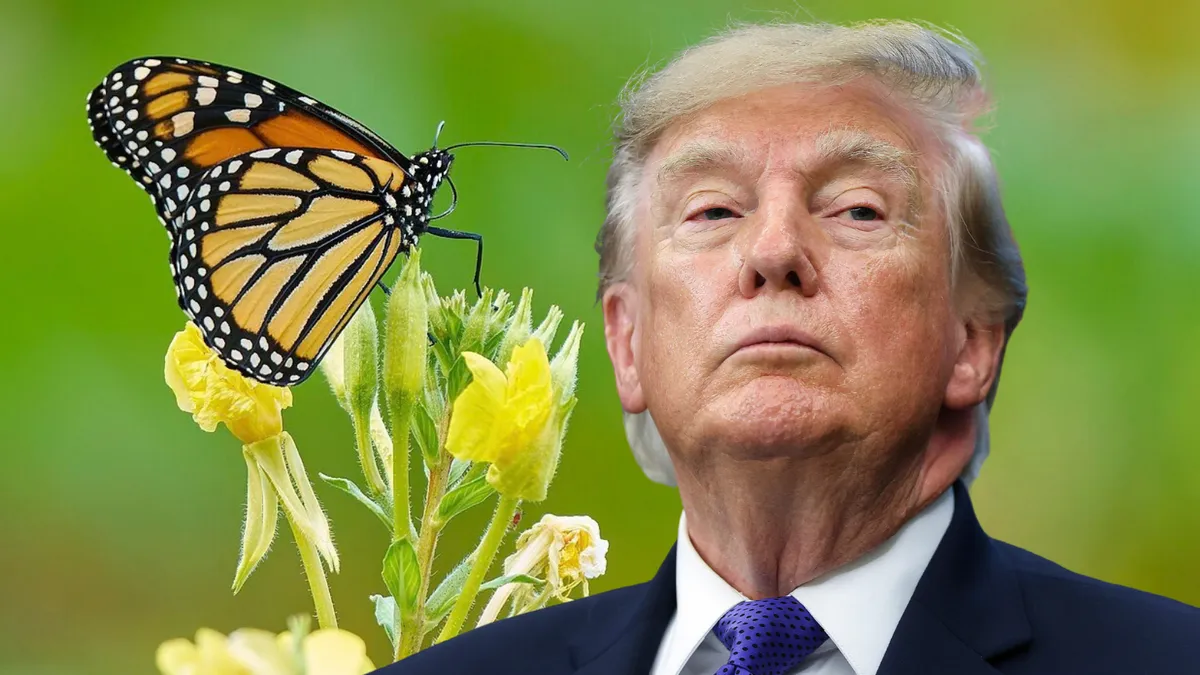
In 2026, U.S. President Donald Trump’s administration denied protections under the Endangered Species Act to monarch butterflies until 2030.
- A rumor spread online in fall 2026 that U.S. President Donald Trump’s administration had formally denied protections for monarch butterflies under the Endangered Species Act until 2030.
- This rumor originates from a September 2026 settlement between conservation groups and the Fish and Wildlife Service over the federal agency’s failure to finalize a policy proposal that would have protected monarch butterflies under the act.
- In December 2024, under then-President Joe Biden’s administration, Fish and Wildlife formally proposed such a rule. Under the act, proposed rules must be finalized within one year. Thus, Trump’s administration was supposed to make a decision by December 2025. It did not, which resulted in the lawsuit.
- The settlement specifies that the Trump administration must finalize the proposal to protect monarch butterflies by June 2030, meaning the administration could technically issue a decision anytime before 2030. However, the Center for Biological Diversity, one of the plaintiffs in the lawsuit, said Fish and Wildlife “asserted that they do not have the resources to issue the final listing before the agreed upon date because of budget and workload.”
- Given that we cannot predict the future, we have rated this claim as a
mixture of truth and undetermined information.
In fall 2026, a rumor spread online that U.S. President Donald Trump’s administration had formally denied protections for monarch butterflies under the Endangered Species Act until 2030.
In other words, posts claimed that the government had refused to designate monarch butterflies as an at-risk species deserving of specific protections under federal law — and that the government would not consider the issue again until 2030.
The claim circulated on Facebook (screenshot) and X.
The claim is largely true, although it omits a few details. On Sept. 30, 2026, the Fish and Wildlife Service reached a settlement with conservation groups, including the Center for Biological Diversity, over a delay on the federal agency’s decision as to whether monarch butterflies should be protected under the Endangered Species Act.
The settlement requires Fish and Wildlife to issue a final decision by June 6, 2030. Technically, that means Fish and Wildlife could issue a decision anytime before that deadline. However, Center for Biological Diversity spokesperson Tierra Curry said Fish and Wildlife “asserted that they do not have the resources to issue the final listing before the agreed upon date because of budget and workload.”
We reached out to Fish and Wildlife to confirm whether this is true and await a response.
It’s also worth noting that Trump is due to leave office in January 2029, so it’s possible that a future administration may prioritize making a decision on monarch butterfly protections before 2030.
Because we can’t predict what the future holds, we have rated this claim as a mixture of truth and undetermined information.
Monarch butterfly conservation
Fish and Wildlife estimates that, by 2080, the probability of extinction for eastern monarchs ranges from 56% to 74% and for western monarchs the probability for extinction is greater than 95%. Threats to the species include loss of habitat, exposure to insecticides and the effects of climate change, the agency said on its monarch butterfly conservation page.
The Endangered Species Act allows the federal government to designate imperiled species as threatened or endangered. Each designation comes with its own protections and resources for conservation.
For more on the Trump administration’s changes to the Endangered Species Act, see our explainer.
Background on conservation efforts
In December 2020, under the first Trump administration, Fish and Wildlife announced that protection for monarch butterflies was “warranted but precluded by work on higher-priority listing actions.”
Fish and Wildlife’s news release on the decision said 161 species were listed as higher priorities for formal protections under the Endangered Species Act ahead of the monarch butterfly.
“With this decision, the monarch becomes a candidate for listing under the Endangered Species Act (ESA), and its status will be reviewed each year until it is no longer a candidate,” then news release said.
Under former President Joe Biden’s administration in December 2024, Fish and Wildlife proposed an official rule that would have designated the monarch butterfly as a protected species under the Endangered Species Act:
We, the U.S. Fish and Wildlife Service (Service), propose to list the monarch butterfly (Danaus plexippus), the iconic orange and black butterfly, as a threatened species and designate critical habitat under the Endangered Species Act of 1973, as amended (Act). We propose to list the monarch butterfly as a threatened species with protective regulations.
Under the Endangered Species Act, Fish and Wildlife is supposed to publish its final decision within one year of publication of a proposed rule, which would put the rule into effect and thus, in this case, officially list the monarch butterfly as an endangered species worthy of protection.
Trump took office January 2025. His administration did not meet that one-year deadline, which prompted the lawsuit from the Center for Biological Diversity and the Center for Food Safety.
What the settlement says
The settlement does not prevent the Trump administration from making a decision before 2030. Here’s what it says on Page 2:
On or before June 6, 2030, the Service shall submit to the Office of the Federal Register for publication a final listing determination for the Monarch Butterfly, pursuant to the ESA, 16 U.S.C. § 1533(b)(6).
Curry, the Center for Biological Diversity spokesperson, said in an email that, in effect, the settlement meant the denial of current protections would end in 2030 with a final listing. The Center for Biological Diversity’s news release about the settlement called it a “bittersweet move for conservation groups.”
In other words, it’s not as if the Trump administration withdrew the proposal to protect monarch butterflies — rather, the settlement means Fish and Wildlife has until 2030 to make a decision on whether to finalize protections for the species.
There are also additional ways, per the settlement, that the deadline to make a decision could be extended. For example, if the government were to shut down due to a lapse in funding before 2030, the deadline would be extended for the number of days the shutdown occurred (see Page 2).
