


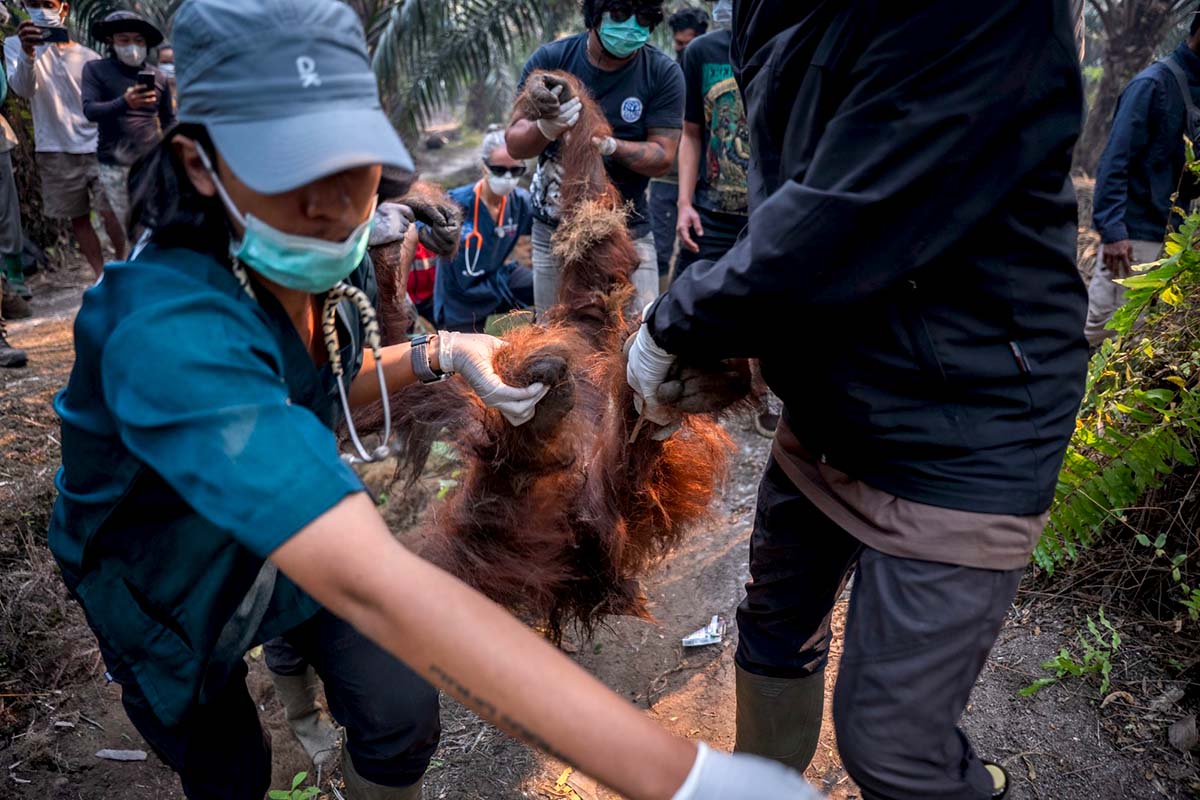
- In Indonesia, fires are burning in rainforests that contain 13 of the 20 largest remaining populations of Bornean orangutan (Pongo pygmaeus).
- Without urgent action, thousands more orangutans could be killed, injured or displaced, warns the IUCN SSC Primate Specialist Group, a network of primatologists, field researchers and conservation experts.
- Actions must include long-term measures, including community-led efforts, beyond emergency firefighting to tackle the fires, say experts.
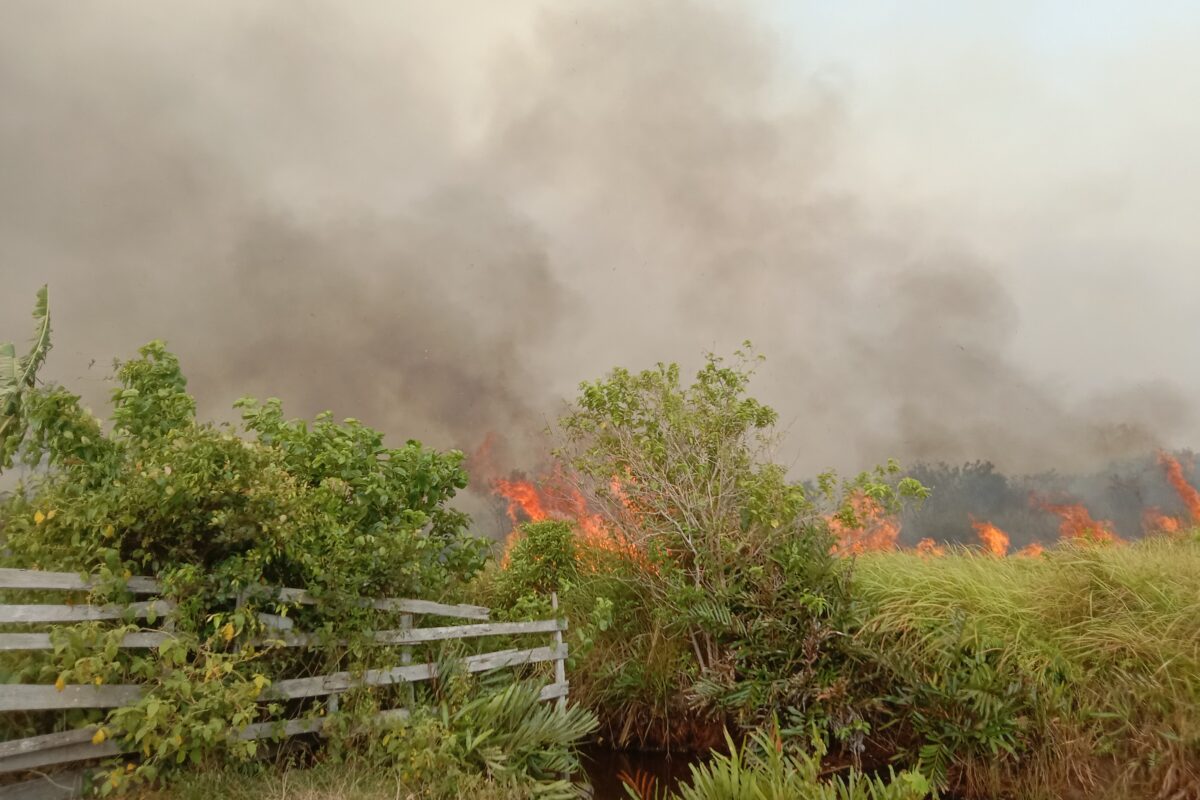
JAKARTA — Fires burning within rainforests that contain more than half of the world’s critically endangered Bornean orangutan population have prompted scientists and experts to call for urgent action in response to the escalating fires across Indonesia.
The warning comes as Indonesia faces a severe fire season fueled by strong El Niño conditions, with conservationists scrambling to rescue wildlife trapped in burning landscapes. Fires are burning in rainforests that contain 13 of the 20 largest remaining populations of Bornean orangutan (Pongo pygmaeus). As of Sept. 22, the Ministry of Forestry reported that 100 wildlife, including 53 Bornean orangutans, had been rescued.
Rescuers have found some orangutans suffering severe physical injuries after escaping the fires. In Central Kalimantan, an approximately 4-year-old orangutan named Novita was found trapped in a burning area near Sebangau National Park in Central Kalimantan province with serious burns on all four hands and feet, according to local news Betahita. She was later taken to a rehabilitation center for treatment.
In locations where orangutans are surrounded by fire and have nowhere to go, they can “literally burn alive,” said Borneo Nature Foundation (BNF) CEO Anton Nurcahyo.
The risk may be particularly high for females with young, Anton told Mongabay. Their tendency to remain in established home ranges can be a disadvantage during fires, while females with young are less able to move quickly when flames spread.
In September, one adult male, found severely weakened and struggling to breathe in an oil palm plantation, died despite emergency treatment, with examination indicating that smoke exposure caused acute oxygen deprivation.
“Without urgent action, thousands more orangutans could be killed, injured or displaced,” says the IUCN SSC Primate Specialist Group, a network of primatologists, field researchers and conservation experts, in a statement.
There is a precedent for such a warning. During the 1997-98 El Niño fires, millions of hectares burned across Borneo and researchers estimated that thousands of orangutans died, possibly as many as one-third of the global population at the time.
The current fires are not necessarily comparable in their eventual extent or impact, and the number of orangutans affected by the 2026 fires is not yet known. But the 1997-98 fires demonstrate the potential scale of losses when severe El Niño-driven fires spread through orangutan habitat.
“I believe that the toll on wild animals being burned, dead, because of the fires is huge,” said Karmele Llano Sanchez, a veterinarian and co-founder and CEO of YIARI — a Borneo-based NGO that works to establish and maintain sustainable orangutan populations, and rescues orangutans and other species from burning forests.
The fires are also not simply a short-term wildlife rescue emergency, the IUCN primate group says: They are destroying a substantial proportion of the remaining habitat of Bornean orangutans, including some of their most important populations.
One of three subspecies found primarily in the forests of southwestern Borneo, Pongo pygmaeus wurmbii or Central Bornean orangutan is particularly threatened, as fires are occurring in habitat containing 70% of its population, the group warns.
“The concerns are that orangutans may die [because of the fires] and [those who survive] have to leave their habitat,” Ronna Saab, executive director of the Indonesian Orangutan Conservation Forum (FORINA), told Mongabay. “The short-term concern is that their shelter will be destroyed.”
Local extinctions
Some of the fires are burning in areas that had previously burned, Anton said.
“There are orangutan habitat rehabilitation sites that have burned again this year, from West Kalimantan to East Kalimantan,” he told Mongabay. “Some have burned completely; others only partially. Therefore, efforts to rehabilitate orangutan habitat are being pushed backward again.”
One affected effort is a decade-long restoration site being prepared for orangutan habitat in West Kalimantan, a province of Kalimantan, the Indonesian part of Borneo. In March 2026, fires burned part of the site, where the government and YIARI, together with local communities, had planted 150,000 trees to restore orangutan habitat.
Repeated fires, like those occurring this year, could lead to what Ronna calls “slow extinction” in some orangutan metapopulations — networks of separated local groups or subpopulations living in different forest patches.
“If this metapopulation continues to burn, there could be local extinction,” Ronna said.
The warning comes as Bornean orangutans remain highly vulnerable to habitat loss and fragmentation. Their population has declined dramatically in the past several decades, while their slow reproductive rate limits their ability to recover from population losses.
Female orangutans have one of the longest birth intervals among mammals: One study suggests they give birth only once every six to eight years. In her lifetime, a female may produce only three or four offspring.
When Borneo’s tropical rainforests are cleared or fragmented for industrial agriculture such as oil palm plantations, logging and mining, the remaining forest is divided into isolated “islands”. As a result, orangutans often live in isolated forest patches rather than in one continuous jungle.
Ronna said some metapopulations identified in earlier assessments can no longer be found in recent surveys. In one location, researchers found only a single nest and no orangutans, while local residents said they had not seen the animals there again.
These observations do not by themselves establish that a metapopulation has gone extinct, but Ronna said the findings would be considered as part of an ongoing Population and Habitat Viability Assessment (PHVA) which examines the status and viability of orangutan metapopulations.

National parks on fire
Orangutans rely primarily on lowland forests for their survival. The IUCN SSC Primate Specialist Group says every protected area in Kalimantan’s lowlands has reported fires within its borders.
Fires are burning within the boundaries of the three national parks with the largest orangutan populations in Kalimantan — Sebangau, Gunung Palung and Tanjung Puting — each containing large expanses of globally important carbon-rich peat-swamp forests.
BNF’s Anton said the extent to which fires had penetrated orangutan habitat varied between protected areas. In Sebangau National Park, fires remained largely along the edges, he said, while fires had already entered Gunung Palung National Park in West Kalimantan and Tanjung Puting National Park in Central Kalimantan.
More than 4,500 hectares (11,100 acres) had burned in Tanjung Puting by Sept. 13, according to official data.
The fires threaten long-term research and conservation infrastructure, with flames approaching orangutan research stations.
In September, fire had advanced to within 200 meters (656 feet) of the Rangkong Research Station in Gunung Palung National Park and 150 m (492 ft) of the Tuanan Orangutan Research Station, while teams were standing by at stations in Sebangau and Lamandau, a wildlife reserve also in Central Kalimantan.
Rescued orangutans in rehabilitation and reintroduction centers are also under threat.
In July in West Kalimantan, fires approached within 100 m (328 ft) of a facility run by YIARI, where more than 60 orangutans are undergoing rehabilitation after being rescued from the illegal wildlife trade and habitat loss.
Meanwhile, fires have burned close to Indonesia’s largest orangutan care facility operated by the Borneo Orangutan Survival (BOS) Foundation in Central Kalimantan. According to the BOS Foundation, 21 orangutans at the facility have shown respiratory symptoms including coughing, sneezing and nasal discharge.

Outside protected areas
The conservationists warn that the situation outside protected areas is even more concerning.
Almost half of all wild orangutans live in unprotected forests managed for timber extraction, ecosystem restoration and areas zoned as High Conservation Value or HCV, according to the IUCN’s statement. Other sources estimate a higher figure.
Across Borneo, these forests are also burning, including peat forests in the Mendawak Biodiversity Corridor in West Kalimantan, a crucial refuge and corridor for orangutans.
Hotspots have been detected in orangutan habitat within company concessions.
One of them is in a concession managed by forestry company PT Mohairson Pawan Khatulistiwa (Mopakha), which manages 36,973 hectares (91,362 acres), including peat forests, in Ketapang district, West Kalimantan.
There are more than 660 orangutans inside the concession, according to the company.
In 2017, the Indonesian government sanctioned Mopakha over the construction of 8.1 kilometers (5 miles) of canals in peatlands within the concession. Such drainage can lower water levels in peat and increase its vulnerability to fire.
In 2026, fires have burned at least 1,800 hectares (4,450 acres) in Mopakha’s concession, according to data from forest monitoring platform Nusantara Atlas.
In August, the government froze the company’s license, citing repeated burning in the concession.
In 2026, fire has also burned inside palm oil plantation PT Kayung Agro Lestari (KAL), home to around 60 orangutans.
Satellite analysis shared with Mongabay by technology consultancy TheTreeMap, which runs Nusantara Atlas, found that a peat-swamp forest that provided orangutan habitat within the concession had been almost completely affected by fire.
First Resources, the Singapore-listed parent company of KAL, told Mongabay it enforces a zero-burning policy across its plantations and operates an integrated fire-management program that includes fire-prone maps, daily satellite monitoring, drone surveillance, ground patrols, firefighting teams and peatland water management.
First Resources disputed any suggestion that it had neglected the conservation areas, saying its conservation team had supported government authorities and other partners in monitoring wildlife and evacuating orangutans from the affected area.
For BNF’s Anton, these fires emphasize the challenges that unprotected areas face.
Protected areas such as national parks have a clear management authority, funding and, usually, conservation partners helping the government protect them, but unprotected areas often don’t, Anton said.

Long-term effects
The effects of the fires on orangutans could persist long after the flames disappear, with studies identifying physiological and ecological consequences.
Smoke from fires can physically weaken orangutans through damage to their respiratory systems.
Smoke exposure has also been linked to a 2.5-fold increase in hookworm infection intensity, alongside higher prevalence of two other intestinal parasites, according to research on wild Bornean orangutans. Orangutans with high levels of parasitic infections can suffer from severe anemia and weakness.
During haze periods, orangutans have been observed to rest more and travel less to conserve energy. Yet they still show ketosis, a sign of increased fat breakdown, despite eating more.
Researchers suggested that the additional energy demands may be related to the immune response to smoke exposure.
Orangutans can also experience an energy crisis when fires destroy food-producing trees. This could lead to a decline in reproduction, which is already slow, Ronna said.
Fire-damaged forest structure can also increase the energetic cost of moving through the canopy, as orangutans have to expend more energy navigating damaged forest.
The long-term effects on forests are also significant.
Compared with unburned forest, burned areas can experience a 58%-98% decline in habitat structure, tree density and canopy cover, while becoming hotter, drier and increasingly dominated by fast-growing, fire-adapted plants rather than native trees.
Recovery is slow and partial. Some structural features, such as canopy height, have showed signs of improvement within a decade, but tree diversity remained suppressed even 12 years after burning, according to a 2024 study. Repeated fires could therefore lock forests into a degraded state.

Not enough
With fires expected to continue until rains return in late October or November, the government continues to deploy resources to combat them.
Since August, the government has deployed 64 aircraft and more than 54,000 personnel.
The IUCN SSC Primate Specialist Group recognizes the extraordinary efforts of government agencies, firefighters, local communities, conservation organizations, wildlife-response teams and researchers responding to the emergency.
“The people on the ground are accomplishing an extraordinary amount with the resources they have,” said Caitlin O’Connell, deputy director of the Gunung Palung Orangutan Conservation Program. “But they cannot fight fires of this scale alone. They urgently need greater assistance to stop these fires before even more irreplaceable rainforest and orangutan habitat is lost.”
The group is calling for greater technical and financial support from the international community to immediately strengthen firefighting operations, protect frontline teams, support affected communities and wildlife, and prevent the fires from spreading further into irreplaceable forests.
But putting out fires is only the immediate response. It does not restore a burned peat forest, reconnect fragmented canopy, restore food supplies or undo the physiological effects of smoke, the group points out.
That’s why emergency action must be followed by sustained investment in prevention, the group says.
The group also says it is important to invest in protecting and rewetting tropical peatlands, as fires are many times more likely to recur in previously burned land than in forested habitat.
“The underlying causes of peatland fires must be addressed, including drainage and deforestation, the expansion of plantation agriculture and artisanal mining in high-risk areas, and the use of fire to clear agricultural land,” the group says.
Indonesian President Prabowo Subianto recently acknowledged the importance of protecting and restoring peatlands to prevent fires, with a plan to create a new agency to restore and manage peatlands prone to burning.
It echoes a measure the government took in response to the severe fire season of 2015.
The government is currently drafting a regulation that will serve as the legal basis for establishing the new agency.
Go beyond planting trees
BNF’s Anton said international support for restoration should go beyond replanting burned forests. Projects should also build the conditions needed to prevent restored areas from burning again, including firefighting infrastructure, community patrols, stronger coordination among government agencies and communities, and solutions to land-tenure problems.
“Restoration should not simply mean restoring areas that have already burned,” he said. “They need to make sure that the trees planted today won’t burn five years from now.”
BNF has used community-based fire patrols as part of its fire-prevention work around Sebangau National Park.
Since 2016, the organization has supported community patrols in areas that historically recorded high numbers of hotspots.
BNF now supports nine community groups with 138 members, Anton said. The groups patrol for 16 days a month, with BNF covering their logistics and daily expenses.
The number of hotspots in the patrol areas has declined, according to Anton, but they remain relatively high, he said. BNF also compared burned areas in locations where it had established patrols with villages where it had not established fire-prevention activities. Villages with historically low numbers of hotspots remained relatively low, Anton said, but their total burned area was five times larger than in the areas where BNF had intervened.
Anton said the experience also shows why international funding for fire prevention should cover the ongoing costs of community patrols, rather than focusing only on emergency firefighting once fires have started.
“Protecting Indonesia’s forests and peatlands protects both apes and the people who share these landscapes,” he said. “Climate change is here, and we will face more devastating fires in the future. We must build resilience and have effective systems in place to prevent further forest loss.”
Citations:
Kuze, N., Sipangkui, S., Malim, T. P., Bernard, H., Ambu, L. N., & Kohshima, S. (2008). Reproductive parameters over a 37-year period of free-ranging female Borneo orangutans at Sepilok orangutan rehabilitation centre. Primates, 49(2), 126-134. doi:10.1007/s10329-008-0080-7
Gwynn, A. L., Morrogh-Bernard, H. C., Thornton, A., Segah, H., Azis, A., & Van Veen, F. J. (2024). Gastrointestinal parasites of wild Bornean orang-utans (Pongo pygmaeus) in a habitat affected by wildfire smoke. Global Ecology and Conservation, 55, e03214. doi:10.1016/j.gecco.2024.e03214
Erb, W. M., Barrow, E. J., Hofner, A. N., Utami-Atmoko, S. S., & Vogel, E. R. (2018). Wildfire smoke impacts activity and energetics of wild Bornean orangutans. Scientific Reports, 8(1). doi:10.1038/s41598-018-25847-1
Widyastuti, K., Reuillon, R., Chapron, P., Abdussalam, W., Nasir, D., Harrison, M. E., … Berger, U. (2022). Assessing the impact of forest structure disturbances on the arboreal movement and energetics of orangutans—An agent-based modeling approach. Frontiers in Ecology and Evolution, 10. doi:10.3389/fevo.2022.983337
Harrison, M. E., Deere, N. J., Imron, M. A., Nasir, D., Asti, H. A., Aragay Soler, J. … Struebig, M. J. (2024). Impacts of fire and prospects for recovery in a tropical peat forest ecosystem, PNAS, 121(17) e2307216121. doi:10.1073/pnas.2307216121
Banner image: An orangutan rescued in Kalimantan amid ongoing fires in Indonesia in 2026. So far, the team from YIARI have rescued 43 orangutans from forest fires. Image courtesy of YIARI.
FEEDBACK: Use this form to send a message to the author of this post. If you want to post a public comment, you can do that at the bottom of the page.

