


Sometimes, when policymakers, activists, and interest groups are failing to move the needle, popular culture can create the kind of pressure that is necessary for political change.
This is certainly part of the hope behind the new documentary The AI Doc: Or How I Became An Apocaloptimist. The filmmakers have decided that the best way to reach broad audiences about the dangers posed by artificial intelligence is through movies. Though the film is a documentary, Tristan Harris, co-founder of the Center for Humane Technology, has explained in interviews that a model for this project was, The Day After, a fictional film about nuclear war that aired on ABC in 1983. The movie, Harris said, was “an example of the power that a film can have to nudge the world in a different direction.”
Rather than focusing on the halls of Congress or the seminar rooms of Washington think tanks, Harris—who is interviewed in the film—understands that changing public opinion requires movies, television, social media clips, and other forms of cultural outreach. These are the spaces where it might still be possible to reach Americans.
The AI Doc, directed by Daniel Roher and Charlie Tyrell, sounds the alarm on the dangers we all face. The point of the film is not to dismiss the immense benefits that AI is already bringing, but to force an important conversation—one that has recently rapidly intensified in U.S. politics as a result of citizen activism and industry figures going public with their concerns—about what could happen if its development remains unchecked. Last month, the film was screened for members of Congress and their staffs.
The strategy behind the documentary builds on important precedents. The Day After, along with a film about computers released that same year, offers evidence of how the arts, whether documentaries or fictional productions, can exert a powerful influence on the public and even on policymakers.
The early 1980s was a frightening time for many Americans. During his first term, President Ronald Reagan had ramped up defense spending as part of his promise to take a tougher stance against the Soviet Union, in contrast to previous presidents who, Reagan argued, had placed too much faith in detente and its arms control agreements. He insisted that peace could only be achieved through strength. The president used harsh rhetoric against the USSR, calling it “the focus of evil in the modern world” in a famous 1983 speech, and considered it a nation that could not be trusted. When tensions rose in 1982 over missiles in Europe, an international nuclear freeze movement mobilized to protest, rally, and raise awareness of how close the world was moving toward nuclear war.
Several incidents in 1983 heightened fears, as the political scientist Beth Fischer recounted in her classic work, The Reagan Reversal. The Soviet shootdown of a South Korean passenger airliner in September had intensified tensions between the superpowers, so much so that Reagan was the one pushing back against hard-liners in his own party who wanted to impose strict strategic or military-related measures. Although Secretary of State George Shultz was a powerful voice of diplomacy within the administration, much of Reagan’s first term had been characterized by confrontation. The level of tension became especially apparent in November, when NATO conducted Able Archer 83, an exercise stimulating the escalation of a conventional conflict into a nuclear war. The exercise alarmed already anxious Soviet officials, some of whom feared it was cover for an actual attack, prompting the Soviet military to place air units on high alert.
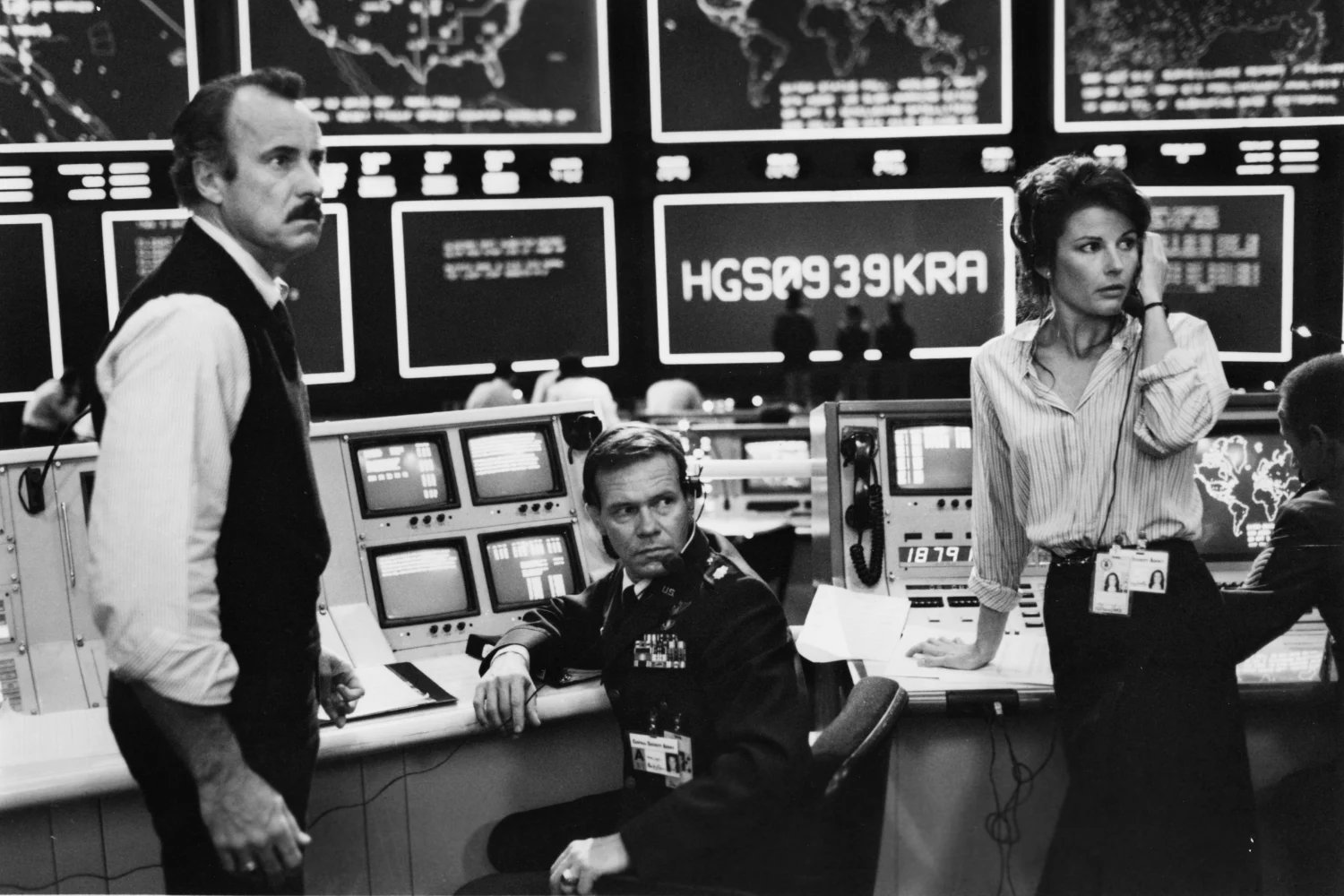
One movie, WarGames, brought to light the dangers of computers in this new nuclear age. In 1983, personal computers were becoming an increasingly prominent feature in U.S. households. While mainframe computers had been around since World War II and were used primarily by large businesses and the federal government, computing became far more accessible during the late 1970s and early 1980s with the rise of the personal computer.
Apple had introduced its easy-to-use models for home users, starting with the Apple I in 1976 and then a more consumer-friendly Apple II one year later, which featured a built-in keyboard and could show color graphics. The company was planning to unveil the MacIntosh in 1984. The MacIntosh featured a mouse that allowed users to interact with the computer by moving a pointer around the screen instead of relying on typed commands—no technical proficiency required. Other companies were also entering the growing market for personal computers in homes and businesses, most notably IBM with the IBM PC in 1981.
Alongside the spread of personal computers, Americans were discovering new ways to connect to online services. In 1979, CompuServe began offering consumers online service, allowing users to dial in over telephone lines to send messages, participate in electronic bulletin boards, read news, and access other kinds of information.
But new technology always raises concerns about new kinds of dangers. At a time when most Americans were just gaining their footing with the personal and interconnected computers, a major Hollywood movie helped ordinary viewers imagine some of the problems that the new technology might create.
In June 1983, audiences filled movie theaters to see WarGames, directed by John Badham, in which Matthew Broderick plays David Lightman, a smart, middle-class high-school student from Seattle.
The story revolves around Lightman, along with his friend Jennifer Mack, played by Ally Sheedy, as he tracks down cutting-edge video games by dialing telephone numbers in search of computer systems. This was the frontier of computer technology. Lightman hacks into a computer that he believes contains unreleased games, but that is in fact a military supercomputer running the War Operation Plan Response. Lightman shares with his friend a fascination with smart computer—designed by someone named Stephen Falken, whom he believes to be dead—that were capable of learning from experience. As he explains to her, Falken “designed his computer so that it can learn from its own mistakes … it could teach itself.”
After the computer tries to persuade David to play a conventional game, the teenager insists on something called “Global Thermonuclear War.” The game leads the military computer to simulate a Soviet nuclear attack. Terrified, military officials initially mistake the game for the real thing. The FBI arrests David while the entire situation spins into a dangerous crisis. The military computer eventually begins trying to obtain the codes that would enable it to launch a nuclear strike. The countdown to nuclear holocaust has begun. In the end, David saves the day by capitalizing on the ability of the machine to learn from experience by teaching it through the game of tic-tac-toe that some kinds of competition produce no winners.
The movie became part of a national conversation about the need to take seriously the national security threats posed by computers. “There are scary stories, and there are scary stories,” noted the Philadelphia Tribune. “What makes this one so scary is that it’s possible.” The very same machines that could open up worlds of knowledge and allow for instant communication could also threaten catastrophic consequences. For the press, the public, and among policymakers, WarGames raised difficult questions about what safeguards were needed to prevent anything resembling the catastrophic scenario imagined by the filmmakers.
Reagan, a former actor, was especially shaken after watching the movie at Camp David. Several days later, Reagan asked John Vessey, chairman of the Joint Chiefs of Staff, whether “something like this” could “really happen?” Vessey returned with the answer: “Mr. President, the problem is much worse than you think.” In 1984, the president issued National Security Decision Directive 145, which focused on strengthening the security of the nation’s computer and telecommunications systems.
Just a few months later, another movie—centered on the effects of war—stirred the national consciousness. On Nov. 20, ABC aired The Day After.
Better than any speech, the film captured the fears running through the U.S. public. Before it aired, schools organized discussions to prepare children for what they would see. Americans watched the movie in groups at colleges, schools, churches, and other civic institutions. In one scene, a mother peers out of her window to see ICBMs being launched while her little children, who were frolicking on the lawn, look on. When the bombs hit the town, a boy and his father are vaporized while standing in the field. The final part of the movie shows a town filled with graves, corpses, and a handful of people who have survived. “The picture of a post-apocalyptic world is unrelentingly bleak, as depressing as anything ever depicted in a television drama,” observed Tom Shales in the Washington Post.
The movie, viewed by over 100 million people (and aired without any commercial breaks during the final hour), depicted what the aftermath of a nuclear war might look like in a small town in Kansas. Four students at a school in Poughkeepsie, New York, watched it with their advisor; one “leaned away from the screen” when the movie showed the bombs falling, while “others curled into a fetal position. There was disbelief,” the Los Angeles Times reported. After the movie aired, White House phone lines were jammed, as so many people called in to express their fear. The images were terrifying. Reagan wrote in his diary that “it’s very effective and left me greatly depressed.” His administration sent out spokespeople to respond to it and speak to live audiences. In a special ABC broadcast immediately following the film, Shultz said that “nuclear war is simply not acceptable.”
In the years that followed, Reagan underwent a dramatic shift. The president tempered his rhetoric toward the Soviet Union, placing greater emphasis on “peace” in his mantra of “peace through strength.” Between 1985 and 1987, he participated in a historic series of summits with Soviet leader Mikhail Gorbachev that culminated in the signing of the Intermediate-Range Nuclear Forces Treaty, which eliminated an entire class of missiles, setting the stage for the end of the Cold War.
Many factors contributed to Reagan’s change of heart, including his long-standing belief in nuclear abolition. But The Day After was part of the broader public pressure to step back from the confrontational posture that characterized his first years in office.
In 1983, movies became an important part of the national political conversation.
With the new AI documentary, the world of culture is once again attempting to educate and inform—and, in some ways, alarm—the public about a new technology that is quickly reshaping U.S. society. The film seeks to make clear the risks the world could face if the companies building AI are allowed to continue developing it in an unfettered, unregulated marketplace. Indeed, the sense of urgency is heightened by the fact that some of the most prominent figures in the AI industry itself are sounding the alarm.
While it is harder for any piece of cultural content to command national attention in the way movies could in 1983, or even when Al Gore’s documentary An Inconvenient Truth came out in 2006, culture still has immense power to capture the public imagination. At a time when Americans distrust almost every institution, from government to science to the media, they remain enthralled by what they watch. There is a reason that dinner-table conversations so often revolve around the latest streaming television show: Popular culture allows discussions that, at least on the surface, avoid the more divisive conversations about what is happening in Washington. Yet those very shows are often a way into certain topics. That makes culture valuable real estate, a place where filmmakers and other artists can still influence how Americans understand new technologies and perhaps help move the country toward a better approach to AI.
