


- Hong Kong’s heat stress warning system has been widely criticized as ineffective, failing to raise alerts even when temperatures hit a record high.
- Although the system has since been revamped, critics say the government’s heat stress guidelines to protect workers are flawed.
- Unlike mainland China and other countries, Hong Kong doesn’t require employers to stop high-risk work or let workers rest when heat warnings are issued.
- Workers’ rights advocates also urge authorities to codify heatstroke as an occupational disease.
HONG KONG — On a mid-September day, Wong Ping-kuong, 74, and his colleagues worked quickly to spray clean an outdoor staircase and elevator landing. It was only mid-morning, but already hot. The temperature later rose to 31°Celsius (87.8°Fahrenheit).
Wong has felt the impact of climate change in the half-century that he has worked as a construction worker and later an outdoor cleaner.
“It’s gotten hotter. Before, I didn’t sweat; now my back is often covered with sweat,” he told Mongabay.
Wong and his colleagues consider themselves lucky. They say when temperatures are high, they can go inside their truck, turn on the AC, and cool down a little.
However, heatstroke can occur quickly, setting in within 10-15 minutes. Outdoor workers like Wong are exposed to increasing risks of heat-stress-related health problems, such as dizziness, headache, nausea, heatstroke, or acutely worsening pre-existing chronic conditions such as cardiovascular and respiratory diseases.
Like many places around the world, Hong Kong is suffering from extreme temperatures. Official figures show it is warming by nearly half a degree Celsius per decade. The city also experiences longer and hotter summer months, with the number of “very hot days” quadrupling since the 2000s, data from the Hong Kong Observatory (HKO) shows.
On Aug. 9, HKO logged 36.9°C (98.4°F), the highest temperature at its main monitoring station since record-keeping began in 1884. In the outskirts of Hong Kong, the weather service measured even higher temperatures that day: 39.8°C (103.6°F) — another record.
Unlike other developed economies, Hong Kong lacks a law mandating work stoppage or breaks, even when temperatures reach record highs. And despite the health hazard, workers have little choice. “We have to work no matter how hot it gets,” Wong said.
Flawed warning system
Hong Kong has tens of thousands of outdoor workers, among them around 114,000 construction workers, 12,900 food delivery workers and 13,200 government street cleaners.
The city’s Heat Stress at Work Warning system, introduced in 2023, is supposed to protect workers working in high-temperature environments by issuing warnings about the risks of heat stress when temperatures reach dangerously high levels.
It uses a three-tier color-coded system — amber, red and black — to signify “high,” “very high,” and “extremely high” levels of heat stress.
Employers are advised to follow government guidelines to reduce heat stress for workers when the alerts are issued, including allowing them to rest, providing adequate water and shelter from the sun, adjusting and even suspending duties for those with very heavy workloads.
However, the system has proven to be ineffective. It has issued only the amber warning, never the red and black alerts, despite record-breaking temperatures, including on Aug. 9.
In response to criticism, the government revised the warning system in late August, lowering the threshold and introducing automated triggers to issue alerts.
However, workers’ rights groups say it remains flawed because government guidelines for reducing heat stress when the alerts are issued are not legally binding.
“The Labour Department is not moving fast enough, not doing enough,” said Fay Siu, chief executive of the Association for the Rights of Industrial Accident Victims (ARIAV).

“It’s just an appeal, encouragement; there’s no law. If employers say they can’t do these things, then there’s no legal violation, and there’s no stipulated punishment,” she said.
Sabrina Wan, chief executive of Hong Kong Workers’ Health Centre, agreed.
While major construction sites do follow at least some of the guidelines, the system gives employers leeway to ignore the government’s recommendations and leaves workers without leverage, she said.
“We hear from workers that they are scared to rest because they might be accused of being lazy,” Wan said. “It could affect their work, or they could be scolded by employers.”
She added: “The government will only pursue responsibility if something bad happens to workers.”
Heat-related injuries and deaths
According to the Labour Department, 76 workers suffered from heatstroke or heat stress from 2022 to 2024. One of those workers died.
But rights groups believe the actual number could be higher because many workers simply return to work after being treated at hospitals and don’t report the incidents.
Some cases might not be categorized as heatstroke even if they are. “They would call it a personal pre-existing disease or sudden illness,” Siu said.
ARIAV recorded four deaths suspected to be from heatstroke each in 2024 and 2025 and three so far this year. Siu said the figures were based on interviews with family members, taking into account whether the worker suffered from long-term illness and considerations of the temperature, workload, outdoor nature of work and workers’ health.
This year’s survey by the Service Industry General Union found that nearly two-fifths of outdoor workers had to work outdoors for more than four hours without additional rest or heat-protection equipment when the HKO’s “very hot weather” warnings were in effect. The union said many workers reported suffering from heatstroke symptoms, with some requiring hospitalization.
Big construction sites with many workers tend to provide shaded shelters, water and fans, Wan said, adding that some might even provide iced towels and ventilation outfits to their workers.
“Workers in smaller companies, as well as subcontracted or independent cleaners or gardeners, however, are overlooked,” she said.
K.C. Law, a contractor who hires day workers to do home demolition and remodeling, admitted mandating rest time would be a burden for small companies like his.

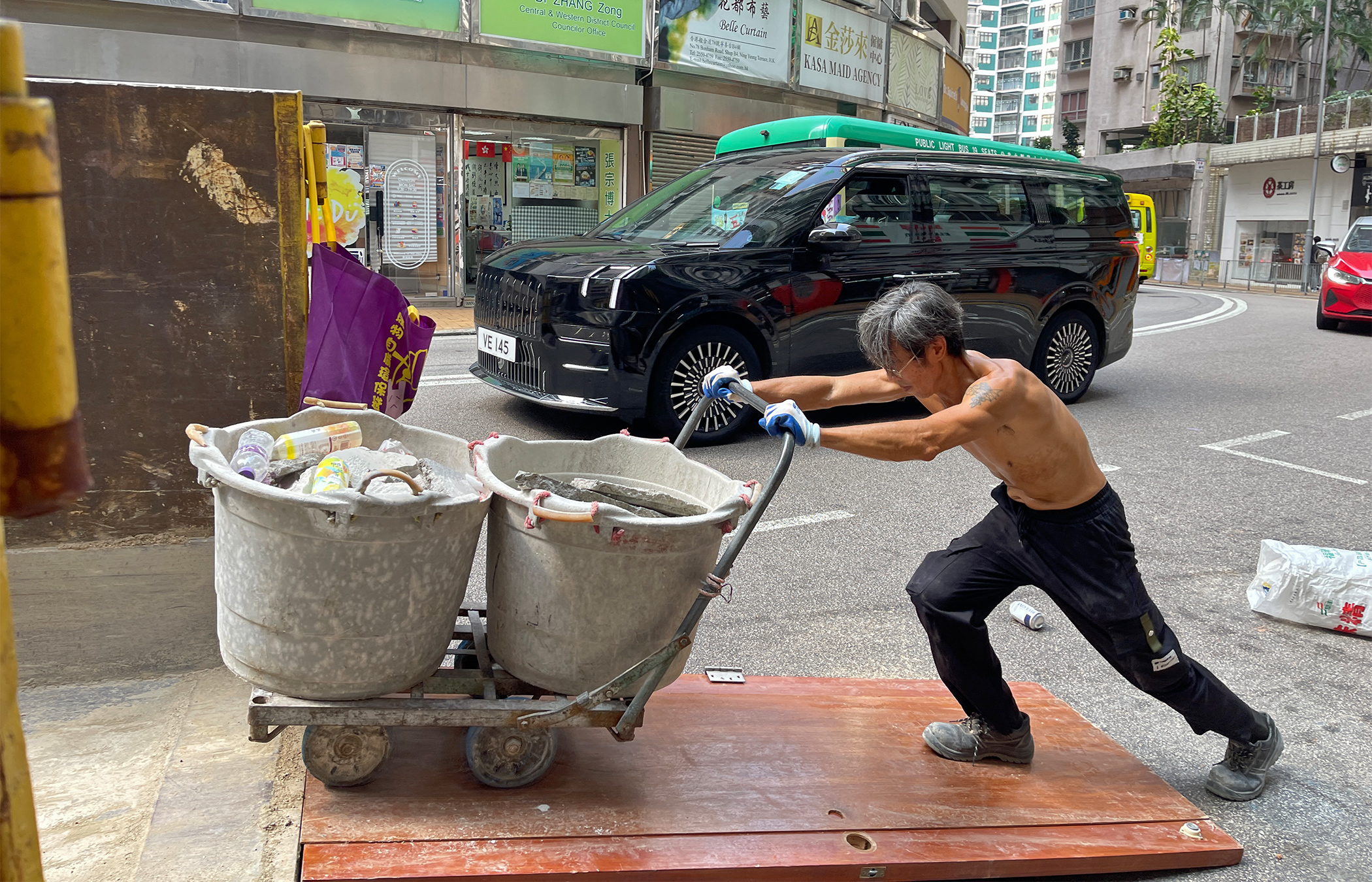
As he spoke to Mongabay, two of his workers, one bare-chested and covered in sweat, hauled construction wagons full of rubble onto an outdoor dumpster.
“I have a fan for each worker,” Law said. “It follows them wherever they work in different parts of the flats. I’ve been doing this for two to three years.”
He added that he also provides large crates of bottled water for his workers. “If you’re tired, drink water, take a break, it’s OK,” he said. “I can tell who is hardworking and who is lazy. If they’re lazy, I won’t hire them again.”
Push for further improvement
ARIAV is urging the Labour Department to codify heatstroke as an occupational disease.
“Right now, insurance companies won’t pay. Families have to file a lawsuit. So, this prevents workers and families from pursuing their rights,” Siu said.
“If it’s codified as an occupational disease, and it’s shown that under yellow, red, black alerts, the worker had been working for a number of hours, then it’s easier for them to seek compensation.”

Some countries, such as Qatar, Spain, Germany and Japan, have legally binding guidelines to protect workers, such as banning outdoor work during the midday in hot seasons, requiring employers to adopt cooling and other mitigation measures such as structured rest cycles, or even granting paid leave when extreme temperatures pose health hazards. Penalties and fines are imposed on employers who fail to comply.
Across the border in mainland China, regulations adopted in 2012 stipulate time limits and actions for outdoor open-air operations under different high-temperature weather conditions, ranging from shortening continuous working hours to stopping operations.
“In mainland China, they even list heatstroke as an occupational disease. Workers can claim disability, but not in Hong Kong,” Wan said.
Hong Kong’s Labour Department did not respond to Mangabay’s requests for comment.
However, in a press statement, published on Aug. 27, when it announced the revamped warning system, it repeated its list of recommendations to employers and employees.
It reminded employers that they may face prosecution “if they endanger the health of employees without providing suitable heat stroke prevention measures.” It said it would conduct inspections and issue warnings to employers at high-risk workplaces to ensure they safeguard the occupational safety and health (OSH) of employees.
It also advised employees to call the department’s OSH complaint hotline or submit an online complaint, if necessary.
For many workers, however, the government’s heat alerts and subsequent action or inaction are far from their minds.
“We only care about getting paid, having a job. We can’t think of that much more,” Wong’s younger colleague said before rushing off to clean another staircase.
To rights groups, this is why those who can’t afford to think beyond holding onto their jobs need help from the authorities to protect their health and well-being.
Banner image: An apartment demolition and remodeling worker pushes a cart loaded with rubble in Hong Kong on Sept. 18, 2026. Image by June Wong for Mongabay.
Six things to know about Asia’s heatwave and the health impacts
World must look to the past to prepare for likely unprecedented El Niño
Cite this article
June Wong (2026). As Hong Kong heats up, calls grow for tougher rules to protect outdoor workers. Mongabay Conservation news. DOI: https://doi.org/10.66709/news-331482

