


How much can a Labour government change the country? According to many voters, journalists and politicians, including plenty in the party itself, the answer to that stubbornly recurring question has always been: not that much. Labour governments can’t restructure the economy, radically redistribute wealth, truly empower the disadvantaged or adopt a genuinely ethical foreign policy without upsetting too many powerful interests, from the British rich to the US government to global financial markets.
This endlessly repeated conventional wisdom – internalised by some on the left as well as centrists and the right – has haunted many Labour governments, from the first, tentative ones in the 1920s to Keir Starmer’s diligent but failed administration a century later. Yet conventional wisdom can be wrong, especially in volatile periods such as the current one, when precedent may count for little.
At last year’s Labour conference, Andy Burnham was widely derided for what was seen as a half-launched and clumsy leadership coup attempt. Much of the media and Starmer’s cabinet reckoned his chances of being prime minister were gone for good. Yet, at this week’s unusually packed and perhaps unwisely optimistic gathering, Burnham’s can-do presence was almost as dominant as Tony Blair’s in his early leadership years: a constant point of reference, from the main hall to the merch stands to leftwing fringe events.
Moreover, Burnham appears to want to use his personal dominance – which may well be briefer than Blair’s, given Labour’s more fragile position in a more fragmented politics – to open up an array of huge issues that his party has long been advised to keep closed. Electoral reform, social care, public intervention in failing privatised utilities, the pension triple lock, even rejoining the EU: announcements about exploring or pursuing all these punctuated his conference speech, in a sequence of softly voiced political shocks.
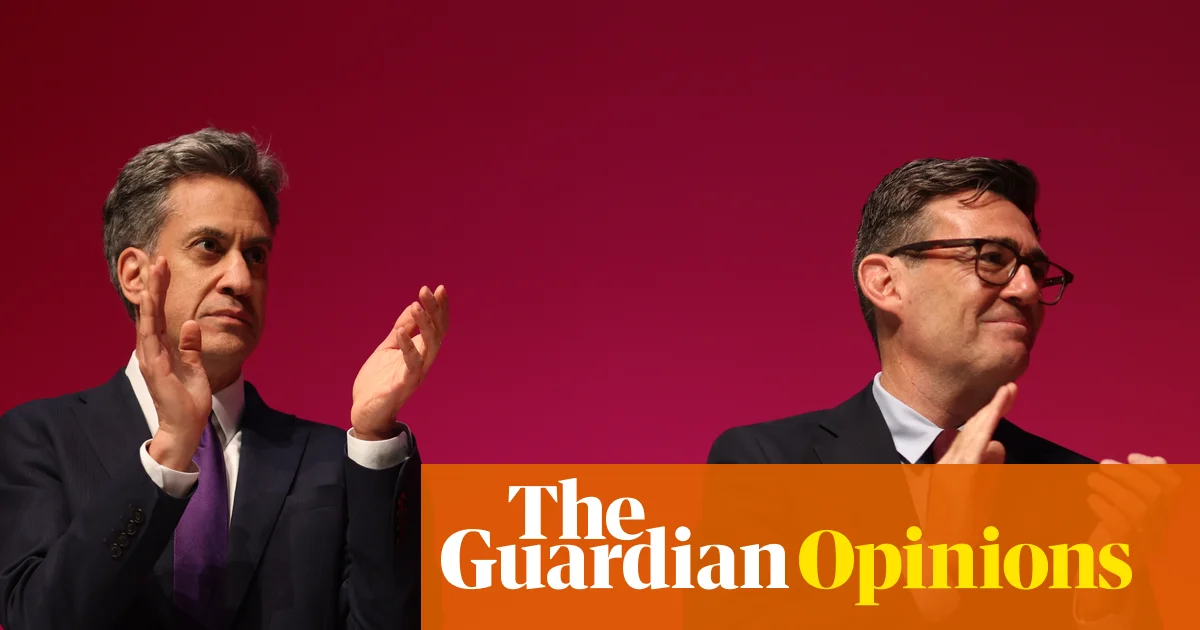
“Change will be difficult,” he acknowledged. But he insisted: “More of the same isn’t good enough.” At an excited fringe event the night before, his ally Ed Miliband, the foreign secretary, who in that job and his previous one as energy secretary has pioneered Labour’s unexpected recent interest in confronting difficult problems and dangerous interests, summed up the party’s defiant new mood. “All politics is a risk. Progressive politics is a particular risk,” he said with relish. Burnham might have similar charisma and communication skills to Blair in the 1990s, but New Labour ministers did not dare say such provocative things.
Defenders of that now remote-seeming political culture would argue that avoiding head-on clashes was one of the reasons Blair was twice re-elected. But Burnham, who served in the Blair government at a formative age, does also have a strong conciliatory impulse, such as his frequently stated keenness to cooperate with other parties. However, as with his reluctance to criticise them by name – his conference speech was almost completely free of the usual party-political attacks – this apparent absence of aggression is in one sense the opposite: a determined attempt to break with the ultra-partisan politics of the post-Brexit decade that has excited many journalists but increasingly exhausted and alienated the public.
Burnham might come across as a nice bloke but he is ruthless, wrongfooting opponents and rendering their tactics obsolete, as his supposedly formidable Labour enemies such as Morgan McSweeney learned this year. Kemi Badenoch and Nigel Farage’s perpetual outrage and tribalism suddenly seem rigid and unreasonable next to Burnham’s talk of hope and national togetherness, and his disarming admission this week that all politicians must do better, that “this country isn’t where any of us would want it to be”.
Labour’s modest but persistent rise in the polls suggests that sufficient voters have had enough of the old high-argument, low-achievement politics to make Labour the leading party again for a period, perhaps up to the next general election and even beyond, when many of his ambitious reforms are actually meant to take place. Of course, proposing, let alone implementing, major changes to the status quo such as loosening the triple lock will also make many voters absolutely furious (even if that policy initially appears popular), and provide regular targets for Labour’s enemies in Westminster and the media. Yet, with the electorate more divided than ever, and the bar for re-election probably set as low as winning over less than a third of voters, being controversial or unpopular matters less for a government than before – provided it holds its nerve and pleases a large enough core of supporters. Burnham’s sweeping attacks on Labour bogeymen such as the privatised utilities seem likely to achieve that. Meanwhile, his cross-party overtures and support for electoral reform may well lure voters and politicians from the Lib Dems and Greens.
after newsletter promotion
Like Pedro Sánchez in Spain, another centre-left premier of similar age who has managed to stay in power for eight years, Burnham is a paradoxical politician: both frank and evasive; opposed to populism and good at populist gestures; prepared to echo the left’s critique of capitalism but also pro-business; a self-styled lone saviour who is able to work in coalitions. Photogenic and politically agile – you could say shameless – Sánchez and Burnham seem better suited to today’s world of flux, short attention spans and deep discontent than the previous generation of stiff social democrats such as Starmer. Perhaps the modern centre-left is finally working out how to govern and reshape the societies that its more popular 1990s predecessor never sufficiently reformed.
For too long, it has been the right that expanded the boundaries of what governments can do. If Burnham’s barely begun administration is to become a significant one – perhaps like that of Harold Wilson, another slippery, charming Labour leader with Merseyside connections – it will need to enact big reforms as well as talk promisingly about them.
Sixty years ago, Wilson won an election landslide, and commemorative items competed with the cult of Burnham on the merch stands at conference in Liverpool. “Wilson’s greatest hits”, said the cover of a souvenir record, “Featuring Creation of the Open University, Equal Pay Act, Abolished Capital Punishment, Race Relations Act, Abortion Act, Decriminalised Homosexuality”. Wilson’s premiership was often unpopular and struggled economically, but it lastingly changed Britain by resolving some contentious social questions. Burnham may have to settle for doing the same.
