


- In August, conservation organizations released another 650 southern mountain yellow-legged frogs into the San Gabriel Mountains, another step forward in reintroduction efforts for this highly endangered species in Southern California in the U.S.
- Once abundant across its range, the species has seen dramatic declines from invasive fish species, climate change impacts, and the deadly chytrid fungus that is wiping out amphibians worldwide.
- The August releases involved the Aquarium of the Pacific, Los Angeles Zoo and the U.S. Geological Society. Other institutions and agencies also released captive-bred frogs and tadpoles in 2026, at other sites.
- With researchers actively exploring ways to manage or mitigate the impact of chytrid fungus, a major obstacle to recovery for this species, reintroductions remain a key tool to keep frogs on the landscape, experts say.
Frog release days always start early, at about 4 a.m., so that staff can get up to the site before the day gets too hot, said Erin Lundy, manager of conservation initiatives at the Aquarium of the Pacific in the U.S. The first challenge is catching the frogs.
A newly morphed southern mountain yellow-legged frog (Rana muscosa) is about an inch long, fast, and very good at squeezing into cracks, Lundy said. It can take a couple of hours for staff to scoop them all up from the tanks. Lundy prefers grabbing them with gloved hands, though others use nets.
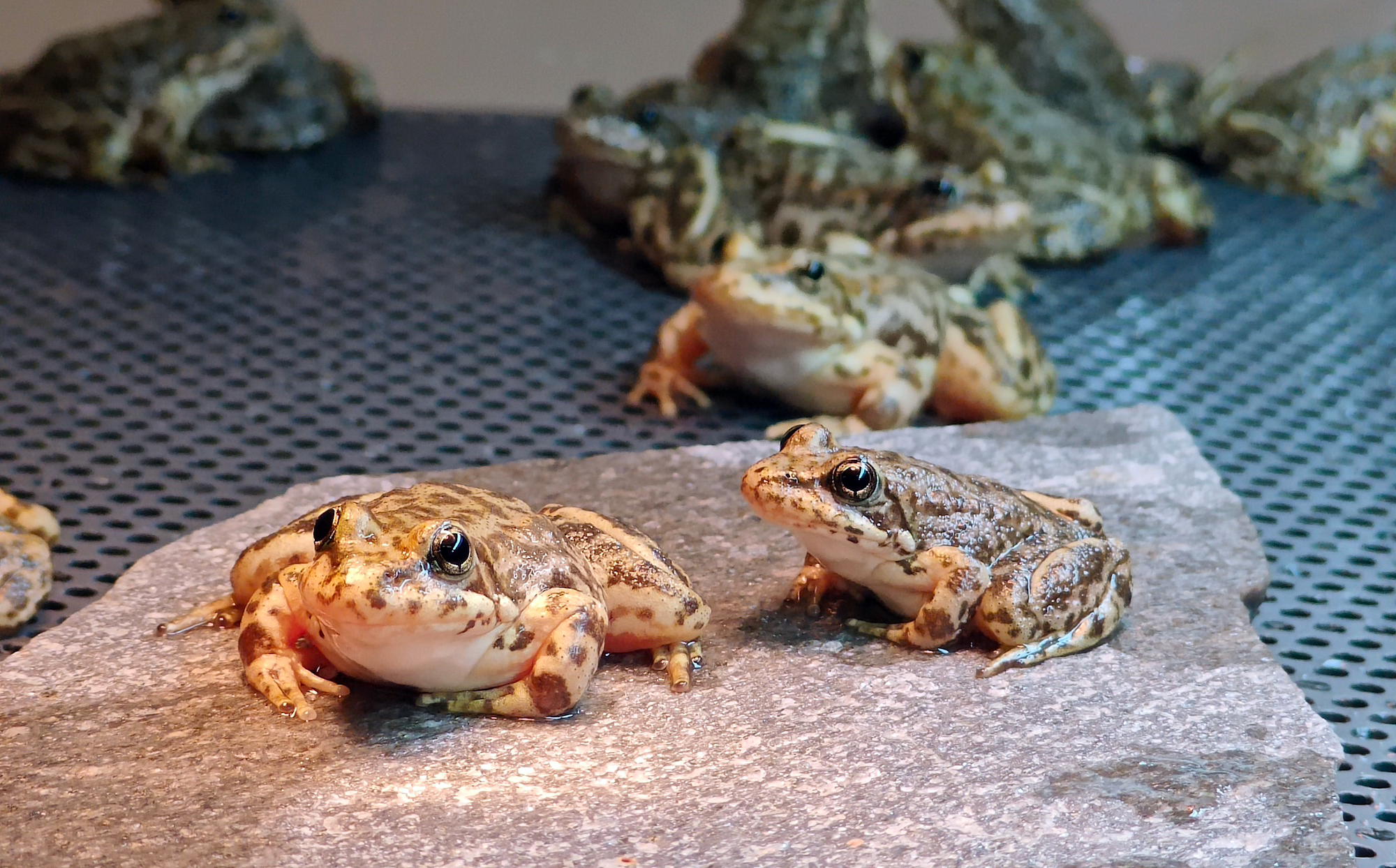
The aquarium has been rearing southern mountain yellow-legged frogs since 2021, as part of a multi-agency, 20-plus-year conservation effort for the species, a Southern California amphibian listed as endangered on the IUCN Red List. Head-starting the frogs by ushering them through metamorphosis in captivity boosts their odds of survive, Lundy said.
This year’s cohort arrived at the aquarium late last summer as 2-month-old tadpoles from the Los Angeles Zoo, where they were bred. Through winter and into spring, aquarium staff watched as their limbs erupted and tails slowly reabsorbed. By August, most were ready for life in the wild. (Metamorphosis for this species takes from one to five years in the wild, and is highly variable in captivity. Those that did not fully metamorphosize by the release date will be held back and released as larger adults next summer).
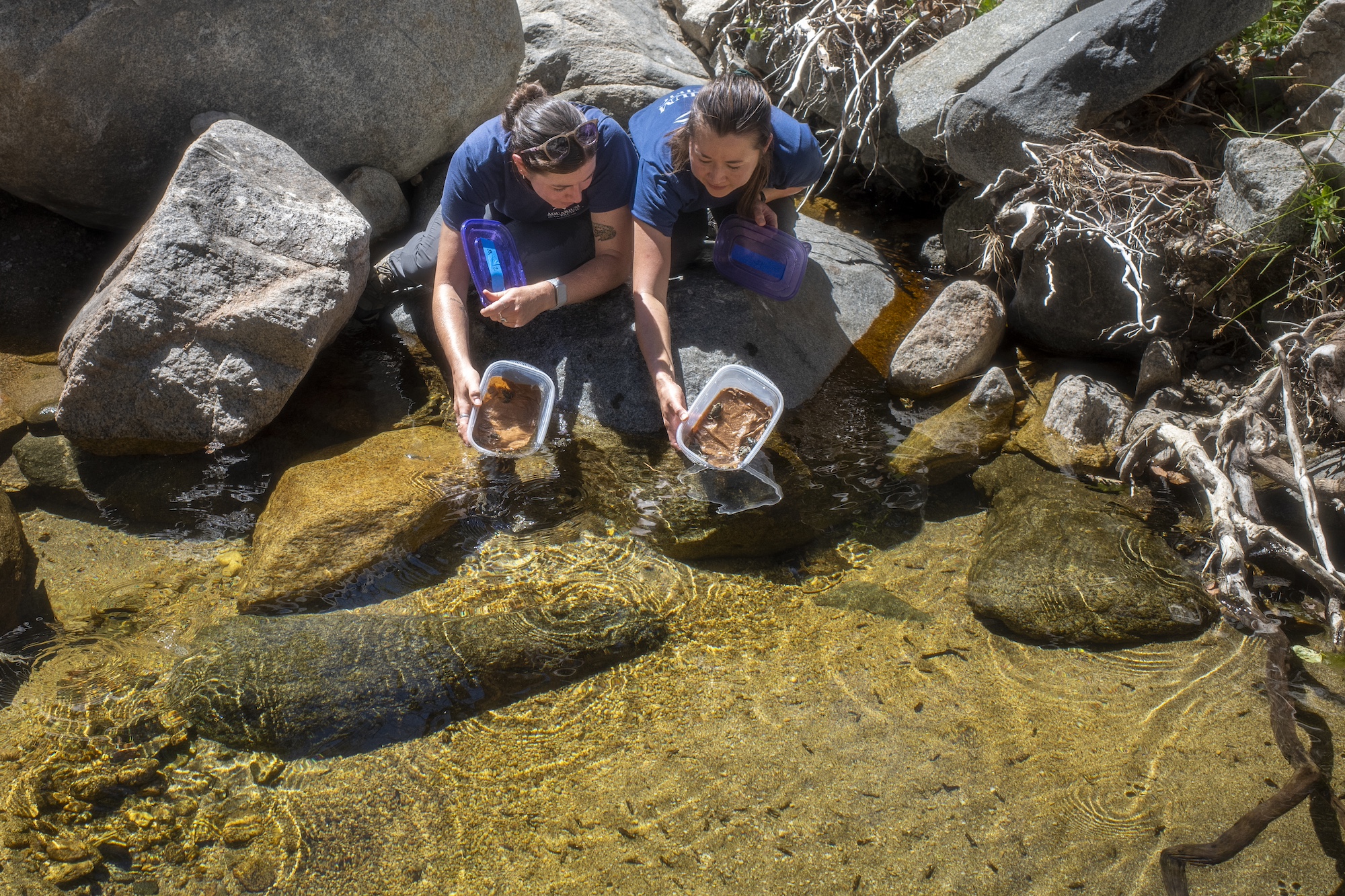
The releases took place at two sites in the San Gabriel Mountains, in concert with partners: The Los Angeles Zoo and the U.S. Geological Survey. Once caught, the frogs were put in containers, with eight to 12 frogs in each, and packed into coolers for the two-hour drive.
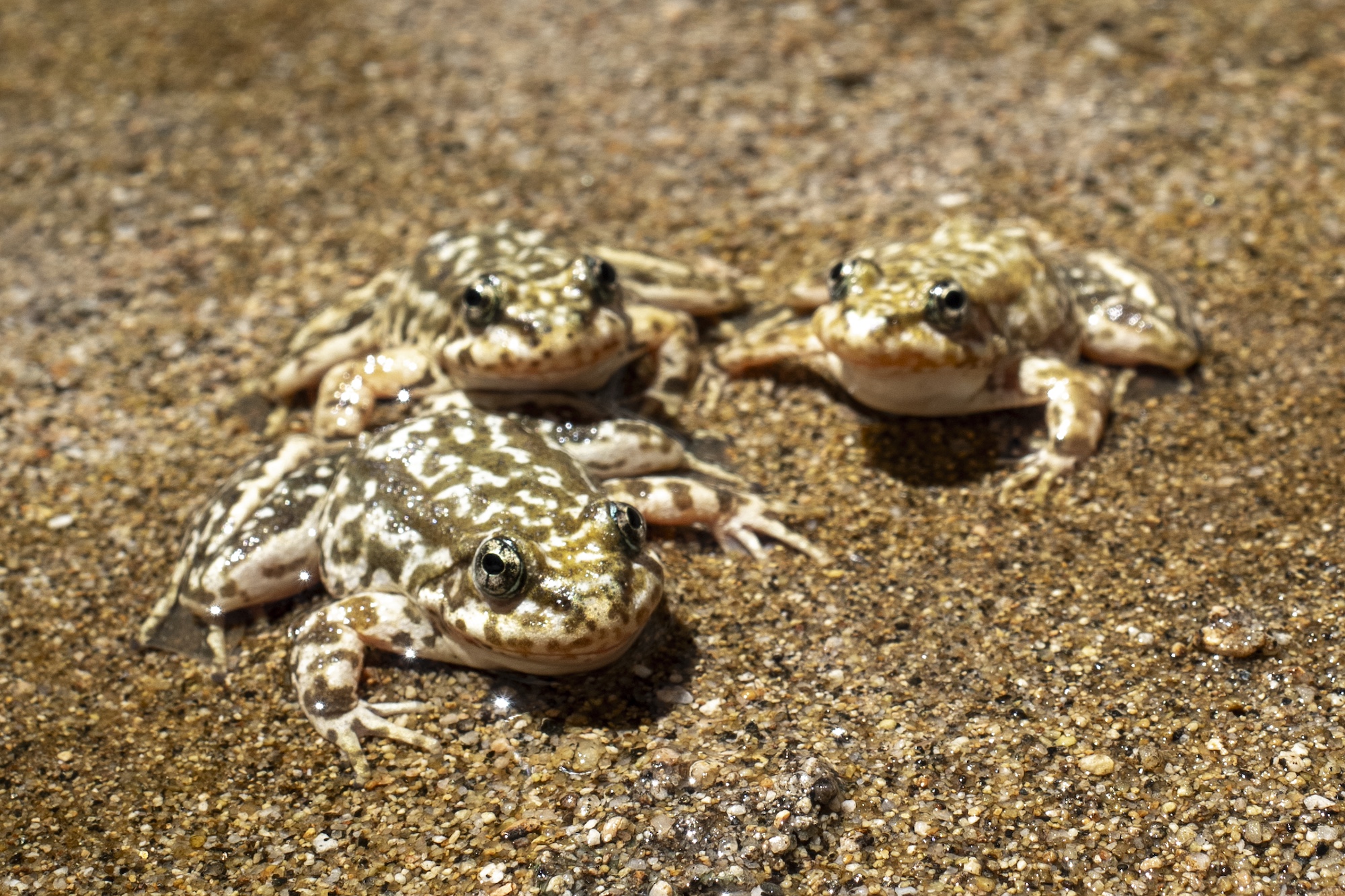
Then the release team hiked through “some of the most beautiful habitat you’ve ever seen,” Lundy said, past waterfalls and streams with the kind of fast-moving water and deep pools that the frogs prefer. Looking around the release site at the algae-crusted granite boulders, the frog’s coloration — a speckled olive-green, with buttery yellow bellies and thighs on the adults — makes a lot of sense, Lundy said. Finally, after floating the containers in the water for a while to let the frogs acclimatize to the temperature, the frogs were set free. In all, more than 650 frogs were released, with nearly 400 of those reared at the Aquarium of the Pacific.
Releases can feel emotional, Lundy said, and it’s deeply gratifying to be part of the larger conservation effort to return these frogs to their rightful place in the ecosystem.
“One time, a frog jumped out of the container, landed on a rock, and immediately ate a fly … And I was like … We’ve done it. He’s functional. He’ll be out here forever,” Lundy told Mongabay in a video call.
Why has the population declined?
Southern mountain yellow-legged frogs were once the most abundant amphibian in southern California’s mountains, so common that biologists describe having difficulty walking around without stepping on one. Declines began in the 1950s with the introduction of non-native trout, with habitat loss, climate change and other invasive species also taking a toll. Increasingly, chytrid fungus (Batrachochytrium dendrobatidis), an introduced pathogen, has emerged as a major threat.
The species is found in two distinct populations. The southern population is found in about 10 isolated locations across the San Jacinto, San Bernardino and San Gabriel mountains. A 2023 survey counted fewer than 200 frogs in the southern population, a population decline of about 98%.The northern population is found in the Sierra Nevada Mountains, and is thought to be more robust.
As an endemic amphibian in these high elevation mountains, southern mountain yellow-legged frogs would have played a unique role connecting freshwater and terrestrial ecosystems, eating and being eaten by different creatures as tadpoles and adults, and contributing to ecosystem functions.
“They just add a layer of interconnectedness to an ecosystem that not a lot of animals do because they have two separate life stages,” Lundy said.
Captive breeding of the species began as a salvage operation in 2003, with 10 frogs rescued following the 2003 San Bernardino wildfire and taken to the San Diego Zoo Wildlife Alliance (SDZWA). SDZWA established a breeding program for the frogs in 2006. Other institutions, notably the Los Angeles Zoo, which established a breeding colony in 2007, and Omaha’s Henry Doorly Zoo, also breed the frogs. Numerous other agencies and institutions are involved in the recovery program, including USGS, the U.S. Fish and Wildlife Service, the California Department of Fish and Wildlife and others.

What other challenges do they face?
Some of the initial challenges included getting the frogs to breed, said Talisin Hammond, a researcher at the SDZWA, with early research showing that the frogs needed to undergo brumation, a hibernation-like state, to successfully reproduce. The SDZWA’s program also incorporates research in husbandry, genetic pairing strategies and assisted reproductive technologies.
Researchers are also turning their attention to combatting the chytrid fungus, which infects the skin of amphibians and has wiped out around 90 species around the world.
The mountain yellow-legged frog appears to be particularly susceptible, Hammond said. That’s partly because both frogs and the fungus thrive in cool, wet conditions. The frogs are also highly aquatic, another risk factor.
“It is death by a thousand cuts, but we do think that chytrid remains one of the biggest obstacles to recovery, especially here in Southern California,” Hammond told Mongabay in a video call.
Researchers, including at SDZWA, are actively exploring strategies like anti-fungal treatment, immune priming through controlled exposure to the fungus, and genetic management.
They are also trying to identify potential introduction sites that might be less suitable for the fungus — for example, drier areas with more basking habitat, where frogs can “cook off” the fungus, a behavior observed in other species that have successfully battled infection. The problem is that suitable aquatic sites with perennial water are now scarce in southern California, Hammond said, because of habitat loss.
There is room for hope. In northern California, the Sierra Nevada yellow-legged frog (Rana sierrae) has seen population recovery following reintroduction using parent frogs that developed immunity to chytrid. The northern population of mountain yellow-legged frogs, found in the Sierra Nevada Mountains, also show some resistance to the fungus. However, it’s not yet clear if the southern population has sufficient genetic diversity to develop that kind of immunity, Hammond said.

With research ongoing, conservationists say reintroductions are critical for keeping frogs on the landscape, so they aren’t wiped out by catastrophic events like fires, floods or drought.
“Reintroduction, having the ability to start new populations, is really essential for the persistence of the species,” Hammond said.
In September, Lundy picked up a new load of about 500 tadpoles, this time from the SDWZA. They’re looking “really great,” she said, bright, alert, responsive, with good coloration.
“And they have a huge appetite,” Lundy said. “They’ve been eating so much already in the last few days, so I think this is going to be a good year for our tadpoles.”
Banner image: Adult southern mountain yellow-legged frogs (Rana muscosa) in the headstarting facility at the Los Angeles Zoo. The L.A. Zoo has been breeding the frogs since 2007, and recently added a headstarting facility. To date, they have bred and released over 7,000 of the frogs. Image courtesy of the L.A. Zoo.
Scientists race to study the Amazon’s frogs before they disappear
Citations:
Jacobs, L. E., Chancellor, S., Durrant, B., Swaisgood, R. R., Shier, D. M. … Calatayud, N. E. (2026). From salvage to science: Overcoming initial challenges and developing an adaptively managed program for an endangered amphibian, the mountain-yellow legged frog (Rana muscosa). Theriogenology Wild, 100151. doi:10.1016/j.therwi.2026.100151
Knapp, R. A. … Matthews, K. R. (2000). Non‐native fish introductions and the decline of the mountain yellow‐legged frog from within protected areas. Conservation Biology, 14(2), 428-438. doi:10.1046/j.1523-1739.2000.99099.x
Knapp, R. A., Wilber, M. Q., Joseph, M. B., Smith, T. C. … Grasso, R. L. (2024). Reintroduction of resistant frogs facilitates landscape-scale recovery in the presence of a lethal fungal disease. Nature Communications, 15(1). 9436. doi:10.1038/s41467-024-53608-4
Santana, F., Swaisgood, R., Lemm, J., Fisher, R. … Clark, R. (2014). Chilled frogs are hot: Hibernation and reproduction of the endangered mountain yellow-legged frog rana muscosa. Endangered Species Research, 27, 43-51. doi:10.3354/aei00648
FEEDBACK: Use this form to send a message to the editor of this post. If you want to post a public comment, you can do that at the bottom of the page.
Cite this article
Ruth Kamnitzer (2026). New releases a leap forward for endangered frog in southern California. Mongabay Conservation news. DOI: https://doi.org/10.66709/news-331219

