


At a Workers’ Party convention in August, Brazilian President Luiz Inácio Lula da Silva made an unusual appeal to his own political camp: “I want to ask the left-wing people,” he said. “Stop this nonsense of thinking that we don’t have to worry about defense.”
Lula then explained what Brazil had to protect, including nearly 10,500 miles of land borders, the Amazon rainforest, 12 percent of global freshwater, and mineral wealth. Though Lula said the country should promote peace rather than war, his message was clear: Brazil needs armed forces capable of deterring threats.
Lula has run seven presidential campaigns, and this is the first to feature defense policy as a key pillar of his platform. This may be surprising, given the close ties between the Brazilian military and influential former right-wing President Jair Bolsonaro. Some military leaders cooperated with Bolsonaro’s failed efforts to overturn Lula’s 2022 victory; Bolsonaro has since been convicted of plotting a coup and barred from politics. His son Flávio Bolsonaro is running in his place ahead of the Oct. 4 first-round vote.
Lula’s shift on defense can be explained at least in part by U.S. foreign policy. U.S. President Donald Trump’s new military campaign in Latin America as well as his sanctions and tariffs targeting Brazil have given a new life to the idea that the country’s sovereignty needs to be protected. A longtime backer of industrial policy, Lula has also leaned into the potential of Brazil’s military-industrial complex to boost the economy.
During Lula’s previous presidential terms—between 2003 and 2011—he was not hostile to military spending. He advanced some of Brazil’s biggest defense programs, such as a conventional and nuclear submarine partnership with France, the development of Embraer’s KC-390 tactical transport aircraft, and the Guarani armored vehicle initiative. In 2008, Lula’s administration enacted Brazil’s first National Defense Strategy.
However, what is new is how forcefully Lula is pushing the subject and the language he uses to do so. Lula presents Brazil’s defense industrial base as an instrument of reindustrialization, technological autonomy, skilled employment, and exports. The word tying those ideas together is soberania (“sovereignty”), which appears 31 times in Lula’s 2026 platform.
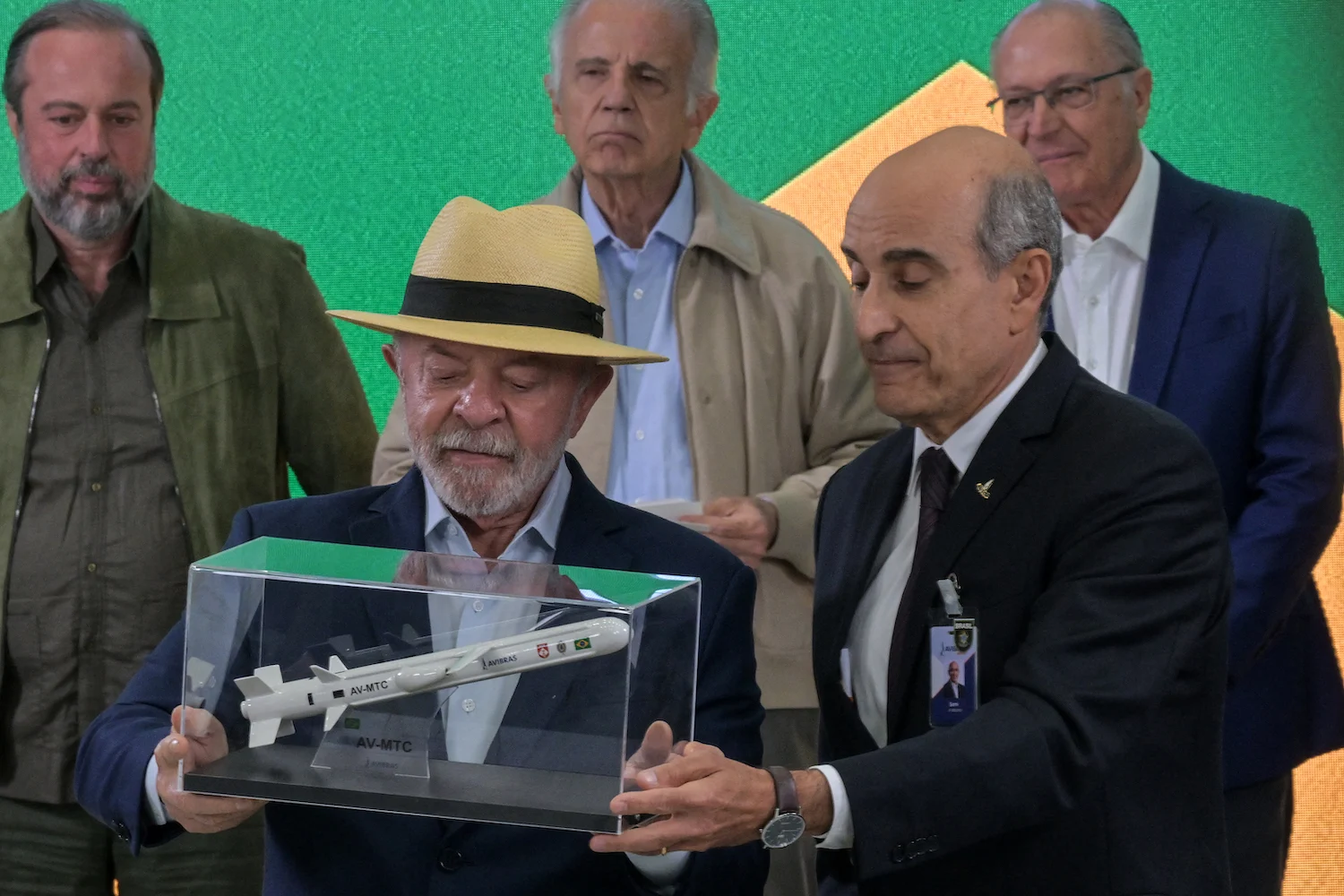
Lula comes from a nationalist left shaped by opposition to Brazil’s 1964-85 military dictatorship. But what he shares with proponents of military nationalism is an attachment to domestic industry, strategic autonomy, and national resources, said a senior retired Brazilian officer, who spoke on the condition of anonymity to reflect candidly on Lula. In recent weeks, Lula has attended the inauguration of a Brazilian Navy frigate, visited missile and artillery manufacturer Avibras, and made an appearance at the naval complex developing Brazil’s first nuclear-powered submarine.
Brazilian governments of different ideological stripes have long sold military programs as engines of industrial growth and technology transfer. David G. Borges, a political philosophy professor at the Federal University of Pelotas who studied Brazil’s defense spending from 1985 to 2022, argued recently that the strategy has repeatedly underdelivered “due to budgetary inconsistencies or internal political instability.”
Brazil historically treated armed conflict as remote. But the U.S. capture of Venezuelan President Nicolás Maduro on Jan. 3 ruptured that assumption. Venezuela shares a long Amazon border with Brazil, and the episode raised concern in Brasília. Two weeks later, Lula met privately with Defense Minister José Múcio and Brazil’s three service commanders, who presented a 15-year assessment of the country’s defense needs at a cost of more than $155 billion.
If financed as net new spending, these investments would boost Brazil’s annual defense budget by 40 percent compared with current levels. That would mark a sharp reversal: Roughly three-quarters of today’s defense budget goes to personnel, such as salaries and pensions, while investment accounts for nearly 8 percent.
Years of constrained spending have shrunk the discretionary portion of Brazil’s defense budget, which fell by around 42 percent in inflation-adjusted terms between 2014 and 2024, according to data from the Brazilian Defense Ministry. By the Stockholm International Peace Research Institute’s measure, Brazil’s military expenditures declined from 1.3 percent of GDP in 2016 to 1.1 percent in 2025, leaving limited room for modernization and readiness.
The new U.S. National Security Strategy has made it harder for Brazil to assume that military coercion will remain safely distant. The “Trump Corollary” to the Monroe Doctrine pledges to restore U.S. preeminence in the Western Hemisphere, neutralize cartels, and prevent outside powers from controlling strategic assets. In March, Trump translated that into the Shield of the Americas, a U.S.-led security coalition that approaches counternarcotics through a military lens. Trump called it a “military coalition” prepared to use lethal force against cartels and terrorist networks. Brazil and Mexico were left out.
That shift coincided with deteriorating relations between Brazil and United States. Since 2025, Washington has used visa restrictions, Magnitsky sanctions, tariffs, and terrorist designations against Brazilian targets, including measures that were explicitly tied to disputes over Jair Bolsonaro. One of his sons, Eduardo Bolsonaro, moved to the United States in 2025 to lobby against proceedings involving his father. He campaigned for sanctions against Brazilian Supreme Court Justice Alexandre de Moraes and other officials and thanked Trump after the announcement of 50 percent tariffs on Brazil, claiming personal credit.
Flávio Bolsonaro met Trump, Vice President J.D. Vance, and Secretary of State Marco Rubio earlier this year; he later sought to delay new U.S. tariffs until after Brazil’s election.
A Brazilian government official who spoke with Foreign Policy on the condition of anonymity to discuss confidential diplomatic matters described the cumulative U.S. actions—and particularly the State Department’s involvement—as attempts to influence Brazil’s political environment ahead of the October election. Latin America’s rightward shift, with recent election victories in Bolivia, Chile, Colombia, and Peru, sharpened the official’s concern. A victory for Flávio Bolsonaro would mean a pro-Trump leader in the region’s largest country, economically and demographically.
The focus on sovereignty offers Lula more than a defense slogan. It lets him distill U.S. pressure on Brazil, critical minerals, military readiness, technological dependence, and industrial capacity into one question: How much freedom does Brazil have to make its own decisions? At this year’s United Nations General Assembly, Lula put the same argument in geopolitical terms, warning of growing superpower overreach and noting Latin America’s proximity to the world’s largest military power. “Brazil does not fit in anyone’s backyard,” he said.
This approach also addresses a political dilemma within Lula’s coalition, where military spending has long been taboo. While the term “national security” still evokes the trauma and repression of military dictatorship for much of the Brazilian left, “sovereignty” reframes defense as a national developmental cause, protecting Brazil’s resources and technological independence rather than empowering the generals.
Lula’s rhetoric has generally been well received across the armed forces, despite officers’ frustration over chronically constrained resources, according to the senior retired officer. In his assessment, some military officers concerned with discipline and hierarchy could see a return of the Bolsonaro family as more disruptive than a fourth Lula term, particularly if a right-wing government pursued amnesty for Jair Bolsonaro and former generals convicted of plotting a coup.
For Lula, that creates a strategic convergence: He can use the language of sovereignty to thwart Bolsonarismo while speaking in a way that many military officers recognize as legitimate. Strengthening the defense industry becomes part of a broader national development project rather than a concession to the armed forces.
Lula’s administration has already built policy around his defense industrial push. The president’s New Industry Brazil plan and federal investment program “increasingly treat defense-related sectors as drivers of growth, reflecting their potential to generate jobs and exports,” said Hélio Caetano Farias, a professor at the Brazilian Army Command and General Staff College.
The Defense Ministry increasingly promotes Brazilian products abroad through a new export catalog and deeper cooperation with FIESP, the country’s premier industrial association. A 2025 law authorized the government to spend around $6 billion over six years for strategic defense projects outside normal fiscal constraints.
Lula’s defense spending push has already run into some constraints, however. In May, around $850 million of Defense Ministry spending was blocked to comply with the country’s new fiscal framework, which caps the growth of discretionary public expenditures. Meanwhile, a comprehensive audit by the Federal Court of Accounts warned that Brazil’s strategic defense project portfolio exceeded the state’s actual financial capacity, forcing major initiatives—such as the Navy’s submarine program—to stretch decades beyond their original schedules.
In response, Lula has floated the possibility of alternative sources of financing for defense programs. While visiting the Aramar nuclear complex in August, he argued that Brazil’s submarine program could not remain “at the mercy” of annual budget volatility, suggesting off-budget funding from the country’s state development bank and oil giant Petrobras. He promised to “find the resources” to finish Brazil’s long-delayed first nuclear-powered submarine—the centerpiece of a development program that also includes four conventional vessels, three of which are already operational.
“We are not thinking about making the submarine just because it is beautiful to make,” Lula said. “Developing the submarine will develop multiple things in this country.” The program involves more than 900 companies and generates 63,000 jobs, Navy commander Marcos Sampaio Olsen said at the Aramar event.
Múcio, the defense minister, has repeatedly said multiyear funding predictability matters more than announcing a larger budget. But he says the need for higher financing is stark, arguing at an August event that Brazil’s military capacity to defend itself today is so feeble that if the United States attacks, Brazil should get its defeat over with by simply “opening the gate.”
Despite Lula’s struggles to fund his defense ambitions, he has already reshaped Brazil’s debate over military spending. While Europe is rebuilding its defense industry because war returned to its neighborhood, Brazil is moving in the same direction for a different reason: Armed conflict no longer feels far away. The rhetoric of sovereignty lets Lula turn that shock into a new project and an argument for his reelection.
