


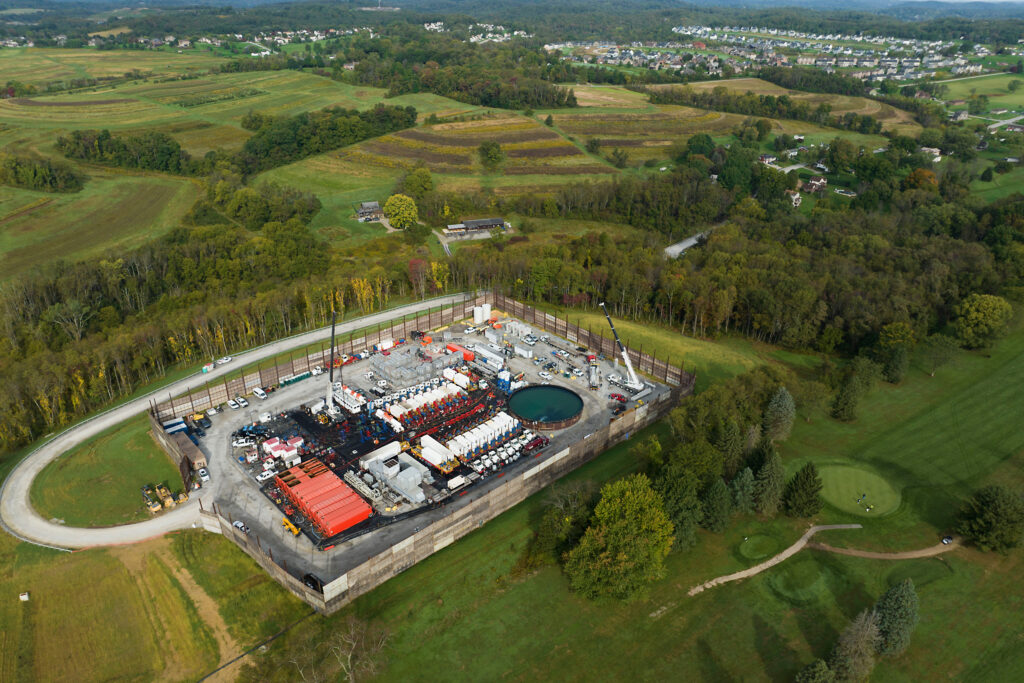
Testing in a limited number of shallow aquifers near fracking sites in southwestern Pennsylvania found low levels of radium overall, but there aren’t yet enough samples to draw firm conclusions about the region as a whole, according to a new report from researchers at Penn State University.
Researchers were looking for evidence that fracking has or has not increased concentrations of radium in drinking water. Oil and gas wastewater can be toxic and radioactive. It is also generally extremely salty.
In 2024, the team took samples from 91 private water wells and springs mostly in Washington County, which is one of the most heavily fracked areas of Pennsylvania. Only six samples found shallow groundwater mixed with brine, and all traces of radium were below regulatory levels.
Radium concentrations were higher within three kilometers of oil and gas impoundments and spills, and there was a “weak correlation” between radium activities and the density of oil and gas wells at that distance, the study found. Nathaniel Warner, one of nine researchers who co-authored the paper, said it was difficult to reach conclusions about contamination closer to oil and gas sites because of a lack of samples available within 1 kilometer.
The results showing increased salinity in groundwater are attributable not only to fracking operations but also to road salting and septic tanks, Warner said. But he said that elevated salinity, regardless of the source, was concerning. More salt in water systems can corrode pipes, releasing metals like lead and copper, and it can have a similar effect in aquifers and wells, raising levels of lead, nickel, cobalt, chromium and radium. “It’s like a cascading effect,” Warner said.
Because so many Pennsylvanians rely on private wells for drinking water, and few of those wells are regularly tested, environmentalists have been concerned about contamination caused by oil and gas operations since the beginning of the fracking boom.
Critics of fracking have long accused the natural gas industry of causing water contamination near drilling sites. Wastewater associated with drilling may be contaminated with manmade chemicals, or with naturally occurring substances, some of them radioactive, that are brought to the surface when drill bores probe a mile or more underground.
In 2025, the U.S. Environmental Protection Agency said fracking can sometimes hurt drinking water supplies as a result of surface spills or underground leaks of chemicals used in the process. Critics of the process often cite the contamination of groundwater at Dimock, in northeastern Pennsylvania, where a resident memorably set his kitchen tap water on fire because of its high concentration of methane, an event recorded in the 2010 movie “Gasland.”
Environmentalists worry that spills and leaks of contaminated water may find their way into aquifers that supply drinking water to people living near drilling sites.
Even though the study suggests fracking may not be responsible for elevated radium levels around some drilling sites, there is not yet enough evidence to clearly answer the question, Warner said.
“There’s not enough overall evidence to conclude that fracking does or does not cause elevated radium,” Warner said. “We have some limited evidence to say that overall, radium is higher. It would be nice to have a lot more samples.”
The researchers were looking for signs of higher radium near oil and gas operations, but they found little sign of it, Warner said.
“You would expect a certain signature of the radium isotopes and the strontium isotopes. We didn’t see that, so it didn’t look like any direct spills elevating radium in these areas,” he said.
This story is funded by readers like you.
Our nonprofit newsroom provides award-winning climate coverage free of charge and advertising. We rely on donations from readers like you to keep going. Please donate now to support our work.
The industry has contended for years that fracking does not threaten water quality because the chemicals used are pumped far deeper than water sources, and the water produced is recycled.
“Produced water can be managed safely, and questions about potential health impacts should continue to be evaluated using sound science and evidence,” said Stephanie Catarino Wissman, executive director of the American Petroleum Institute of Pennsylvania, in a statement.
Dan Bain, a researcher at the University of Pittsburgh, said produced water has shown elevated radium levels before. Recent research from the University of Pittsburgh found much higher levels of radium in Pennsylvania’s oil and gas wastewater than studies conducted earlier in the fracking boom.
Bain said the study’s results highlighted the challenges of studying contamination in western Pennsylvania. “This is such a complicated waste stream. The oil and gas waste, particularly down in Washington and Greene Counties, is so extensive,” Bain said. “It’s hard to pin any set of waste on any one thing.”
“They were very careful to not be definitive,” he said. “It doesn’t look [like] this set of samples has a chemistry that’s consistent with an oil and gas release.” Still, that particular set of results “doesn’t necessarily mean that fracking is not responsible for elevated radium,” Bain said.
Spills of produced water are relatively rare, but they can damage water quality, so it’s important for scientists to understand the consequences, he said.
In June 2022, produced water from a gas well in New Freeport, Greene County leaked into an adjacent abandoned conventional gas well, contaminating the town’s drinking water.
In such cases, the public may be protected from drinking contaminated water simply by its smell, Bain said. “Truthfully, a lot of times that there is a big incident, the water is so foul tasting that people don’t necessarily keep drinking it,” he said.
David Hess, a former Pennsylvania environment secretary who now publishes an environmental newsletter, argued the new study was unlikely to find evidence linking fracking with radium contamination of water supplies simply because fracking takes place far below the level of aquifers used for drinking water. And he said the study lacked baseline samples taken before drilling began.
“At best, this sampling was an unorganized screening tool for that geographic area for finding results—a chemical fingerprint—that could indicate a well communication incident or spill,” he said.
About This Story
Perhaps you noticed: This story, like all the news we publish, is free to read. That’s because Inside Climate News is a 501c3 nonprofit organization. We do not charge a subscription fee, lock our news behind a paywall, or clutter our website with ads. We make our news on climate and the environment freely available to you and anyone who wants it.
That’s not all. We also share our news for free with scores of other media organizations around the country. Many of them can’t afford to do environmental journalism of their own. We’ve built bureaus from coast to coast to report local stories, collaborate with local newsrooms and co-publish articles so that this vital work is shared as widely as possible.
Two of us launched ICN in 2007. Six years later we earned a Pulitzer Prize for National Reporting, and now we run the oldest and largest dedicated climate newsroom in the nation. We tell the story in all its complexity. We hold polluters accountable. We expose environmental injustice. We debunk misinformation. We scrutinize solutions and inspire action.
Donations from readers like you fund every aspect of what we do. If you don’t already, will you support our ongoing work, our reporting on the biggest crisis facing our planet, and help us reach even more readers in more places?
Please take a moment to make a tax-deductible donation. Every one of them makes a difference.
Thank you,
