


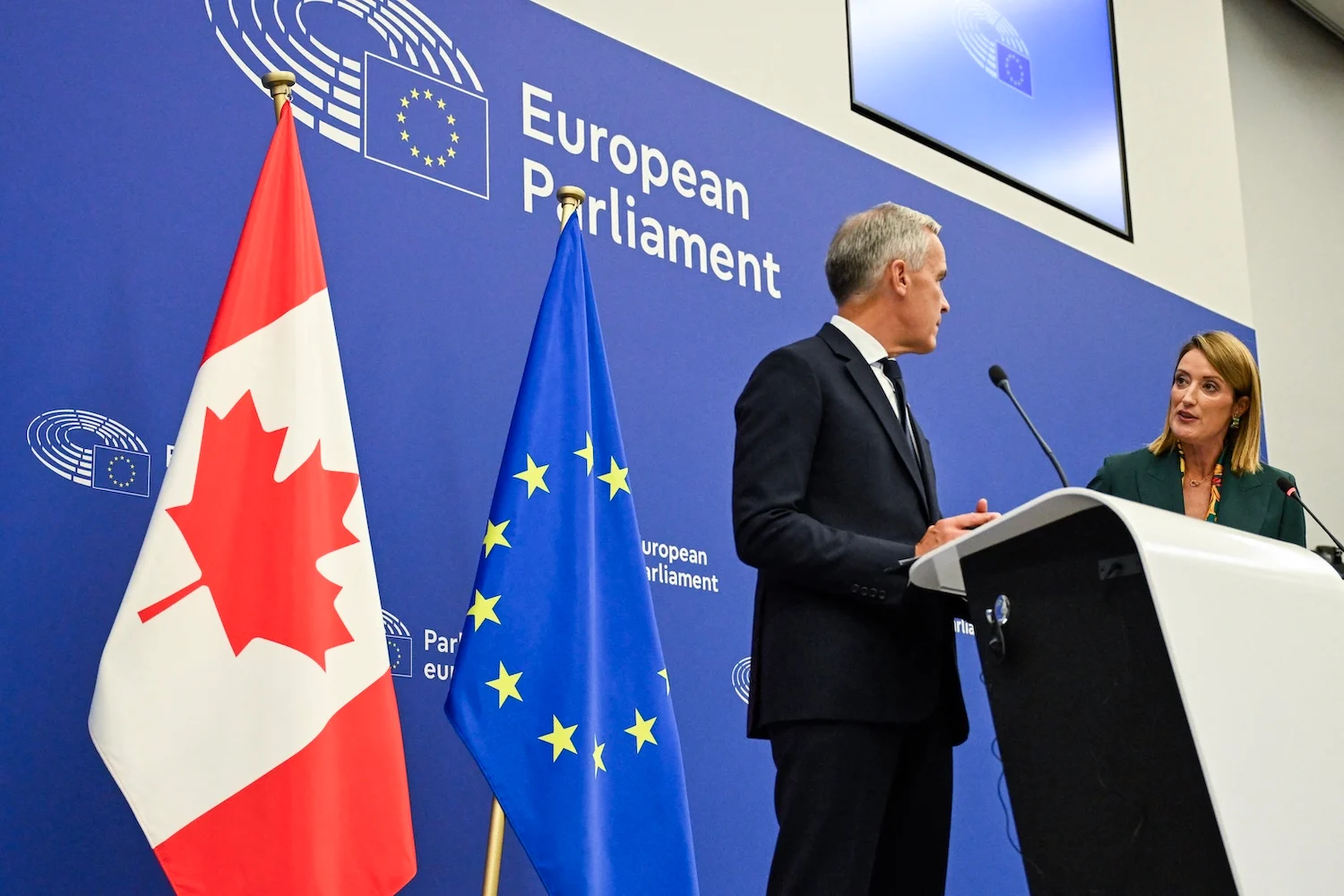
Can Canada become an associate member of the European Union?
Why not? It ticks all the boxes as far as the EU is concerned: a robust democracy, a vibrant economy, and an unflinching commitment to multilateralism, trans-Atlantic security, and the defense of Ukraine.
Can Canada become an associate member of the European Union?
Why not? It ticks all the boxes as far as the EU is concerned: a robust democracy, a vibrant economy, and an unflinching commitment to multilateralism, trans-Atlantic security, and the defense of Ukraine.
Yet Canada won’t join Europe anytime soon, certainly not in a formal way. What both parties will do instead is double down on mutual commitments. Canada and Europe need each other more than ever. With the multilateral global order in tatters and Donald Trump in charge of U.S. foreign policy, they will either hang together or hang apart. The United States is still the partner of choice for Brussels and Ottawa, but both capitals realize they now need to diversify their economic and security relations in order to gain leverage over Washington.
Most recently, European Commission President Ursula von der Leyen floated the possibility of Canada’s associate membership in her State of the Union address in September. The trouble is that there is no such thing as associate membership in the EU’s founding treaties. Sure, Article 217 of the Treaty on the Functioning of the European Union talks about “association” with third countries, “involving reciprocal rights and obligations, common action and special procedure.” Agreements based on that clause form the cornerstone of the relationship between the EU and aspiring members, such as the Western Balkan states or Ukraine.
But Canada’s own treaty with the EU, the Comprehensive Economic and Trade Agreement (CETA), is tied to an altogether different article that governs the union’s commercial policy in the wider world. Unlike Albania, Montenegro, or Moldova, Canada is not applying for membership and therefore not ready to absorb EU legislation without mutual concessions or adjustments. Von der Leyen has come up with a headlines-spurning slogan. But pity the lawyers in the bowels of European Commission whose job it is to turn it into something legally and bureaucratically workable.
In truth, Canada and the EU are already doing a great deal to expand and deepen their partnership and look beyond CETA, which was signed in 2016. During his visit to Brussels in September, Canadian Prime Minister Mark Carney raised the prospect of broadening the EU-Canada partnership to include critical minerals, artificial intelligence, energy, space, and financial services. The forthcoming EU-Canada summit taking place in Montreal on Oct. 29-30 aims to advance the talks on a Digital Trade Agreement that have been underway since March. Canada already became the first non-European country to join the Security Action for Europe (SAFE) instrument in February and could become even more deeply involved in European rearmament moving forward. Should all these upgrades be implemented, Canada will be drawn into the EU’s orbit.
From the European perspective, doubling down on Canada will help improve the EU’s standing in the new geopolitical order marked by uncertainty and economic nationalism. In building this relationship, Europe is doing what it is best at: promoting trade liberalization. The EU may lag behind in technology, remain dependent on the import of critical components, suffer from sky-high energy prices, and struggle with deindustrialization. But it has shown that it can respond to these challenges by creating new markets and new opportunities. This year, it signed an agreement with Latin American customs union Mercosur and finalized trade talks with Australia, India, and Indonesia. Negotiations with Malaysia, the Philippines, Thailand, and the United Arab Emirates are ongoing. By integrating more closely with Canada, Europe can retain relevance in a volatile world.
The same is true of Canada, which is desperately trying to diversify its external economic relations away from the United States. A deal with Indonesia is about to enter into force. Next in line are Ecuador (signed this year) and the UAE (negotiations already wrapped up). Looking forward, Canada is engaged in negotiations with India, Mercosur, the Philippines, Turkey, and the Association of Southeast Asian Nations.
In all of these initiatives, Ottawa is following the same script as Europe. A recent Financial Times op-ed co-signed by Carney, European Council President António Costa, Brazilian President Luiz Inácio Lula da Silva, and Kenyan President William Ruto made a joint call for more collective action in responding to global challenges.
The United States remains the main interlocutor for both Europeans and Canadians on both security and economic matters, and both have chosen different approaches to handling Trump. Europe has been hugging him more closely in order to soften his position on Ukraine as well as on trade. Canada, by contrast, has chosen to play hardball, imposing retaliatory tariffs in advance of the U.S. midterm elections in a bid to gain leverage. In the long run, both Europe and Canada would like to see their principle ally come to its senses again. But in the meantime, cooperating with each other remains the most sensible route forward.
Canada won’t join the EU in the short-to-medium term. Even CETA is still a work in progress, as 10 EU member states have yet to ratify. But all bets are off longer term. Ultimately, whether associate membership proves to be a workable idea hinges less on Canada (or on Trump) than on Europe’s evolution.
Right now, the EU is deepening ties with its immediate neighbors. Energized by Russia’s full-scale invasion of Ukraine, nearly all of candidate countries in the Western Balkans and Eastern Europe are negotiating accession. The United Kingdom has been expanding cooperation as well in security, economic affairs, energy, and other domains. President Recep Tayyip Erdogan’s Turkey, whose relationship with the EU has long gone sour, remains keen to pursue better economic integration through an upgrade of the bilateral Customs Union and to participate in select initiatives in fields such as defense industrial development.
The result of all this is that, for the foreseeable future, the EU will be surrounded by countries with which it has important relationships but that are not likely to become members. It is against this backdrop that “associate membership” gains relevance.
Think of Turkey or war-ravaged Ukraine. German Chancellor Friedrich Merz has suggested associate membership for Kyiv as an interim stage before joining. Meanwhile, Western Balkan countries might find it hard to convince skeptical French to vote “yes” in a referendum to ratify a future accession treaty. In this context, Albanian Prime Minister Edi Rama has stated that he is open to his country joining the EU without full rights, at least initially.
Indeed, countries on Europe’s edges could already be considered de facto associate members, whether they want to admit it or not. That’s the case with Norway and Iceland, for example, which are part of the European Economic Area (EEA). They profit from cooperation and market access without participating in all policies while also paying into the EU’s budget. Canada, which has made a financial contribution to SAFE, could join this club as well.
Even if the EEA scenario is too ambitious, Ottawa may seize on other precedents, such as the EU’s arrangement with a post-Brexit U.K. Canada has a sizable diplomatic presence in Brussels and follows the nitty-gritty details of European integration closely. This means that it is familiar with all options on the table.
The EU is not known for flexibility, particularly if it is concerned that concessions might have spillover effects on its internal market and institutions. However, if Brussels is to succeed in a new, more dangerous world, it will have to become an expert in flexible geometry. Figuring out more nuanced ways to grow closer to a wide array of neighbors will be crucial for diversifying the EU’s foreign relations. Ties with Canada can help lead the way.
