


Welcome to Foreign Policy’s Southeast Asia Brief.
The highlights this week: Wildfires are burning vast swaths of rainforest and peatland in Indonesia, Southeast Asian leaders address the U.N. General Assembly, and Bangkok floods displace thousands of people.
Indonesia’s Worst-Ever Fires?
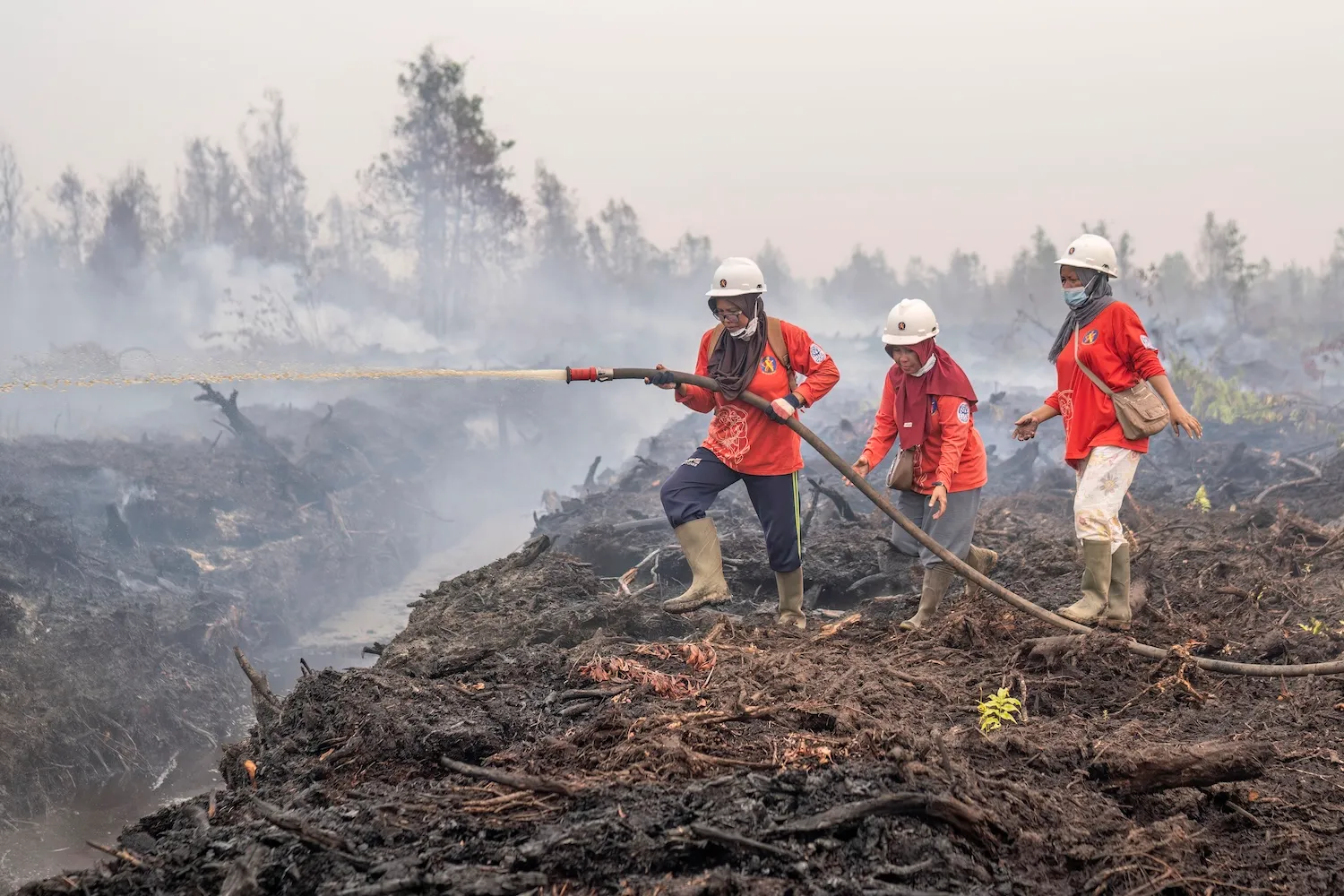
Indonesia may be on track for its worst-ever year of fires.
Wildfires have burned vast swaths of rainforest and peatland in Indonesia in September. The smoke has grown so thick as to drift across borders and oceans to Singapore; Kuala Lumpur, Malaysia; and even Manila, Philippines.
The fire season will likely continue until November, according to Suharyanto, the head of Indonesia’s National Disaster Management Agency (BNPB). The dry season this year is particularly long thanks to the advent of El Niño.
From January to August, nearly 900,000 hectares of land burned, according to data from Nusantara Atlas, an open-access mapping platform that uses peer review satellite data to survey the damage. This is more than in August 2019, the worst year recorded by that organization.
It is possible that 2015 was even worse than 2019, but that’s hard to say definitively. For that year, we have to rely on government estimates, which are hard to compare directly with Nusantara Atlas due to different methodologies. And for 2026, government data so far only goes up to July, so we lack up-to-date estimates.
Regardless, this is clearly an extremely bad year. So, what’s causing it?
Plantation agriculture is the fundamental underlying cause of the catastrophic forest fires of modern days. As Indonesia’s Kompas newspaper cleverly made clear in its reports this month, fire hotspots overlap almost perfectly with the density of plantations.
Plantations worsen the situation in a variety of ways. Clearing and logging build up debris that then serves as fuel. Waterlogged peatland is drained to create plantation land, turning fire-resistant areas into tinderboxes where flames can smolder long underground. And during the dry season, companies and small farmers alike often use fire to clear land to prepare it for planting. But these can easily spiral out of control.
Making matters worse this year is the current El Niño, which BNPB head Suharyanto described as particularly severe, causing a longer and hotter dry season. Research has found that this climatic phenomenon was the biggest factor behind annual variation in fire size in Indonesia. A one-degree Celsius increase in the sea surface temperature anomaly in the central Pacific corresponded with a 50 percent increase in hotspot detections in rural Indonesian districts.
In some areas, firefighting teams are even having to contend with water shortages as they attempt to battle the flames.
A final factor may be a lack of preparation on the part of the government. This year, the BNPB budget was slashed to just 491 billion rupiah (about $27 million). This is down from nearly 5 trillion rupiah in 2024. The Indonesian government has imposed sweeping budget cuts to a variety of programs in an effort to fund expansive social welfare policies.
To be fair, the government has now mobilized considerable resources to combat the flames, and it has promised to crack down on those causing the fires. But some question if government officials will be truly willing to take on the plantation industry—especially because, in South Papua province, fires seem to be taking place in areas near government plantation programs.
Duterte impeachment more likely. Last Wednesday, the 24-member Philippine Senate voted to lower the number of votes needed to impeach Vice President Sara Duterte. She is now much more likely to be convicted, which will stop her from running in the 2028 presidential election despite leading in the polls.
The key change is that instead of needing two-thirds of all senators to vote to convict, now only two-thirds of those senators attending the trial must agree on the charge.
Sen. Francis “Chiz” Escudero, who is presiding over the trial, had initially decided on the former when the trial started but has now been overruled. (Duterte is challenging the decision in the Supreme Court.)
This matters because numerous pro-Duterte senators are facing legal issues that prevent their attendance. At the latest count, one is on the run from the International Criminal Court under investigation for crimes against humanity during former President Rodrigo Duterte’s “war on drugs.” Duterte himself is now on trial in The Hague. Two other senators have been arrested on corruption charges. And one is on medical leave while also facing a corruption probe.
All this shifts the math. Now, just one senator in the Duterte camp needs to flip. And with another six under various forms of investigation, the leverage seems clear.
UNGA report. Three Southeast Asian leaders gave speeches during the recent high-level week of the United Nations General Assembly (UNGA) in New York.
Last Tuesday, Vietnamese President To Lam warned about growing conflict and economic fragmentation in the world. He called for respect for international law, equitable development, technology governance that “serves humanity,” and more multilateralism.
He then visited Canada, where he met Prime Minister Mark Carney and upgraded the bilateral relationship to a “strategic partnership” focused on trade, technology, and security. Perhaps there is a feeling of solidarity between two countries stuck next a mighty and occasionally threatening neighbor.
On Wednesday, Timor-Leste President José Ramos-Horta spoke. His theme was peace, with implicit rebukes of the United States. He invoked Palestine, NATO expansion, Russia’s war in Ukraine, and Cuba but also sharply criticized Iran for “seeking regional supremacy” and for its attacks on Arab states.
On Thursday, Thai Prime Minister Anutin Charnvirakul gave his speech. Notably, he called for reform of the U.N. Security Council to give developing countries a “greater role.” Alongside mentioning Cambodia and Myanmar, he focused on issues of economic development.
Business was on Anutin’s mind as he met with Google executives and investors and rang the bell at the New York Stock Exchange. However, his planned visit to the United Kingdom was cut short as he returned home to deal with the floods devastating Thailand (more on that below).
Notably, Indonesian President Prabowo Subianto, who loves diplomatic travel, skipped out on UNGA this year. Slipping approval ratings and criticism of his relentless overseas travel may have convinced him to stay home. However, Jakarta Gov. Pramono Anung was in town and met with New York City Mayor Zohran Mamdani.
Thai teenager wins America’s Got Talent. On Sunday, 16-year-old Nene Royal, aka Rattikan Amloy, was greeted like a queen when she returned to her hometown of Phuket, fresh from her victory on America’s Got Talent last Tuesday.
Nene triumphed in the long-running talent show, belting out rock hits from the ’90s and early 2000s. She first caught public attention with her audition performance of “Zombie” by the Cranberries and for the finals sang “Seven Nation Army” by the White Stripes. (The first performance is a proper banger.)
Thais are, unsurprisingly, thrilled to see a local girl triumph on the big stage. Her story—learning music at 7 years old and then busking in local markets in Phuket—also has a scrappy appeal.
The future looks good. Top Thai conglomerate CP Group gifted her a luxury condo in Bangkok. And last week, it was announced that she would be the opening act for metal band Avenged Sevenfold’s October concert in Singapore.
She is now working on her first EP.
Residents and pets navigate floodwaters in Bangkok’s Bang Kapi district on Sept. 28.Lillian Suwanrumpha/AFP via Getty Images
FP’s Most Read This Week
An exclusive interview with Min Aung Hlaing in Time by Charlie Campbell. It seems that Myanmar’s regime leader didn’t like the result, since Time is now banned in the country.
A dive into the world of Penang’s elaborate paper effigies, burned as offerings to the dead by Malaysian Chinese, by Marco Ferrarese in Nikkei Asia.
Vietnam is booming—but not enough domestic firms are, Amin Mohseni-Cheraghlou writes for the Atlantic Council.
Bangkok was declared a disaster zone on Saturday, and 10,000 troops were deployed because of massive flooding. At the time of writing, the flooding has subsided somewhat, but numerous areas in the capital and its environs remain affected.
Thailand has been hit by heavy floods throughout the month of September, which have displaced 1.7 million people, not including in Bangkok. At least 23 people have died as a result.
At the end of the month, it was Bangkok’s turn. Starting Thursday, heavy rain dumped 12.6 inches of water on the city—nearly as much as it usually gets over the whole of September.
The resultant floods have displaced almost 6,000 people in the city. While the rain has now relented, government officials estimated on Monday that some people might not be able to return home for about a week. Deep water is slow to drain in the flat, low-lying city, built largely on what used to be floodplains and marshland.
Even in relatively unaffected areas, people panic-buying supplies have stripped the shelves of many supermarkets.
Initial estimates put the damages at 12.3 billion baht (about $366 million). The government has allocated 2 billion baht to relief efforts.
Scenes in Bangkok varied from the harrowing to the strange. Young children and older people were cut off by rising waters and sometimes had to wait days for evacuation.
Meanwhile, some residents took to the streets in canoes or, in one case, a jet ski. (The jet ski rider was arrested and fined for causing a public nuisance and obstructing traffic.) On social media, capybaras, the giant rodents native to South America, gamboled through the streets—perhaps escaped from one of the city’s capybara cafes.
Thailand is no stranger to floods. Last year saw floods across the south, with the city of Hat Yai hit especially hard. A total of 276 people died. And in November 2011, nearly 10 percent of the country was inundated and Bangkok especially so. More than 13 million people were affected, 680 died, and damages totaled an estimated $46.5 billion.
The current floods have also affected neighboring countries. In Cambodia, more than 2,000 families had to be evacuated as floods hit 10 provinces. Prime Minister Hun Manet visited flooded areas.
In southern Myanmar, at least eight people have died and 30 are missing as a result of floods and landslides, a local rescue worker said on Monday. And earlier this month, at least four people died in floods in Vietnam.
Meanwhile, on Monday nearly 200 experts from across the world arrived in Bangkok to help draft a section of the next Intergovernmental Panel on Climate Change report.
