


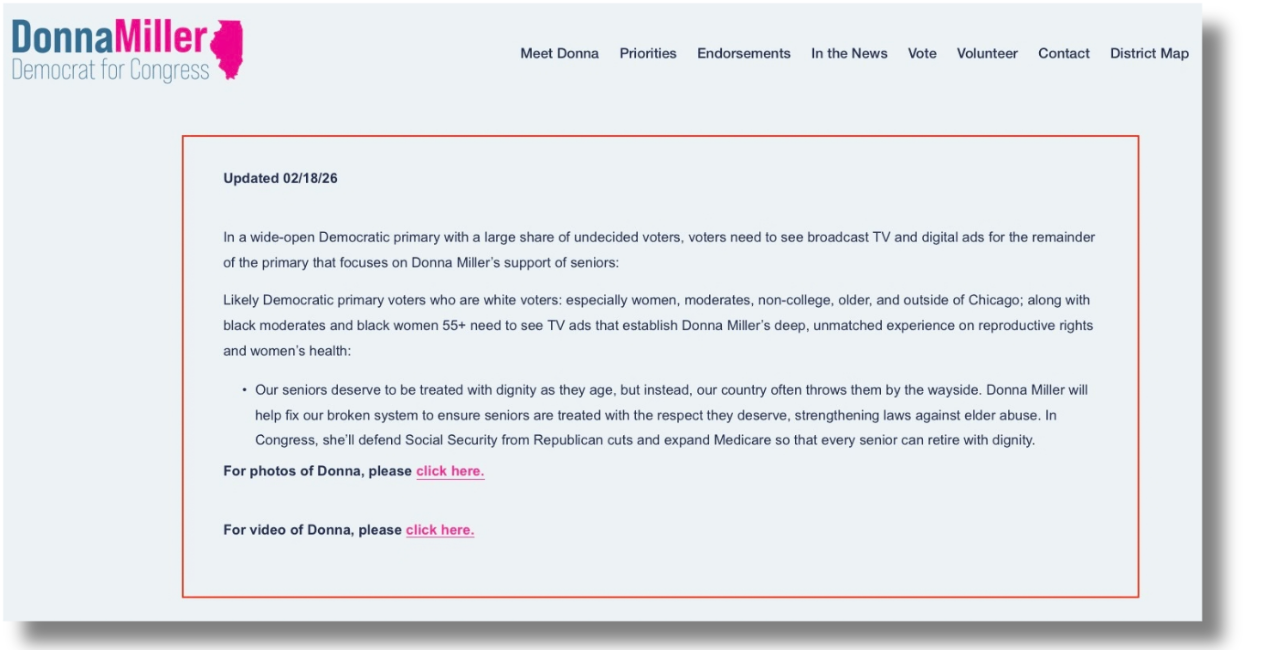
Donna Miller, the Democratic candidate to represent Illinois’ 2nd district, has typical redbox language on her campaign website, donnaforcongress.com.
The campaign website for the Republican Senate nominee in Alabama contains a blunt directive: “saturate” local airwaves with video of President Donald Trump’s endorsement. A Democratic House candidate in California goes even further, posting a link to a detailed menu of messaging timelines, languages, topics and markets down to the ZIP code.
None of it is aimed at voters. It’s directed straight at the super PACs producing ads to support those candidates.
And it’s perfectly legal.
Federal Election Commission rules bar super PACs – formally known as independent expenditure-only committees – from coordinating with the campaigns they support. Yet the tactic known as redboxing has become a bipartisan workaround, allowing candidates to publicly broadcast instructions to outside spenders while staying within the letter of the law.
And as billions flow through outside groups this election cycle, it raises a fundamental question: When campaigns can openly publish their playbooks for super PACs to follow, where does coordination actually begin?
“Putting out the request for help is not the same as making a deal for the help,” Columbia University Law School professor Richard Briffault told OpenSecrets. “Even though it’s a very specific request for help.”
Outside groups have spent $1.4 billion during this election cycle, and super PACs ($1.1 billion) account for the vast majority of it, according to OpenSecrets data through Sept. 21.
That flood of money was made possible by the Supreme Court’s ruling in Citizens United v. FEC, which opened the door for corporations, unions, nonprofits and PACs to spend unlimited amounts on elections, with one crucial caveat – outside groups cannot coordinate their spending with the campaigns they’re trying to help.
“They couldn’t simply call up a super PAC and say, ‘Here’s what we would like you to do,’” said Gabriel Foy-Sutherland, an assistant professor at Hamilton College in New York who has researched the practice.
That logic rested on the principle that unlimited spending would not corrupt the process because it would be independent.
The FEC is tasked with policing that principle.
The FEC’s 3-pronged test for coordination
Let’s start with how the FEC spots potential violations – and how it struggles to enforce them. It considers a communication coordinated only if it satisfies all three prongs of its test:
- Payment: Was the communication paid for, in whole or in part, by someone other than the candidate, an authorized committee or a political party committee?
- Content: Does the communication meet one of the FEC’s defined content standards, including electioneering, express advocacy or other regulated public communications?
- Conduct: Is there evidence that the campaign and the outside group cooperated, consulted or engaged in substantial discussions about the communication, or that it was created at the request or suggestion of those involved?
The conduct prong is key because it contains several safe harbor provisions – legal carve-outs that, when met, allow candidates, committees or vendors to avoid liability and make enforcement significantly harder.
Those safe harbor provisions include:
- Firewall: A written, implemented policy that blocks information from flowing between anyone creating a communication and anyone working for the candidate, their opponent or a party committee.
- Endorsement/solicitation: A candidate may publicly endorse or solicit funds for another candidate, committee or qualifying nonprofit as long as the communication does not promote the endorsing candidate or attack their opponent.
- Public information: A communication is not coordinated if it relies on publicly available information, including news articles, transcripts, speeches, interviews, press releases or – crucially for redboxing – any publicly accessible website, including one belonging to a candidate or political party.
Taken together, these exemptions make coordination extremely difficult to define – and even harder to enforce in the current regulatory environment. The FEC has lacked a quorum of commissioners for more than a year. Even when it’s fully staffed, its 3-3 partisan split frequently results in deadlocks. Additionally, Supreme Court precedent holding that the “appearance of corruption” alone cannot be the basis for restricting spending has further narrowed legal boundaries.
The result is a system where most coordination complaints never lead to legal action. A 2012 report from the now-defunct Center for Public Integrity found that the rules are so specific that without a witness to the communication, the FEC is unlikely to even open an investigation. FEC spokesperson Myles Martin directed an OpenSecrets inquiry to the agency’s website but declined further comment.
“Even if, in the end, you actually get the evidence, and it’s so clear against the existing rules that the commission’s willing to go ahead, it’s usually going to be quite some time after the election,” Briffault said. “You are going to find relatively few cases in which it was done in real time.”
Expert: In tight races, redboxing ‘more or less a must’
The most out-in-the-open way for candidates to legally communicate with outside groups is redboxing – the practice of placing a public message in a section of a campaign website that effectively serves as instructions for an outside group to follow.
Named for the red-bordered boxes where these messages often appear, redboxing exploits the FEC’s public-information safe harbor. As long as the content is posted publicly, campaigns can describe the message they want delivered, the medium they want it delivered through and the voters they want it targeted toward.
Redboxing has become a staple of modern campaigns. Foy-Sutherland said his research shows it appears in up to 40% of House races and “a significantly larger proportion of Senate races.”
“I think it’s more or less been embraced as a kind of necessary aspect of any kind of campaign arsenal,” Foy-Sutherland said. “Adding a red box to your campaign website is more or less a must in a competitive race.”
And while the messages are technically public, they’re often placed in corners of campaign sites that only seasoned operatives know to check – typically in sections labeled “media” or “what voters need to know.” Through Sept. 24, RedBoxWatch, which monitors federal candidates’ websites for evidence of redboxing, identified 168 instances across 38 states during the current cycle with 148 of those involving House candidates, including those linking to sites managed by national party committees.
(function(){function e(){window.addEventListener(`message`,function(e){if(e.data[`datawrapper-height`]!==void 0){var t=document.querySelectorAll(`iframe`);for(var n in e.data[`datawrapper-height`])for(var r=0,i;i=t[r];r++)if(i.contentWindow===e.source){var a=e.data[`datawrapper-height`][n]+`px`;i.style.height=a}}})}e()})();
While the site found significantly more examples among Democrats (150) than Republicans (14), the tactic is used across the political spectrum. Two major Capitol Hill campaign committees – the Democratic Congressional Campaign Committee and the National Republican Congressional Committee – publish detailed messaging pages that appear tailored for outside spenders, often using tell-tale phrases like “voters need to see” or “voters need to keep learning” while offering video clips for groups to use in those ads. OpenSecrets reached out to both organizations but did not receive a response from either.
The “What Alabama Voters Need to Know” page on GOP Rep. Barry Moore’s Senate campaign website urges readers to “get the Trump endorsement video in front of every Alabama Republican,” offering detailed guidance on how to do it. The page instructs readers to “saturate” the clip across digital and connected-TV platforms, place extra emphasis in Mobile and Huntsville – described as the two markets with “the largest pools of persuadable primary voters” – and run audio cuts on rural and Christian radio stations. OpenSecrets reached out to Moore’s campaign but did not receive a response.
A more unusual example appeared on a since-deleted section of House candidate Micah Lasher’s campaign website. The New York Democrat’s page noted that he “literally wrote legislation that would stop outside super PAC spending in our elections because he believes pages like this shouldn’t exist.” It went on to describe super PACs as “an unfortunate reality of our current political environment” and said the campaign wanted to “make our message clear to the voters” of the state’s 12th District – effectively acknowledging the very dynamic the page was designed to exploit.
Critics argue that redboxing allows campaigns and party committees to bypass contribution limits because outside groups can effectively produce ads at the campaign’s request in what amounts to an in-kind contribution.
“I don’t think it is illegal,” Briffault said. “I think it should be.”
But others say the practice is squarely protected by the FEC’s public-information safe harbor, which treats publicly posted content as categorically non-coordinated because it is available to anyone – allies, opponents and voters alike.
A blog post written by David Keating – the president of the Institute for Free Speech and the founder of SpeechNow.org, the nonprofit whose 2010 lawsuit against the FEC joined Citizens United in paving the way for super PACs – dismissed criticism of redboxing as “needless sound and fury.”
“The most ironic part is, people advocating for this are the same ones that are always advocating [for] transparency,” Keating told OpenSecrets. “And here the campaigns are being so completely transparent. … Journalists out there and people out there are finding this red-box stuff, and it’s becoming an issue and it’s becoming a controversy. And that’s what we want. We want people talking about this stuff. More information is better for the voters and everyone else.”
In a more practical sense, he added, experienced and well-funded super PACs don’t necessarily need to be spoon-fed instructions by campaigns.
“It’s not like, suddenly, they’re going to do whatever the redboxing says,” he said.
What would reform look like?
Redboxing isn’t the only maneuver raising questions.
In Michigan, Democrat Abdul El-Sayed’s Senate bid is backed by a super PAC that lists as a top funder nephrologist Jukaku Tayed – his father-in-law. That’s not a new phenomenon: “Friends and family” super PACs have existed almost as long as super PACs themselves have. The FEC dismissed a complaint in 2013 after deadlocking along party lines over whether it should investigate a super PAC because it had a family connection.
Other common practices that might give the appearance of corruption but have not met the FEC’s strict legal criteria for a violation include shared vendors between a campaign and an outside group, super PACs run by former staff members of an active campaign or super PACs performing core operational duties. For example, the main super PAC backing Ron DeSantis’ 2024 presidential campaign (Never Back Down) took on major ground-game tasks including funding canvassing, organizing bus tours and hosting campaign events. Because the FEC’s coordination rules primarily target paid advertising and not field operations, those activities were considered permissible, even as watchdog groups voiced their opposition.
“I think those are also evidence of – if not proof of coordination – evidence that maybe goes with the content of the messages that would be again, supportive of coordination,” Briffault said.
It all leads to a fundamental question: What would meaningful reform look like?
A 2024 bill introduced by Rep. Jill Tokuda (D-Hawaii) would have closed the redboxing loophole by treating any super PAC or outside spending as coordinated – and therefore illegal – if it followed messaging, guidance or suggestions publicly posted by a campaign. That bill died in committee.
The legal landscape shifted dramatically in June, when the Supreme Court struck down federal limits on how much political party committees can spend in direct coordination with candidates – potentially shifting some donor dollars away from independent super PACs in favor of the traditional party system. However, super PACs are likely to remain a primary vehicle for megadonors wishing to spend unlimited sums because individual contribution limits to party committees remain capped.
Foy-Sutherland suggested creating stronger criteria for redboxing – a checklist that, if met, would qualify a public post as a violation of contribution limits. It echoes the approach he and co-author Saurav Ghosh of Campaign Legal Center outlined in their 2024 paper, proposing a formal definition of redboxing that regulators could actually enforce.
Briffault went further, sketching out several potential reforms aimed at tightening coordination rules while noting constitutional limits on how far Congress or state legislatures can go.
His ideas fall into three main buckets:
- Presumptive coordination for single‑candidate PACs: He suggested that PACs created to support a single candidate or a very small number of them should be treated as presumptively coordinated because “everything they’re doing is for that candidate.” While campaigns could attempt to evade this by adding token support for other candidates, Briffault argued the rule could still meaningfully narrow the loophole.
- Lowering the threshold for conduct: He said the law should treat contact short of an explicit agreement as sufficient to establish coordination. In his view, simply talking with a candidate about “what would be helpful to you” should count, even without a formal deal.
- Treating interactions as evidence of coordination: Any interaction between a candidate and an outside group, he said, could be considered “presumptive evidence of coordination.” That would shift the burden away from proving a detailed agreement.
Keating offered a vastly different view, arguing that the underlying problem isn’t redboxing or coordination rules at all – but the existence of contribution limits. In his view, those caps push donors toward super PACs in the first place.
“I don’t know what more we could or should do about stuff like that,” he said. “Part of the problem is that we have these contribution limits in the first place, so there wouldn’t be as many super PACs, or [as much] money going into super PACs, with people supporting candidates or just being able to give to the candidate.”
But while Keating sees the solution in loosening rules, Briffault views the problem in how narrow those rules already are.
“The courts and the FEC have looked for clear-cut [proof], something almost tantamount to an agreement,” Briffault said. “And that’s just unrealistic in a world in which parties can work with each other with winks and nods.”
