


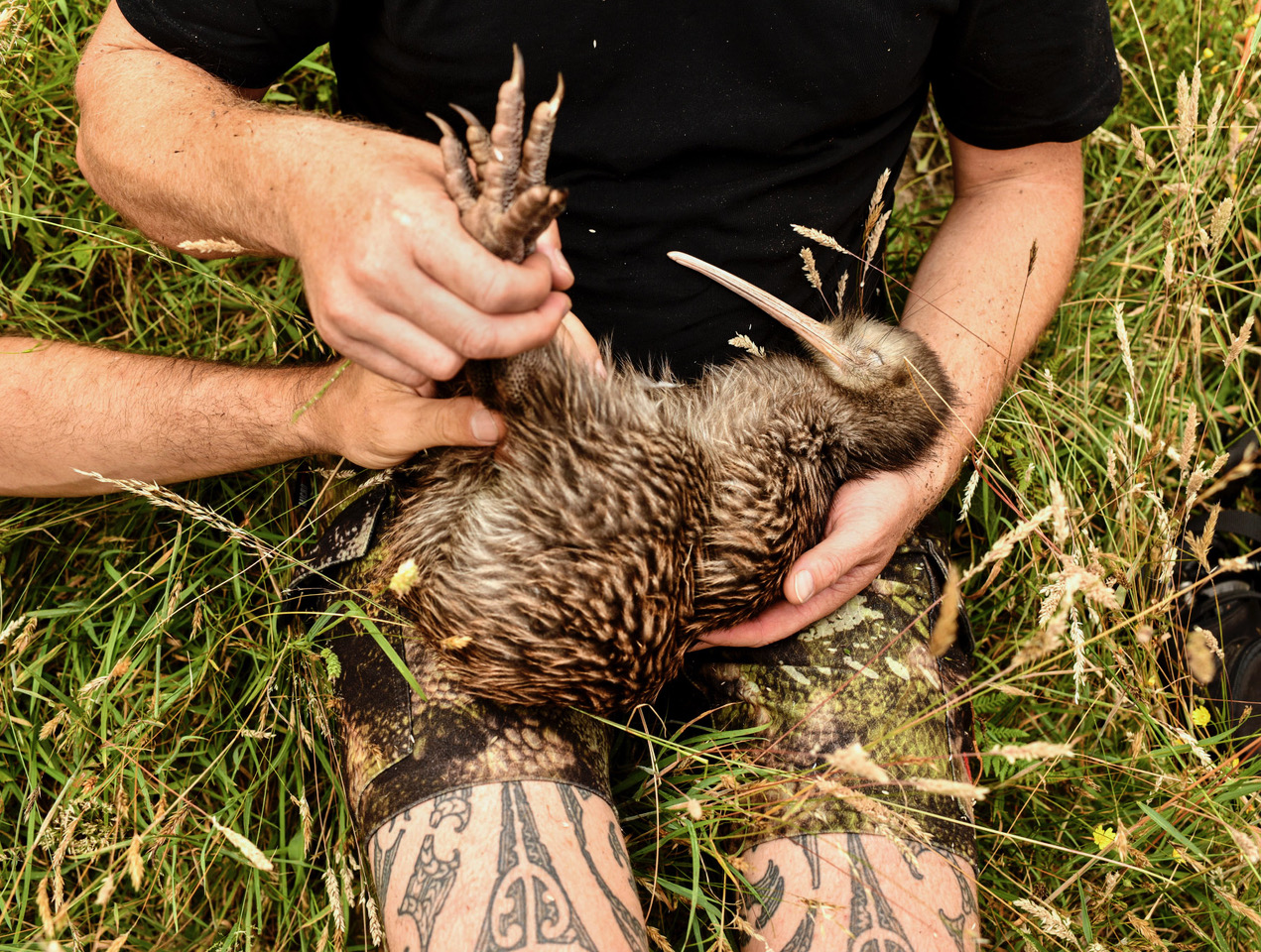
For the first time in 150 years, kiwi once again live in the hills surrounding Wellington, Aotearoa New Zealand. More than 250 manu (“birds” in the Māori language) were successfully translocated back to the region, thanks to the efforts of the iwi (nations of Aotearoa), community members, and landowners behind the Capital Kiwi Project.
Paul Ward, the project lead and founder, joins the Mongabay Newscast this week to explain the yearslong effort to make this possible.
A large part of it was removing stoats, which prey on kiwi before the chicks reach “fighting weight” (1 kilogram, or 2.2 pounds), which is when they can defend themselves. The project did this by deploying more than 5,300 traps to remove stoats from the project area, covering about 24,000 hectares (59,300 acres).
But removing predation threats to the kiwi was only the start, as it took years of relationship building with iwi, translocating birds, and educating community members on care — many of whom had never seen a kiwi in person before.
“The three legs on which this project are based are those relationships with iwi, with Māori, the relationships with the communities, and the relationships with the landowners. And if you pull one of those legs off, the tripod falls over,” Ward says.
“This is a relational project as much as it is what you might traditionally call a conservation project. And I think at a fundamental level that if we lose our relationship with these animals, with these manu … they risk becoming a museum species,” he says.
Rāwiri Walsh (Taranaki Whānui ki Te Upoko o Te Ika, Ngā Rauru Kītahi, Ngāti Raukawa ki te Tonga, Te Āti Haunui-a-Pāpārangi) is the project’s Kaimanaaki Kiwi (kiwi guardian) and iwi liaison. He also joins the podcast to explain the process from the perspective of Te ao Māori (the Māori world). For the Capital Kiwi project to receive kiwi, they must be gifted the birds by iwi through a tono, a gifting process. The project then bestows the bird on a community through a pōwhiri, a traditional Māori welcoming ceremony.
“For any species translocation, the government entities and Department of Conservation have to have sign-off or agreement from the tribes that it affects, so in their areas,” Walsh says.
And then the tono, as Walsh explains, is a request to the iwi for the birds.
“From a Māori perspective, we just had to agree with the iwi that we were receiving from, and they had to agree with us that they wanted to give us kiwi,” Walsh says.
“What we were able to do when moving kiwi is … welcome the people, both the sanctuary workers as well as the iwi, onto the lands that they were bringing the birds. And then … the responsibility and the onus to the birds would switch … we would do the pōwhiri or the ceremony, and then there would be a process where they would be handed over,” Walsh says.
The project is far from over, Ward says, as communities now share responsibility for caring for the birds. He adds that this model is a proof of concept for reintroducing other species. In total, including newly hatched chicks that made it to fighting weight (more than 90% of them), Ward estimates there are over 300 kiwi in the hills surrounding Wellington.
“Ten years ago, [the] challenge probably would’ve [been] ‘Are we being too ambitious?’” he says. “I think now that challenge is one of complacency.
“We’re leaning into those relationships with our partners, with our iwi, our landowners, and our communities to explore what other taonga [property] species might be returned to these environments.”
In the episode, Ward and Walsh reflect on what the kiwi means for the people of Aotearoa New Zealand, and how the return of kiwi has impacted Māori.
“When you take that bird, and you release it, and you’re placing it in a burrow, you’re putting something back into that whenua [land],” Walsh says. “And for us as a people, we believe that we’re an integral part of that whenua, and when we are able to go out there and release kiwi or go out there and do that work on that land, that we’re putting ourselves and something back into that environment that has … a net positive benefit.”
Mike DiGirolamo is the host & producer for the Mongabay Newscast based in Sydney. Find him on LinkedIn and Bluesky.
Banner image: Walsh performing a health check on a kiwi chick. This photo was one of National Geographic’s 2023 images of the year. Image courtesy of Robin Hammond/Capital Kiwi Project.
Related listening on returning species to the wild. This project brought saiga antelope back to the grasslands of Kazakhstan:
Notice: Transcripts are machine and human generated and lightly edited for accuracy. They may contain errors.
Kiwi return to Wellington
Paul Ward: I think one of the things that we- we’ve been able to reflect on after doing this work now for, for nearly a decade is unlike a bird that can fly, like a, a, a kaka parrot or a tui or a kereru, when you release a kiwi, you’re putting it back into the ground. And I think there’s this sense of being an intrinsic part of what’s known as the whenua, the land, and collectively we’re restoring something that belongs to the land. And I think it’s something that, you know, whether you’re Maori, whether you’re Pakeha, like myself, or that all of us as n- as people who live on this place can identify with, with that act.
Rawiri Walsh: For us as a people, we believe that we’re an integral part of that whenua, and when we are able to go out there and release kiwi or go out there and do that, that work on that land, that we’re, putting ourselves and something back into that environment that, that has a positive, a net positive benefit.
Mike DiGirolamo: Welcome to the Mongabay Newscast. I’m your host, Mike DiGirolamo. Bring you weekly conversations with experts, authors, scientists and activists working on the front lines of conservation, shining a light on some of the most pressing issues facing our planet and holding people in power to account. This podcast is edited on Gadigal Land. Today on the newscast, we speak with Rawiri Walsh and Paul Ward of the Capital Kiwi Project. This conservation initiative is the culmination of several years of work, and it has successfully reintroduced two hundred and fifty kiwi, Aotearoa, New Zealand’s iconic flightless bird, to the hills surrounding its capital city, Wellington, which hasn’t seen the presence of these birds in over a hundred and fifty years. The story of the kiwi, like many endemic species in Aotearoa, is complex. Ward, the project’s founder, explains this context, while Walsh, a descendant of Taranaki and also the project’s Indigenous liaison and kiwi guardian, explains the relationship-building process with the nations of Aotearoa, known as iwi, and how kiwi were then translocated to the communities and landowners now responsible for caring for them. But before any of that could happen, the project team needed to place over five thousand three hundred traps across the project’s twenty-four thousand hectare area to remove the primary threats to young kiwi chicks, namely stoats. The project, Ward says, has successfully reared an estimated sixty to seventy chicks. But I think the most remarkable aspect of this project is what Ward says. It is as much a relationship-building project as it is a conservation project. He suggests it provides a blueprint for other efforts to follow. And in a video for the project, Walsh reflected on what it means for the people of Aotearoa, many of whom who have never seen a kiwi in person until now, to finally witness their return. He describes it as repairing a wound. Paul Ward, Rawiri Walsh, welcome to the Mongabay Newscast. It’s a pleasure to have you with us.
Paul: Kia ora. Pleasure to be here.
Rawiri: Thank you for having us.
Mike: So can you introduce the Capital Kiwi project to our audience, when it was started and what you set out to do with this project?
Paul: Yeah. The Capital Kiwi project is the mission to restore, the kiwi, Aotearoa, New Zealand’s national symbol and taonga, whi- which means treasure, to the hills surrounding our capital city. It’s arguably our most famous manu, or bird, and it’s become a symbol of both our people and peoples who live here, but also of our unique evolutionary path that biodiversity that’s found here has taken. And it’s been, for a bunch of reasons that we’re looking forward to talking about, it’s been exiled from these hills for well over a century, probably around 150 years.
The Cultural Significance of Kiwi
Paul: And so the restoration of the kiwi to these hills is a restoration of something that’s important to these hills and something that belongs to them, and it’s something that’s been done by us as people who live here.
Mike: And, Rawiri, do you have anything to add to that? And can you speak to how kiwi are central to the identity of people of Aotearoa and also traditional Maori beliefs?
Rawiri: Yeah, tena koe., yeah, ko Rawiri Walsh toku ingoa. I’m here at Taranaki. So I’m Rawiri Walsh, and I am whakapapa, or I hail from Ngā iwi o Taranaki, which means the tribes of the western and lower North Island of New Zealand. Obviously, when we travel the world, we’re known as Kiwi. A long time ago, I traveled to Canada and someone called me Kiwi, and then afterwards they were shocked because they were worried that they might have offended me. So I had to turn and reassure them that, “No, don’t worry. We’re still good.” But yes, so for us as, as Maori, obviously we arrived here over 1,000 years ago to Aotearoa and we came from the Pacific where we had things like coconuts and our traditional sources of food and we had to find new ones as well as, like, food and fiber. And the kiwi basically became, which were around Aotearoa by the millions, so they became our food and our fiber all wrapped up in one, walking around on two big strong legs. So very, very quickly, kiwi became common practice in terms of our clothing. So the feathers are woven into what’s called a kahu kiwi, which is a, a fiber base, and then the feathers are taken and turned upright and placed and basically create a phenomenal insulated coat that you didn’t need anything else to keep you warm on the coldest days. And of course, the, the food resource is essentially the, about the size of a chicken. Having come from the Pacific where we did have chickens and they didn’t survive the journey, so we didn’t have that food resource on arrival. So for 1,000 years before European settlement, we had a strong connection and relationship with these birds.
Paul: Just to go big picture for a second, I mean, you’re talking to us from Australia and, and we’re both coming from ecosystems that are famous for their highly endemic biodiversity. So we have animals here- Yeah … that, that exist nowhere else in the world because they’ve evolved separately from continental land masses., so in Australia, of course, the kangaroo, the platypus, the, koala, et cetera. In Aotearoa, we’re incredibly unique in that these special animals are almost all birds. We only have, apart from the sea animals like our sea leopards and sea lions and seals, we only have two species of mammals. They were both bats, pekapeka. Everything else are manu or birds. And so we have these extraordinary manu that are different to birds anywhere else in the world. And arguably the most famous example of that evolutionary process is the kiwi. It’s sometimes we joke that it’s, it’s almost as if you asked a five-year-old who’s had too much sugar to do a Mr. Potato Head bird, and the kiwi might be what they come up with. You know, it’s the size of a rugby ball. It’s got these, these massive dinosaur matimati claws. It’s got whiskers like a cat. Its bones are dense unlike other birds.- They
Rawiri: actually have b- have bone marrow.
Paul: Yep. Mm-hmm. It’s got this, this massive almost chopstick bill with nostrils right at the end of it. So it’s this kind of, ex- utterly of this place- Yeah …, and found nowhere else. And-
Rawiri: Feathers are more hair-like-
Paul: Yep …
Rawiri: than other birds. And then just to add on top of that, Paul, before you, I know you’ll go somewhere else. From a, te reo Maori perspective, the bird is different again because of our, our puraka, which are old, narratives. So the, the kiwi itself is known as the Manuhunu-a-Tane, which means the hidden bird of Tane Mahuta, who is our, our atua or god of the forest. And there was a time when he was being attacked from a, a horde of, insects, and he called out to his children to come and protect him. And the kiwi was the one who bravely took up that call. And in, thanking the kiwi, because the kiwi went from flying in the air to having to go down onto the ground to battle the insects, obviously then losing their wings, so Tane thanked them by giving them the nice long bill, the warm feathers, and then the big strong legs. So obviously they lost that advantage of flight like the other birds, but they gained in other ways.
Threats & Conservation History
Paul: They’re almost like experts of the underworld. Like, where we might be at nighttime half blind and clumsy, the kiwi knows that landscape, the whenua better than us as people. So ever since people have come here, they’ve occupied a, a special relationship with us. So from, for Te Ao Māori, as Rawiri was talking about resource and pūrākau and, and stories. And then when European Pākehā settlers, so some of my ancestors came several hundred years later, they also continued to occupy that special place. And so as the country was looking to find symbols to express itself in the world, and that’s as sports teams were going overseas and playing matches, as armed forces were going overseas for, world wars and things like that, the kiwi became the symbol of the people. So for example, when those first rugby teams played in England, it was a kiwi beating up a lion. Also shows kind of our, I guess, our collective sense of humor in that our air force has a flightless bird as its symbol or its ensign. So they became, for a whole bunch of reasons, became … You know, when we could have chosen a giant eagle or a moa or a whole bunch of other animals or a mischievous kea, we settled on the kiwi as a, as an animal that, that embodied aspects of, of how we saw ourselves. So Like many of the manu that evolved here, of the birds that evolved here, they were vulnerable to some of the animals that were brought with us as people who have settled here. When Polynesian settlers arrived, there was the kurī, a dog, and the kiore, a rat. And then when European settlers arrived hundreds of years later, there was a whole suite of animals that were brought. Cats, dogs, stoats, zebras, camels, foxes. Whole bunch of animals and, for a whole bunch of reasons. And the Indigenous fauna, because they hadn’t evolved with those mammalian threats, essentially those animals with four legs and teeth, they were vulnerable to them. And we lost several species to extinction, and it continues to be a, a, a tension in terms of what guardianship of our natural world means to live in this place. And-
Rawiri: Just to jump in there from, ’cause I know a lot of your listeners are ecologists, so as we mentioned, a lot of our native species are only birds. So a lot of the predators here a- are avian, so they hunt by sight rather than smell. And so the kiwi and its fellow colleagues who were prey, all they had to do was be camouflaged. So remember the name te manu huna a Tane, the hidden bird. They had it going sweet. They were pretty safe from the skies, and that’s still their natural defense today at some times just to, when they feel threatened, just to stop, head down, and stay, hidden. And then with the introduction of, as Paul said, kurī or the native Polynesian dog, which has now extinct, but then replaced by Europeans bringing the modern dog. And then the introduction of stoats, which are a mustelid, to try and remove rabbits, which obviously was a failed endeavor, but meant that you now have two species in particular with very, very keen senses of smell, and a species that is quite pungent and has its own certain odor. And so it’s just a very unbalanced and uneven equation in terms of predator and prey.
Paul: If you think of lots of our famous birds internationally, like the Kākāpō or the kaka, the parrot you talked about, they’re browns and greens and they are extremely well camouflaged. But some of those, those habits that they had before mammalian predators were brought by us aren’t very helpful in the, in the modern world. So for a long time, conservation in Aotearoa New Zealand was about loss and decline. And essentially we were watching in front of us, like m- many of these, species head towards extinction. And eventually we started to figure out that we needed to remove them from some of those predation threats. So, and we became kind of world famous in the, the ’60s, ’70s, and ’80s for what might be described as, kind of ambulance at the edge of the cliff conservation. Which was removing those species to islands and behind fences away from those predator threats so that they’re able to suc- successfully breed. And so- Maybe it’s worth having a kiwi conservation 101 for your listeners. Kiwi Unlike many of those, desperately threatened species, we’re actually still around in lots of parts of the country right up until the, the ’70s and ’80s and ’90s. And I think the estimate of their population before people arrived were in the tens of millions, and we’re down now to, I think, what’s estimated to be 60 or 70,000 kiwi left. So there’s been a, a significant decline, but they’re also still present in lots of areas. And they have this enormous egg, and it’s not much smaller than an emu or an ostrich egg, but it’s obviously the, the adult bird is significantly smaller. So a stoat or a rat struggles to open their mouth up enough to puncture that egg. And in the burrow there’ll typically be a big pair of adult kiwi claws defending it. So they get a kind of design tick at the egg stage. And then when a kiwi reaches adult weight, especially a big brown kiwi nui, a big female, kiwis can be three and a half, four kilos in size, so think of kind of a, a mid-range rooster, and they’ve got these enormous kind of dinosaur matimati, or claws, and they can fight off pretty much all predator threats other than dogs and ferrets, which is a, a kind of a big mustelid. So they get a tick at that adult stage and they get a tick at the egg stage, but where they get hammered is in between hatching and getting up to that fighting weight or the weight that they can defend themselves. And because an, an adult kiwi can live for a very long time, 50 years plus, in those parts of the country where people were still hearing and occasionally seeing and experiencing kiwi, what we didn’t understand is that they were the, the old adult birds. And it wasn’t until we were able to get transmitters and, trail cameras, and r- relatively recently, in the last 20 or 30 years, that we were able to study what was happening to the chicks that we were able to understand the challenges for kiwi conservation. And that was that in areas where there’s no pest control occurring, or predator control, 95 to 100% of those chicks were not making it to, to that weight where they could fight for themselves. And so essentially when those adult birds died after 40, 50-plus years, there was no young generations coming up to replace them. So kiwi were, on our own watch, slowly heading towards extinction. But what that meant when we learnt that was we were starting to learn the recipe to look after kiwi, and that was deal to that danger zone period in between hatching and getting up to fighting weight. And the initial response was that kind of classic ambulance at the edge of the, the cliff response, and that was uplifting the eggs, incubating them, hatching them, and then growing those chicks in a predator-free environment, and then returning them to the wild when they were at that stoat-proof weight. And on a bird-by-bird basis it, it was, you know, it’s effective, but it’s ultimately a, a version of intensive care, I guess. And it’s, it’s arguably invasive and- Rawiri, do you want to remark on it from a Te Ao Māori perspective?
Rawiri: Yeah. There’s a lot of other Indigenous peoples around the world and none will, will understand the mamae or the hurt when we start talking about uplifting children and removing them. So immediately the idea of pulling eggs away from their parents and removing them from an environment triggers a lot of emotions. What we do know from, takahē, which are another native species, is we get what’s called imprinting, which was where we start to try and rear the takahē chicks in a space, and then what they would do is think they were human and not, not a bird. And so from there we tried to use takahē puppets to feed the birds, and in doing so, that was a lot better than– but they would then they would still have some kind of effects. But the best thing is for a bird to raise a bird, and we have basically no idea what we’re doing, and it might be subtle or it might be something that happens far down the line, what we’re actually doing when we take these eggs and we rear them and then put them back. At one of the captive breeding places– Sorry, I sh-should add first, from a Western science point of view, it’s believed that there’s no maternal or paternal messaging or information shared, and yet at the kiwi creches where they raise these eggs, one of the handlers told me she walks along and she whistles like a kiwi, and then how rapid the egg shakes lets her know how soon that’s going to hatch. Hmm. So how can you have that, that a human can communicate with an animal while it’s in the– still inside the egg, and yet we believe or we have this false notion that these birds can’t have that communication threshold? So there’s obviously issues and consequences there, and from a Te Ao Māori perspective, it’s obviously just a separation of what we would ca-call whakapapa. So Those parents have laid that egg and hatched that chick in that land and that space, and then we come along and we move it and we move it somewhere else, and there’s no guarantee that it’s gonna come back to that space. So we’re, we’re kinda separating that bird from where it naturally would be occurring.
Paul: One thing I should do though is just say that for many of our species, and in- these intensive conservation actions are, are absolutely required because if we, for example, hadn’t moved birds like Kākāpō or takahe from those wild environments in- into predator-controlled environments, we would lose those species entirely. But-
Mike: Right …
Building the Capital Kiwi Project
Paul: but the, the ultimate aim is for us to evolve to a relationship with, alongside our wild things, where a part of nature not separate from it, where they’re able to exist as they have done for tens of millions of years in this place. And this is where we’re getting to where Capital Kiwi comes from as a project. So our desire was to restore kiwi to the hills of our capital city, and this is a place which has gone from about 30 years ago, it was described as a basket case for our Indigenous biodiversity. You know, I, I grew up in the northern suburbs of the city, and if I wanted to see native wildlife, I had to go somewhere else. My lived experience growing up was blackbirds and sparrows and possums and rabbits, so all, all animals that had been brought here from other places. And there’s been this kind of community-led, iwi-led change over the last 20, 25 years in the city that’s been the base of Kiwi Return. There’s kind of three elements to it. One, one is a predator-free sanctuary called Zealandia was established almost in the middle of the city, and it meant- Mm … that some of those species that we’ve talked about, like the kaka parrots, have been able to come back to the wild and fly over the fence and almost kind of prove their ability to survive in the 21st century alongside people. And then the, the second element has been networks of pest control across the landscape. And then the third aspect is this shift from guardianship being something that a Department of Conservation ranger or a city council ranger does somewhere else, like in a national park or on an island, to those acts of guardianship being something that we do as people who live here, whether that’s mana whenua, the Indigenous people, whether that’s a mountain biker or a four-wheel driver or a family. And it’s something that we do in our backyards and in our paddocks and our reserves. So- On that kind of foundation of community-led change, we were starting to, probably about 10 years ago, some of those birds, like kākā parrots, were starting to breed, successfully breed and reestablish themselves in the wild. And kākā, for example, had been gone from the skies in Wellington for about a century. And Rawiri and I were both involved in a project up in one of the valleys near the heart of the city called Waimapihi. And we’d monitored a kākā nest over three years, and I think 20 or 21 of the chicks in that nest had successfully fledged and were flying around the city. And based on these, I, I guess, feathery proofs of concept, we wondered whether you could restore a taonga specie- well, a kākā is also a taonga, but restore an iconic species like kiwi to this peopled environment. And just for your listeners, we’re, the landscape we’re talking about isn’t a national park, it isn’t a regional park. It’s farms, forestry, city suburbs, national power infrastructure. So there’s wind turbines and the power lines from our hydro lakes in the South Island run through there. So it’s a peopled environment that covers about 24,000 hectares. And our challenge was if we were gonna restore kiwi to this type of environment, what would it take to do that? And on the one hand, we needed to, it was a technical challenge. We needed to get a, a network of pest removal across that landscape that equals, I think it’s about five and 5,300 traps across that 24,000 hectares But it was also fundamentally a social challenge, and it meant that we had to go and build relationships with iwi, with landowners, with those farmers, and with the communities that would be the guardians of the kiwi if we were able to bring it back. And so we spent probably 18 months, two years, having cups of tea on Marae, which are the meeting houses for Maori, in village halls, in farm wool sheds. And we basically asked those communities, those people, “Would you like to bring kiwi back?” And the answer, as you’d imagine, is, you know, this is our national symbol and, et cetera, is yes. And we had, you know, there was an, an old fella, Ted Smith, who was in his 90s out in Makara and, and he gave us one of our motivating quotes, which was, “If we can’t look after the animal that has gifted us our name as a people, then we probably deserve to be renamed idiots.”-
Mike: I loved his video.
Paul: Yeah. It was really good. And it’s, and it’s kind of al- almost, I think we couldn’t have done this with just about… If you think of a, a mokomoko, one of our, our lizards or geckos, or our tiny pekapeka, our bats, kiwi are almost apolitical. They’re, it’s hard to think of a, a symbol that would be almost as, you know, unanimously agreed upon that we should look after and, what- whatever your politics, whatever your, whether you’re blue, red, green, yellow, everyone will agree that we should look after kiwi. And so they were al- they’re almost this-
Rawiri: Picture, picture a bald eagle, but even the salmon fishermen love them.
Paul: Yeah. that’s a good description. And so they were this incredible, I guess, gate o- opener or Trojan manu or Trojan bird that enabled us to get that, that network across that landscape. And I guess if you think of, it’s a network of traps, but it’s also a network of relationships. And if you think of a, a tripod, a camera tripod, and there’s three legs. The three legs on which this project are based are those relationships with iwi, with Maori, relationships with the communities, and the relationships with the landowners. And if you pull one of those legs off, the tripod falls over. But if those three relationships are strong, it, it’s a robust platform to do some, quite incredible things. So, but remembering that this was a, this was not a place that people would’ve expected kiwi to be able to thrive in. If you were to inter- have interviewed us 10 years ago, a lot of people would’ve thought this was a, an idea that wasn’t possible or, or that was slightly crazy. But we had enough, I guess, proofs of concept or success examples of what had been achieved in smaller locations for kiwi in other parts of the country., Whakatane, Rimutaka over, over the other side of the harbor, the Bay of Islands, Whangarei. And what our provocation was, or our challenge, was to amplify those success examples over a large landscape and do it alongside people. We had to run that trap network for three years, and we’re also one of the first, predator-free projects, which some of your listeners may be aware of. the national mission to remove some of those key mammalian predator threats entirely from the islands. And we’re one of the first projects funded as part of that mission. And so our number one target was to remove enough of those stoats in that landscape so those kiwi chicks could get up to that fight weight. And we had to show that we were having sufficient impact over three years, that those stoat numbers were sufficiently lowered that we could have conversations about bringing kiwi back into that environment. And the other critical part at this point was where were we gonna get the kiwi from? And- Right … and so where kiwi have been looked after is one of the success stories is within fenced sanctuaries. And islands and fenced sanctuaries have been very effective because they don’t have those predator, threats, or they’ve removed them entirely. But one of the challenges is that they’re all quite small with regards to the massive ranges of our Indigenous animals. So kereru, a kaka, a tui, a kiwi all have huge ranges. And so in those confined environments, those fenced environments, they’ve actually started to, and islands, they’ve actually started to run out of space. And even some of our most cr- critically threatened species need large scale areas in the wild where we can return them to their natural ranges where there’s appropriate predator control. And we were really fortunate in that we were, because of the scale at which we were operating, we were the largest addition to kiwi conservation where we could start to consider restoring kiwi to the wild. So we were able to have conversations with those fenced sanctuaries who were looking to, it’s a crude term, but looking to export some of their kiwi which had been grown through kōhanga or nest programs. And so it was really great timing for the project in that we were able to see whether we could collectively, working in partnership, return kiwi to the wild where they should be
Mike: Hello listeners and thank you for tuning in. As I always like to mention, Mongabay is a non-profit news organization, and we rely on the funding from listeners like you. So I encourage you to donate to this podcast by going to patreon.com/mongabay. You can pledge as little as a dollar per month to become a monthly sponsor of the show. If you’d like to learn more about the Capital Kiwi project, I’ve included links in the show notes
Paul: Rawiri, do you wanna talk a little bit about the tono process? I
Mike: was just gonna ask about that.
Relationship with iwi and the tono
Rawiri: Yeah. So whenever you do a species translocation now in Aotearoa because of, ’cause the tribes or iwi of New Zealand have what’s known as Te Tiriti o Waitangi, which is a, an agreement signed in 1840 with the English Crown, which then obviously was handed on to the New Zealand government. There’s a lot of history there, but where that leads us now is essentially that for any species translocation, the government entities and Department of Conservation have to have sign-off or agreement from the tribes that it affects, so in their areas. So obviously, well, not obviously, myself, I whakapapa or I’m, I’m a descendant of the Taran- Taranaki Whanui tribe of Wellington, which is a collective of different iwi. So alongside Paul, we’re looking to receive kiwi. We happened to be asking for kiwi just at a time when Operation Nest Egg, as we talked about earlier, and then the fence sanctuaries basically were getting to a point where they had an abundance of birds and they were looking to move them on. So from a, a DOC or Department of Conservation perspective and a, the kiwi ecologists’ perspectives, it was obviously they were ready to start moving birds yesterday. And then from a Maori perspective, we just had to agree with the iwi that we were receiving from, and they had to agree with us that they wanted to give us kiwi. There is a, a kuia or a, an elder named Poto Davis who’s at Maungatautari, so Sanctuary Mountain Maungatautari with her iwi, Ngāti Korokī Kahukura.
And so they have probably the largest fence sanctuary in, in, in New Zealand. And so they have the most kiwi in the North Island in terms of availability to give. And she put it out to all the other iwi who were coming to ask for birds. She said, “You know we have lots of birds. You know we are happy to give you birds, but you have to do this in the right way, which is in the form of a tono.” So a tono was a traditional practice carried out of old, which was you would– essentially it’s just an ask. When you do a tono, you’re doing an ask for something. So my great-grandfather traveled from Taranaki to not far from where I am now in the lower North Island, and he did a tono for, to marry my great-grandmother. And sorry, I have a snorting son
Mike: Rawi conducted this entire interview while holding his sleeping son. And I just want to acknowledge this because the other night he worked a 14-hour day helping rescue a seal.
Rawiri: And when he, he’d obviously she knew about that too, but that’s the kind of thing that could happen. If you were to not be able to or not have children, you might do a tono to a sibling or a cousin who has too many children, and then they could give you some. So that’s the kind of thing. You’re doing a tono for something that’s obviously very important. It’s not just a request for a loaf of bread and that sort of thing. So what Poto was doing was she was saying, obviously we don’t tono for loved ones anymore in that same kind of way. But so we want to carry out the practice of tono through translocation of these birds. So, but the wero or the challenge that she laid down was This can’t be Rawiri Walsh, who’s runs around on the ground and is an, is a boots on the ground admin kind of guy. This needs to be our rangatira or our, our leaders, our, our people in decision-making powers. So this is, that’s the high level that it had to get to. And so again, that was my cousin Joe before me, and my role was to run around and alongside Paul and organize our leaders who are very busy people, and get them to go up to the Waikato and to go there and lay down a tono and ask for these birds. Which obviously they did so. That, that tono was received and accepted, and that’s how we ended up with the birds.
Remarkable Results
Paul: And so there was a really beautiful aspect of some of those birds, some of those kiwi that were the founder birds for those sanctuaries also came from Taranaki. And so there was a beautiful reciprocality of relationships that was being, expressed through this process. And so in late 2022, our first kiwi arrived and we had a, powhiri, a welcome ceremony behind the school out in Makara, and there would’ve been a crowd of 3 or 400 people. There were the farmers, the, the local school kids, the local community, the gifting iwi, and the receiving iwi that Rawiri is, is, is uri, is, is a member of. And it was the moment where I think we all witnessed the power of the kiwi as a unifying, symbol, was when a bird called Anahiera, who was, nearly 50 years old, was brought out to be briefly shared with the people before she was released. And she was taken from a pine forest harvest in Taranaki in 1980, and then spent 40 years at a Otarahunga kiwi house, which I guess the closest reference is like a, a zoo. And so her homecoming here was her return to the wild after 40 years of captivity. And she is a, a big kiwi. She would be three and a half, four kilos. Her ngutu, her beak, is too long for the kiwi beak measuring calipers, so she almost has kind of supermodel dimensions as far as a kiwi goes. And when she was brought out, all the noise that was there in that crowd just disappeared, and there was a, a silence, and it was if she was kind of a feathery Beyoncé or a, or a Princess Diana or she, she had, a spirit that everyone there could feel the chills up their spine. And I think part of that was we have this- Incredibly strong symbolic relationship with kiwi. But most of us have never seen a kiwi or experienced a kiwi outside of a zoo nocturnal house or a lot of international tourists probably have more wild encounters with kiwi than we do as a people who ha- share the same name as the bird. There was this kind of shock of recognition, and I think people will see a kiwi that might be a stuffed toy in an airport shop or on a, a rugby league jersey or a… And so to see this, this animal in, in the flesh was, yeah, I think, well, I think was very powerful. And I think mixed in with that was the knowledge that this collective of people that ranged from farmers to the elders, the kuia, the schoolchildren, had been responsible for returning kiwi to the hills that it had lived on for millions and millions of years and been briefly absent from for the last 150. So there was this emotion that was being expressed, I think, in the returning. And I think one of the things that w- we’ve been able to reflect on after doing this work now for, for nearly a decade is unlike a bird that can fly, like a kaka parrot or a tui or a kererū, when you release a kiwi, you’re putting it back into the ground.
Mike: Yeah.
Paul: And I think there’s this sense of being an intrinsic part of what’s known as the whenua, the land, and collectively we- we’re restoring something that belongs to the land. And I think it’s something that, you know, whether you’re Maori, whether you’re Pākehā like myself-
Mike: Pākehā means European
Paul: settler or that all of us as people who live on this place can identify with that act. So for the ecologists and conservationists who are listening in the audience, the next question I’m sure that everyone will be asking is: how are those birds going? And nearly four years later, it’s a deep pleasure to report that they’re going better than we ever could have hoped for or imagined In our Department of Conservation permit, we had a chick survivorship target of 30%. So-
Mike: Right …
Paul: of the, the chicks that we monitored, remember that’s the critical survivorship metric for kiwis, getting those chicks from hatching through to that weight they can fight off stoats, which is about a kilo. So of the chicks that we monitored, we had to get 30% of those through to stoat-proof weight. That’s a lot of death, even in delivering success. And I think that one of the, the aspects that we’re disconnected from, I guess, that bread and tooth and claw aspect of conservation. So we were hopeful that with the network of traps and that network of relationships that we’d applied to that landscape, that we’d do a little bit better than that. We have got veterans of kiwi conservation on the team like Pete and Jeff, who’ve worked with these manu for 20, 25-plus years. So we were hopeful we’d hit 45, 50%. We lost our very first chick to some kind of predation. That was around 2023. And so we’re, “Okay, this is what we’re in for.” But we were still hopeful of delivering good results. So after that first chick, we only lost one other chick over the next three years, and we’re sitting at well over 90% chick survivorship.
Rawiri: And the other one we lost wasn’t to predation.
Paul: And- Just
Rawiri: natural …
Paul: and so this is, an extraordinary result and it’s, almost literally, you know, pun fully intended, it’s beyond our wildest expectations in terms of how those birds are going. There’s a few reasons that we can talk about for that. One of them is that in those, in our modified environments, so in our farms and what we call scrub, which is, where landscapes that have been cleared of original forest are starting to come back with vegetation, which is often a mixture of native vegetation and, and introduced trees like gorse and barberry. But in those mixed environments, there’s a heap of food. And so if you control or manage the predator threats- There are a, a heap of opportunities for our manu that are capable of fending for themselves as adults. And I think, one of the aspects that’s been really fascinating is how fast those kiwi in those environments are getting through to that stoat-proof weight. So when we started, the typical time to, to, it takes to get to that weight was about six to eight months. Some of our birds are hitting that weight in about four months, and so you’ve effectively halved the danger zone that they’re, where they’re vulnerable to those, introduced predation threats. And when the birds come out of those confined environments, they have a health score which is, between one to five. And often in those confined environments like an island or a, or a fenced sanctuary, they’ll be kind of sitting in the middle when those popula- like a three. When we review those, those metrics, when we do these first health checks after they’ve been released, they’ve all either held weight or put on weight, and they’re hitting kind of fours and fives because there’s an abundance of food out in those environments. And these aren’t, you know, we’re, this, this isn’t a national park, this isn’t thousand-year-old rainforest. These are sheep and cattle farms, fo- forestry. They’re modified environments. And so-
Rawiri: We often, when we catch our birds,- You know, be quite shocked in how good a condition they are because we are quite used to working with those birds that are set in that, that mid-range. And the way we would do a health check is we’re obviously looking at the condition of the bird at like same way we’d look at ourselves. How good is our hair, how good is our skin, and things like that. We would weigh them for their size and age, you know, what kind of weight. Have they put on weight compared to last time? And then we would also feel their body. If we can feel their ribs and if we can– if there’s prominence in their spine, then that would automatically be down to a score of one. If they’re obviously quite emaciated or quite skinny, then that’s when they start to get a score of, of lower. Their tick and lice obviously issues. When they start getting into you can’t feel their ribs, you can’t even make out the spine, you pick up the bird and you can genuinely say that’s a fat bird, and that’s what we would– that’s almost– ’cause you call someone fat and obviously in, in te ao tangata, at the human world, and you’re being quite offensive. But we’re catching these birds and we’re going, “What a fatty.” Like, “Wow, this, this thing’s been eating all the way,” you know? And so when we’re weighing her and being like, “You’re kidding.” I had one of my colleagues aft- like we translocated in November, so these birds, there should’ve been a shock to them. They should be losing weight and they shouldn’t be doing so well. And we went to check on one of the birds in March, was it Paul? So what two of the birds weren’t able to be translocated because she was gravid, so she had an egg inside her, so she got moved a bit later. So we know that the birds that we moved weren’t pregnant. And come February, we went to do a health check, and this is when I was very new to the space and sort of my first time pulling a bird out of a burrow. And I reached in, obviously felt the feathers, went to reach down and grab her feet as we would do to pull her out, and I put my hand on a big shiny egg And I turned to, to Pete, obviously, who was there as, as my trainer and guiding me, and I said, “There’s an egg.” And he just turned and goes, “off.” Because he d- he didn’t believe me. He was like, “You– We’ve only just moved these birds. They’re gonna be going down in quality. They’re not gonna be laying eggs. That’s not what happens.” And for us, as, as the receiving iwi, and for the, for the gifting iwi, I should add, it hasn’t just been Otorohanga and Sanctuary Mountain Maungatautari and their, their respective iwi. It has also been Rutukare. So, which is also another Taranaki iwi, which is– So it’s been quite nice that essentially we’re kinda gifting to ourselves, but from a different place. And so there’s been that reassurance that when we– obviously having done the tono, and then having gone and worked on their lands and caught birds from there, we’ve established really strong relationships.
And then when we turn around and tell them, “Oh yes, by the way, your birds are gaining weight,” or, “They’re laying eggs,” there’s kind of been that reassurance. And from a Maori worldview, if you’re going to be adopting your children out or sending a loved one to go and marry someone else somewhere away, you just– it’s nice to get that reassurance that they’re doing well.
Mike: Mm-hmm.
Rawiri: And, because of those relationships and because of that continual two-way communication, when there have been perceived hiccups that otherwise might have become mountains, we’ve basically had those relationships, we’ve communicated what’s happened, and everyone goes, because the relationship is so strong, we’ve been able to just push through. And nowadays, whenever anyone has an issue in those spaces, w- everyone is just a phone call away.
Paul: And yeah.
Rawiri: And
Paul: I, I think that’s an awesome– This is a relational project as much as it is what you might traditionally call a conservation project. And I think at a fundamental level that if we lose our relationship with these animals, with these manu, they risk becoming a museum species. If you have to go to an island or go to a zoo to engage with them, we’ll lose the relationship with them required to actually look after them. And so I think one of the things that the project is striving to do is to ensure that doesn’t happen. So it– as much as we have a technical job to do, which is removing those stoat predation threats, we also have a job to do, which is reconnecting the people with these manu in a meaningful way. and I think that’s part of where the project has resonated internationally. Those first chicks we were talking about in 2023 ended up on the, the front page of The New York Times. And the rest of the stories on that front page were Trump, conflict in Gaza, conflict in the Ukraine, and the rise of AI. and then in, in the bottom left-hand side of that page, there’s this picture of these two kiwi chicks from a muddy Makara hillside. Yeah. And in that context, those two chicks are, I guess they kind of symbolize hope and agency. I mean, w- in Aotearoa New Zealand, we’re facing all the same challenges that, that you’re facing and that the world is facing., our social media is d- is striving to divide us, to separate us, and those chicks, I guess, are a, a symbol of, of hope that we can still, you know, that we haven’t completely stuffed it up and that we can bend those curves- Mm-hmm … in the right direction. And I think one of the things that’s been a g- great pride for the project has been seeing the reactions of the people to the return of an animal like kiwi to a landscape where they’ve been gone from for a very long time. And I think there’s, it’s a demonstration of possibility that we can, like I said, bend the graph in the right direction. But for ev- every year since we’ve moved birds, so over the last, since 2022, we’ve had kind of a, there’s often releases onto locations like the Meridian Wind Farm, which is a, a big wind farm, to the local golf club behind the school. But every year we’ve had a main event welcome or pōwhiri where the birds are able to be… Maybe I’ll let you explain, Rawiri.
Rawiri: Oh, yeah. So in, in Te Ao Māori in particular, if you have your takiwā or your region where you’re from, and you have manuhiri or guests, visitors in a sense, whenever they come onto your land, you would obviously want to know if they were friend or foe. A traditional way we would do that is we would– people would travel by waka or boat, and to do that, they would put a silver fern out the front of their boat if they came in peace, essentially flying a, a white flag as you travel into potentially tre- treacherous waters. So our native, our national icon for a bird is obviously the kiwi, but our national icon is the silver fern. And 99.9 New Zealanders won’t know that’s actually a Māori symbol for saying that we come in peace. So ironically, when our military travel overseas, they’ll do so with a silver fern on their passport. Or the All Blacks on
Paul: their, on their rugby
Rawiri: jersey. Yeah, yeah, yeah. So they’re going into war, but they’re not really because they’re going in peace. And so when friend or foe would arrive, you would do a, a pōwhiri, which is a welcoming ceremony is not quite the right word, but you would– there’s certain practices and ways that would find out whether they were friend or foe as they did so. We don’t necessarily have the same context around that these days. People don’t seem to be traveling up and down the coast in, in, in waka, in boats. But what we were able to do when moving kiwi is obviously welcome on the people, the, the sanctuary workers as well as the iwi onto the lands that they were bringing the birds. And then what we had was the responsibility and the, onus to the birds would switch from the moment they were caught on the foreign lands or neighboring lands, then they were brought down here. We would do the, the pōwhiri or the ceremony, and then there would be a process they would– where they would be handed over. So again, very similar in a Pākehā world to a wedding with the father handing over the daughter, whereas this would happen, this was happening in regards to these birds. And I mentioned earlier on about the strength of the relationships. So we did have a somewhat natural causes of a, a bird that died, and so I called the iwi that had gifted it and I said, “Sad news that a bird has passed.” And he said, “Well, you don’t have to call me. These are yours now. They’ve been handed over.” But thank you very much, ’cause it’s still nice to know, because we still care about them- in the same way that the father who’s handed over the daughter would still very much care about their daughter. So we’ve held these pōwhiri each time we’ve had a, each year we’ve had a translocation, usually on the first one, and we’ve definitely done so for each of the gifting sites. And then in our final translocation this year, we coincided it with two of our main release sites coming at the same time, and we did so at our, at our final one in our national government house, known as the Beehive. Yeah.
Mike: And so when you hand over, when you do this process, the local community then in, in a way that’s like, like you just explained, akin to a, a wedding almost, they accept the responsibility of caring for these birds. Exactly. Yeah. It’s-
Paul: Yeah … and it’s just an, an example of that responsibility w- for me personally, was for those first birds in 2022, when Anahiera was brought out, there were kuia, or elders, who had their great-grandchildren with them. So there were four generations of people who had looked after Anahiera in that context. And I remember feeling that weight of exchange, was that we were essentially being a member of a, a- it was like receiving a member of a family or whānau, and I could feel that weight. You know, these are wild animals, and as, as Rawiri has said, that they’re occasionally, they, they will die, and there will be things that happen. But that sense of collective responsibility is really important. And, and at those events, which, so this year we had our, our main event at the Beehive, at our national parliament, but we’ve also had pōwhiri at Te Papa, our national museum, at the marae there, at Pipitea Marae, which is a, a significant marae in the heart of the city, at Waiwhetū Marae, which is a, a significant marae for Te Āti Awa, one of the Taranaki iwi. And in those places, you have all sorts of members from across the community that are joining the mana whenua, the home people, to receive those birds, and they range from school teachers, farmers, our trappers, who include the four-wheel drive club. The mountain bikers. There’s a whole group of predator-free community trappers along our western suburbs of the city, and one of them’s called RAMBO. And the area they look after is called Otari, which is a, an old native forest, and RAMBO stands for the Rodent and Mustelid Busters of Otari. But none of them really look like Rambo. But the wider point is that these ceremonies are a place where, in a world in which we’re, like I said, we’re pushed apart, enable a coming together which is quite powerful, and I think for many of us has been a very special thing to be a part of.
What Comes Next
Mike: So you’ve now, and correct me if I’m wrong, you’ve rewilded, reintroduced 250 kiwi to the hills. What happens now? Are, do you have plans for more, or what is the work that’s required to keep building this effort?
Paul: So it’s not job done, game over. That network of protection needs to continue to be, of traps, of kiwi awareness around things like traffic and dogs needs to continue to be maintained But I think, just in terms of those statistics, so we’ve released 250 birds. Based on the monitoring we’ve done of the chicks, there is extremely conservatively at least another 60 or 70 birds out there that we haven’t monitored. So there’s a population of 300 plus kiwi wandering around those hills surrounding our capital city. So I think the challenge now for us is 10 years ago, that challenge probably would’ve, are we being too ambitious?, I, I think now that challenge is one of complacency, and I think the– what we’ve delivered around kiwi has proved that a concept like this is possible alongside our people. And so we’re leaning into those relationships with our partners, with our iwi, our landowners, and our communities to explore what other taonga species might be returned to these environments. And we’ve got some exciting news that we can’t quite share on your podcast right now, but-
Mike: Ah …
Paul: but we are, all I can say is stay tuned and, if, if you follow the project on social media, on Instagram or Facebook, that there’ll be, we’re looking forward to sharing that in, in due course.
Mike: Will do. Will do.
Rawiri: One, one thing I will add as well is obviously from us as iwi, first and foremost is the wellbeing and, and the, the health of these, these bird populations and the fact that they have been gone from millions or essentially countless birds. I remember reading one account that a settler was an ornithologist, wanted to get his hands on a kiwi to send to England, and despite his best efforts trying to catch the bird that he could hear every night, he was never able to catch it. So he shoulder tapped two young Maori who were walking down the street and said, “I really wanna get these birds.” And they said, “Well, wait here. We’ll be back in an hour.” And they came walking back with two birds in, in each hand, and he just couldn’t understand, and that was the connection that they had with these birds. And so for us as iwi, first and foremost is the health and wellbeing of the population. But as we mentioned before, with the– when you have a thriving population, you also end up with animals obviously naturally dying. And then when you can take that and revitalize old practices such as the use of their feathers in clothes making and what we’d call a, a kahu kiwi, which is essentially a, a kiwi-feathered cloak, as well as things like using the bones fori, which are chisels used in tattooing. So they have quite a distinct shape and give you a different line compared to other bird bones which might be used in tattoo and other practices. And then the other connection for us is obviously to, to whenua. So Paul already mentioned when you take that bird and you release it and y- you’re placing it in a burrow, you’re putting something back into that whenua. And for us, as, as a people, we believe that we’re an integral part of that whenua, and when we are able to go out there and release kiwi or go out there and do that, that work on that land, that we’re, putting ourselves and something back into that environment that, that has a positive– a net positive benefit.
Paul: Yeah. And I, and I think that aspect is really, really fundamental to the kaupapa, to the project, is that we’re not separate from nature, we’re a part of nature. And traditional conservation r- even if you think of national parks or islands, has tended to posit that nature as somewhere else. And I think that intrinsic to our ability to look after te taiao or nature going forward has to be a recognition that it, it’s a part of who we are and it’s a responsibility that we all have. And I think we’re on a journey of reconnection and guardianship towards enabling that, and we’re really only just beginning. But I think one of the– I talked earlier about growing up in the northern suburbs of this city in the 1990s and- There being re- not a, a single Indigenous bird in my lived experience. It was, I talked about there being blackbirds and sparrows. The, the whole cast of Beatrix Potter was essentially in, in my backyard. And, if I open my door now in Newtown, Rawiri and I are about a kilometer away from each, each other, almost in the heart of the city. I’m listening to a tui I can hear outside, one of our, our beautiful songbirds. I’ve got nesting kereru, the large-
Rawiri: It’s a honeyeater …
Paul: a honeyeater.- For the, again, for the, for
Rawiri: the ecologists. Yeah
Paul: And I’ve not so far away from me in, in, in the Governor-General’s house, I can hear kārearea, the, the falcon, which was absent from these skies for about a century. And joyously I can hear the kind of the raucous call of the kaka, the parrot. And not too far away from us, Rawiri’s a little bit closer, is, we had a report last night of a kiwi in Waimapihi, which was that place that I talked about where, this journey started for Rawiri and I. And, so it’s, it’s an extraordinary turnaround over a generation of collective work from the people who live here, and it’s certainly not just us as a project, it’s work from iwi, from Zealandia, the fenced sanctuary, from Predator Free Wellington attempting to get rid of those rats from the city. And we’re, we’re essentiallybrella projects for that, that swell of community-led effort. And, yes, it’s great to be sitting here making that comparison, but I do feel like we are really only just beginning and the challenge is how do we continue to make that relationship with nature, with te taiao, an intrinsic one to the people who live here so that it’s part of your sense of belonging and identity as a citizen?
Mike: Well, Rawiri Walsh and, Paul Ward, this is an incredible story, and I thank you so much for coming on the show to tell me about it, and I’ll be sure to direct listeners to where they can find more information about the Capital Kiwi project. And thank you. Thank you for speaking with me today.
Rawiri: My pleasure.
Paul: Awesome. Sure. It was a pleasure.
Mike: As always, if you’re enjoying The Mongabay Newscast or any of our podcast content and you want to help us out, we encourage you to spread the word about the work that we’re doing and leaving a review. But I also encourage you to read our news and inspiration from nature’s frontline at mongabay.com, or you can follow us on social media. Find Mongabay on LinkedIn @mongabaynews and on Instagram, Threads, BlueSky, Mastodon, Facebook, and TikTok, where our handle is @mongabay, and on YouTube at MongabayTV. Thank you as always for listening
