


Reading Time: 4 minutes
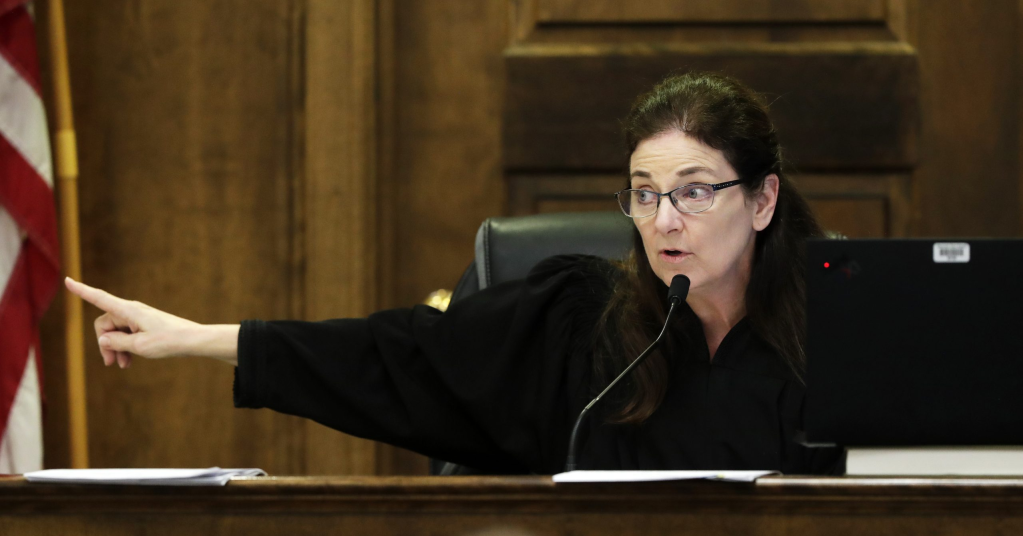
Brown County Judge Tammy Jo Hock said she doesn’t give her staff breaks, works them through lunch, makes them stay late. This was the only way cases could keep moving through court, Hock told the county’s Public Safety Committee on Sept. 9.
“It’s unreasonable what I do to my staff,” Hock said.
She pointed to the judicial system getting less than 2% of the 2025-27 state budget. “When you limit your resources like that, you’re not providing what the state needs,” Hock said. “And at some point, I hope they start addressing that.”
Warnings that underinvestment may be causing Wisconsin’s judiciary to fall short in delivering justice have mounted ahead of the Nov. 3 elections to decide the state Legislature, vested with budgetary powers, and the governor’s office. The politics in the budgeting process has left many in the judiciary frustrated at years of being under-resourced despite studies showing what’s needed. It has angered some county boards faced with the choice to locally fund gaps in the judicial system or not.
Sign up for Northeast News, our free email newsletter focused on northeast Wisconsin.
Those within the system are burdened with the consequences.
Brown County has the largest deficit of judges and court commissioners of any Wisconsin county, short nearly six officials, according to the Wisconsin Judicial Needs Assessment Survey issued in April.
The finding adds to well-documented inadequacies elsewhere: short staffing in district attorney offices; low pay in public defense; struggles to recruit and retain lawyers; shortages in mental health treatment for those to stand trial.
Prosecutors face backlogs of cases in the thousands, slowing convictions. About half of all criminal cases needed more than six months to resolve in 2025. Some defendants have gone for months without an attorney, straining jails. Many judges feel pressure to move cases quickly, even when more time would improve their decision-making, according to the judicial needs assessment. Interest in law careers has dwindled, compounding staff shortages.
Outagamie County District Attorney Mindy Tempelis on Aug. 25, during the state’s first study committee into district attorney funding, said Wisconsin “was not meeting its obligation” and argued the state Legislature should invest in making a Wisconsin-specific judicial system that would not break down.
“People’s lives are on the line,” Tempelis said.

‘The entire system is broken’ with possible paths forward
In addition to the number of cases before them, judges face more time-consuming work than in the past, according to the 2025 Wisconsin Judicial Needs Assessment Study.
Digital evidence has mounted, become routine and taken much time to review, the assessment said. More litigants are self-representing and using artificial intelligence to create filings, which have made judges take more time to interpret “often lengthy, unclear, or legally inconsistent” files, according to the assessment. And judges are spending more time on cases before trial as evidence suppression and other pretrial motions have grown more popular.
For those making cases before judges, the workload has also grown more burdensome.
Tempelis told the state’s study committee that the current formula to calculate how many prosecutors each district attorney office needs has become outdated.
The formula assumes attorney work still revolves around paper files, faxed police reports, physical photos and evidence that could fit into a folder, Templis said in her presentation. There are now hours of footage from body cameras, which each county may use different versions of, and thousands of text messages to extract, she said.
Tempelis also said the mental health system is broken, with jail being the always-open alternative. She emphasized the attorney shortage in the state, the lack of lawyers interested in going to rural counties and inconsistency with which the Legislature decides to fund pay progression for prosecutors, leaving it entirely unfunded at times.
She pointed to the 1,400 cases that make up the backlog in her office.
“There are no prosecutor bodies, court bodies, or defense bodies to pick up that backlog anywhere in this state,” Tempelis said. “And that is a horrible realization for defendants and for victims and for our communities.”
Tempelis argued the Legislature could invest in finding data that would show the true workload of prosecutors, saying the studies should reflect work as close to real time as possible. She pushed for fully funding attorney pay progression and creating a prosecutor council, an agency that, in other states, advocates for and supports the work of attorneys.
She said she had no doubt the Wisconsin Legislature was not going to give the judiciary everything it wished for. She argued, though, that a sustainable system supported by data would prevent politically motivated decision-making.
Under the current system, Tempelis said that counties picking up the tab for the state’s responsibility was unfair. District attorneys, their assistants and public defenders are state employees.
She said she was lucky that the Outagamie County Board made it a priority to fund a prosecutor position in her office. However, “They are frustrated. They are angry and they don’t want to. But they’re trying to make a good decision for the people of Outagamie County; that’s their job. But funding us is not their job, because the state asked for it.”
Jennifer Bias, the state public defender, said, “The point has been made that the entire system is broken.”

Adding judges requires added support personnel
Judge Hock pressed the Brown County Public Safety Committee on Sept. 9 to endorse a resolution for the County Board to call on the state for two more circuit court judges.
Court dates were being pushed further out from a growing caseload. There were 3,755 pending criminal cases in the county in 2025, according to the resolution. Hock asks attorneys in the hallways if they will take cases as public defenders.
While she recognized the court assessment called for about six more judges, Hock said the director of state courts believes the Legislature will only have the stomach to fund two.
Plus, it’s not just as simple as electing two judges.
To accommodate two more judges, the county would need to provide enough support personnel to the tune of an additional $222,814, including two sheriff deputies, judicial assistants, court coordinators and a one-time staff setup charge. Accommodation for space has already been budgeted in the Brown County capital improvement plan, according to the resolution.
Brown County Board Chairman Patrick Buckley pointed to the county needing to shell out for support staff and court infrastructure as the state adds more judges, saying he didn’t think the county should have to pay for more prosecutors and wished to see more consolidated staffing “because throughout the county, as budgets get tighter, who do we cut? The sheriff’s office? 911?”
“I can’t address how the county and state share those expenses,” Hock replied. “All I can tell you is what the need is.”
This story was produced as part of the NEW (Northeast Wisconsin) News Lab, a consortium of five news outlets.
Judges warn that underfunded courts are falling behind is a post from Wisconsin Watch, a non-profit investigative news site covering Wisconsin since 2009. Please consider making a contribution to support our journalism.
