


- Singapore plans to reclaim an estimated 590 hectares (1,460 acres) of seascape and merge several islands to create a new “western island”.
- The mega-project could bury up to 60% of Singapore’s remaining reefs, many of which are “mother” reefs and of regional ecological significance.
- The reefs are traditional fishing grounds for the Indigenous Orang Laut, who say that the project would restrict their access to an area of cultural significance.
- The project raises awkward questions about the volume and source of sand needed to construct the island.
SINGAPORE — “For seven thousand years, Singapore has changed around these reefs,” says Debby Ng, a Singaporean biologist who studies the city-state’s shrinking coastlines of seagrasses, mangroves and corals. “They are still here.”
Despite colonization, war, shipping and industrialization, reefs a few kilometers south of Singapore’s gleaming shoreline have endured.
“It would be a tragedy if we were to lose them now — in peacetime, at the height of our prosperity, when we possess more knowledge and capacity to protect them than any generation before us,” Ng tells Mongabay.
At a National Day rally on Aug. 23, Prime Minister Lawrence Wong announced plans to merge a cluster of islands covering roughly 590 hectares (1,460 acres) of seascape into a new “western island” for advanced manufacturing, energy and defense.
No timeline for the western island project was given. Wong said reclamation would take place “over the coming decades” and that plans were being studied carefully.
But the announcement has alarmed Singapore’s marine conservation community, which says the project could affect some of the country’s most biodiverse waters.
The islands include Pulau Semakau, which houses Singapore’s offshore landfill, and Pulau Bukom, home to an oil refinery, as well as Pulau Sudong and smaller islands including Pulau Hantu, Pulau Jong and Pulau Sebarok.
The area is estimated to contain about 60% of Singapore’s remaining coral reefs, 22% of its seagrass meadows and 5% of its mangroves.

The blueprint for the project is Jurong Island, created by merging seven islands in the 1980s to form a petrochemicals hub. Wong said Jurong Island had supported Singapore’s development for the past 50 years, and that the western island would help shape “the next 50 years and beyond”.
Some have speculated that the new island could host Singapore’s first nuclear power plant, although the government has not confirmed this will happen.
The announcement came as Singapore’s nature groups were already grappling with plans to develop some of the city-state’s remaining forests, and with Long Island, a major coastal protection project that conservationists say could affect hundreds of hectares of seagrass habitat.
Sam Shu Qin, a marine scientist and co-founder of conservation initiatives Our Blue Spaces and Our Singapore Reefs, says the western island plans have left researchers questioning the value of ongoing reef restoration efforts.
“We had so much hope, especially looking at the scale of the government’s commitment in marine conservation,” she says, pointing to the National Parks Board’s 100k Corals Initiative, Singapore’s largest reef restoration program, launched in 2024.
The announcement felt like “a big step backwards” and has created uncertainty among donors who worry that their funding could ultimately be wasted, she says.
“Building support for marine conservation in Singapore takes years,” Shu Qin says.

Resilient reefs
Singapore has already lost some two-thirds of its original coral reefs since the 1960s, as the city-state expanded its land area and transformed its coastline into a global shipping and oil refining hub.
Dredging and reclamation have also made Singapore’s waters chronically turbid. Typical turbidity levels are below 20 formazin turbidity units, but can exceed 150 near dredging and coastal development, reducing the amount of light reaching corals.
Yet the reefs have proved remarkably resilient.
Singapore is home to more than 250 hard coral species as well as around 120 species of reef fish. The rediscovery in 2011 of the Neptune’s Cup sponge (Cliona patera) in southern waters was another indication of the biological richness that persists alongside some of the country’s most industrialized coastlines.
The reefs also contain large, breeding-age colonies that scientists have documented spawning in recent decades.
“These large, breeding-age colonies are the mothers and fathers of future generations of coral,” biologist Ng says. “Their offspring are carried by currents beyond their home reefs, replenishing damaged reefs and establishing new colonies elsewhere.”
Destroying them could therefore have consequences beyond the individual reefs buried by reclamation, she says.
“Once these colonies are destroyed, their biological history cannot be recreated,” Ng says.
“The largest and oldest colonies are too massive and structurally complex to move safely. Reclamation over their reefs therefore does not mean moving them somewhere else — it means sacrificing them.”
The government has not announced plans to relocate the reefs, saying comprehensive environmental, technical and feasibility studies must first be completed.
Singapore also announced plans in September to map its marine and coastal habitats, a move that conservationists hope will provide a fuller picture of what could be affected by future development.

Reclaiming Indigenous territory
The western island plans have also unsettled Singapore’s Indigenous Orang Laut community.
Firdaus Sani, founder of Orang Laut SG, a group representing the community’s interests, says its members felt blindsided by the announcement because they were not consulted.
If the project proceeds, he says, an environmental impact assessment (EIA) should include the community’s knowledge of the reefs and surrounding waters, which have long been part of its traditional livelihoods and seafaring heritage.
“We hope that Indigenous voices will hold the same weight as scientists or environmental groups [in EIA discussions],” Sani says. “It’s time to allow Indigenous peoples who are connected to the land and sea into the process of development.”
Orang Laut, or “sea people” in Malay, have traditionally lived a maritime way of life across the Riau archipelago, which spans from the coasts of Sumatra and Singapore toward Borneo. Those living around Singapore were resettled on the mainland in past decades, but many continue to visit and fish around the islands that are now earmarked for development.
Cik Hamsa, a 71-year-old Orang Laut elder, was evicted from Pulau Sudong in the 1970s when the government redeveloped the island as a military live-firing zone. He still fishes around the island, as he has done since he was 17.
If the western island project proceeds, he fears increased turbidity will make it impossible to continue fishing with traditional bubu traps.
“I will still try to go out to sea if I am able to, but if the southern waters are changed, I may have to relearn everything,” he says.
“I know the coral reefs and fishing grounds in these waters; that is where my experience is. If those places disappear, it is not easy to simply move somewhere else and start again.”

The project is also likely to restrict access to waters that have long been used by the Orang Laut, as happened around Jurong Island following its development.
But the community is concerned about impacts beyond Singapore’s maritime boundaries.
Orang Laut SG’s Sani says relatives in Indonesia’s Riau Islands have long experienced the effects of Singapore’s coastal development and fear these could intensify.
Reclamation around Pulau Sudong and Pulau Tekong, Singapore’s largest outer island, which is used for military training and is undergoing further expansion, has increased sedimentation in surrounding waters, reducing fish catches and forcing some fishers to move to other areas, he says.
The concern is shared by Johanes Jamil, an Orang Laut man from Kawal, a village on Bintan in Indonesia, 130 kilometers (80 miles) from Singapore.
“When I heard that some islands may be joined into one big island, I started to think: if the islands change, what will happen to the sea around them?” he tells Mongabay via text.
“For people who live on land, maybe they only see changes in the shape of the island. But for Orang Laut, when the island changes, we also think about the sea. Will the water current change? Will the fish move to another place? What about places where people look for shells, crabs and other seafood?”
Jamil says he does not know whether the western island project will be good or bad, but believes more needs to be understood about its potential effects.
“A big change in one place may have an impact on other places,” he says.


Shifting sands
The project also raises questions about a less visible but critical ingredient of Singapore’s reclamation: sand.
No official estimate has been published for how much material will be needed, because the final land area and configuration have yet to be disclosed. But creating an island across several kilometers of open water could require millions of tons of fill.
An academic paper estimates that Singapore’s Long Island coastal protection project could require about 240 million tons of infill material. The western island could cover an area roughly 300 hectares (740 acres) smaller.
Mongabay has asked Singapore’s Ministry of National Development about the likely quantity, sources and environmental standards governing sand procurement, but had received no response at the time of publication.
Singapore is one of the world’s biggest buyers of sand. Several of its Southeast Asian neighbors, including Indonesia, Malaysia, Vietnam and Cambodia, have restricted or banned exports in recent years amid concerns about the environmental and social impacts of extraction.
Dredging can damage marine ecosystems, erode shorelines and destabilize riverbanks. In the Mekong region, rampant extraction for the construction industry has threatened Southeast Asia’s largest lake, Cambodia’s Tonle Sap.


One of the most well-documented examples of the impacts of sand mining is the Indonesian island of Pulau Nipah. The island was dredged so intensively that it nearly disappeared in the early 2000s. Indonesia subsequently reclaimed it to restore its maritime border with Singapore and banned sea-sand exports in 2003.
Indonesia resumed some sea-sand exports in 2023, while a recent Mongabay investigation found evidence suggesting that Cambodia’s previously banned sand trade with Singapore may have officially resumed.
Madhumitha Ardhanari, a Ph.D candidate at the Global Centre for Mineral Security and the Camborne School of Mines, says Singapore’s announcement suggests the government is confident that it can secure enough material for the project.
But she says there is little transparency in the sand supply chain, making it difficult to assess whether extraction is sustainable.
“Singapore is very particular about getting legally procured sand,” she tells Mongabay. “So it is legal on the buyer’s end. But accountability gets lost in terms of who is doing the procurements, how they do it, and the standards they are holding to.”
“There is no such thing as ‘sustainable’ sand. The only gold standard right now is the legality — which is wild,” says Ardhanari, who has studied the impacts of Singapore’s sand extraction on its neighbors.

Ardhanari is researching whether ore sand, a byproduct of metal and mineral processing, could provide an alternative to sand extracted from rivers and coasts.
For the western island project, she says Singapore should take a more inclusive and transparent approach to decision-making, considering the long-term effects of reclamation, not only within Singapore but across the region.
The question, she says, is ultimately bigger than how Singapore creates more land; it is about what environmental and social costs the city-state is willing to accept — and where those costs are borne.
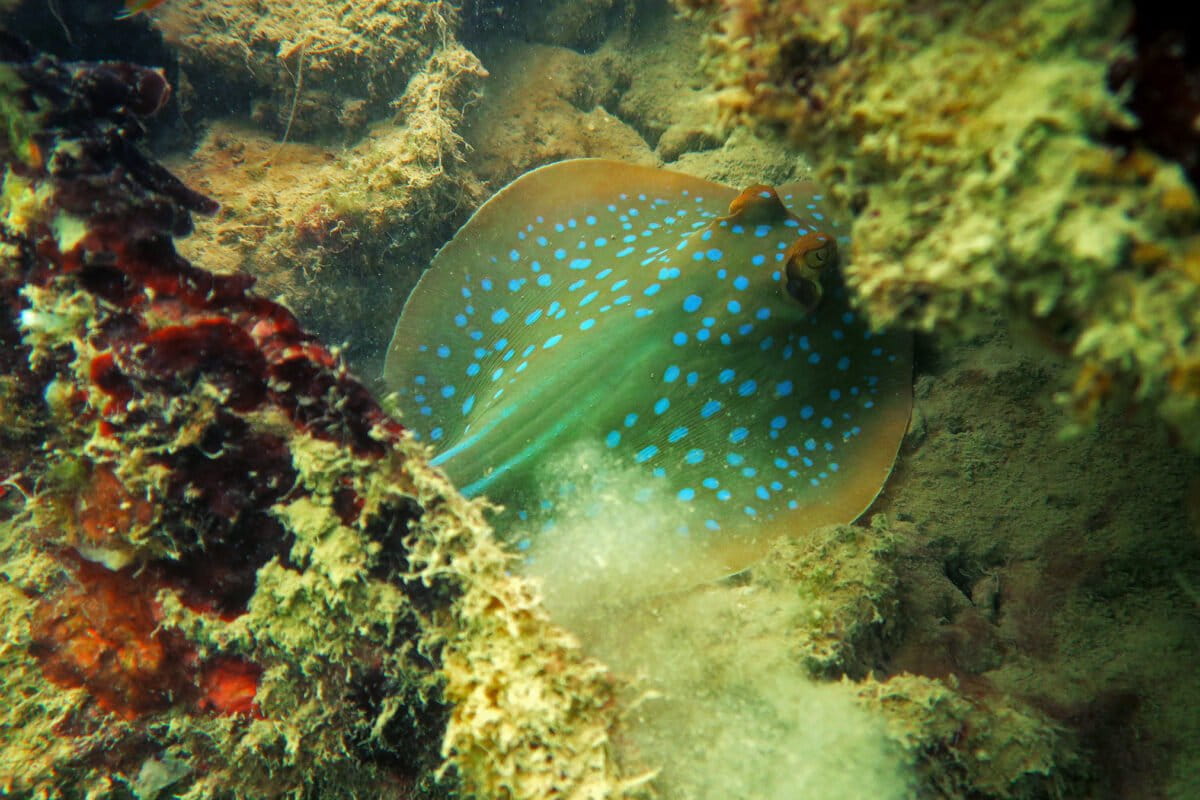
Banner image: A bluespotted ribbontail ray (Taeniura lymma) on a reef bed by Pulau Hantu. Image by Sam Shu Qin.
Cambodia’s banned sand trade with Singapore appears to be back
Citations:
Tan, K. S., Acerbi, E., Lauro, F. M. (2016). Marine habitats and biodiversity of Singapore’s coastal waters: A review. Regional Studies in Marine Science, 8, 340-352. doi:10.1016/j.rsma.2016.01.008
Morgan, K., Moynihan, M., Nugraha, A., Switzer, A. D. (2025). Sediment fluxes on turbid coral reefs are modulated by monsoon variability in equatorial Southeast Asia. Science of The Total Environment, 1002. doi:10.1016/j.scitotenv.2025.180563
Jamieson, W. (2024). Reclaiming resilience through granular arbitrage: Anticipating sea level rise in Singapore. Critical Asian Studies, 56(4), 555-575. doi: 10.1080/14672715.2024.2414376
