


KEN CARYL, Colo.—A new residential development south of Denver is the testing ground for an unusual partnership that could transform home heating and cooling across the country.
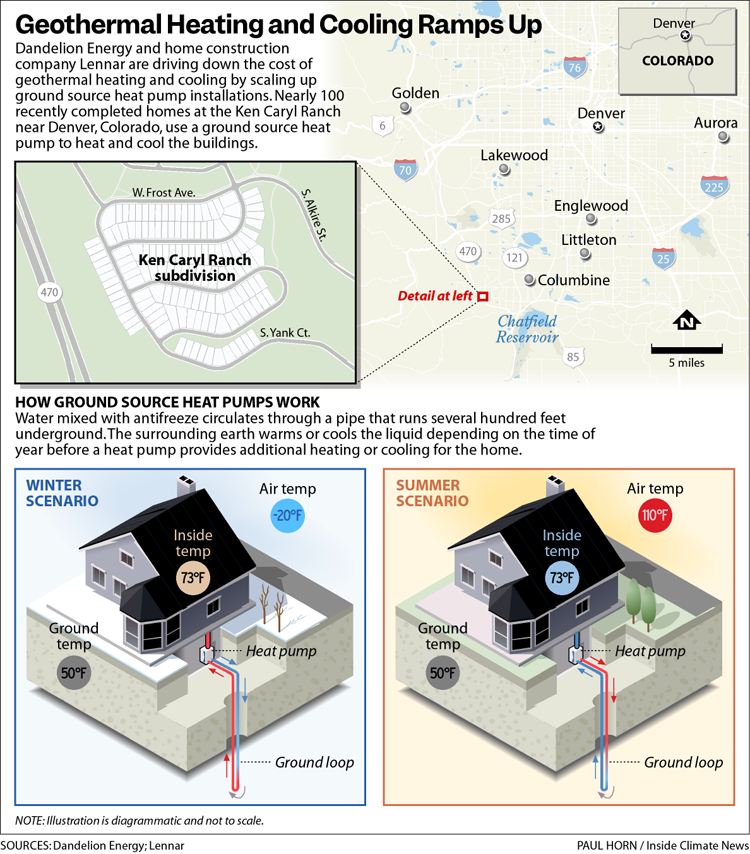
Dandelion Energy, a geothermal startup, and Lennar, one of the nation’s largest homebuilders, recently completed construction of nearly 100 homes at the base of Colorado’s Front Range, each equipped with its own ground-source heat pump. The systems use less electricity than even the most efficient air-source heat pumps, potentially helping Colorado meet its climate goals while reducing peak energy demand and eliminating the need for new gas pipelines.
Ground-source heat pumps draw on steady temperatures belowground to help heat and cool buildings. However, the projects’ custom designs and drilling requirements—homes typically require one or more boreholes drilled several hundred feet deep—are pricey. Drilling alone often costs more than $10,000.
Dandelion, a company that got its start at X—a “moonshot” research and development subsidiary of Alphabet, Google’s parent company—says it can complete geothermal heating and cooling projects twice as fast and at half the cost of similar installations.
The company is “taking a kind of mass market and maximally efficient lens to what has historically been a bespoke kind of custom, high-end product,” said Dan Yates, Dandelion Energy’s CEO and chairman.
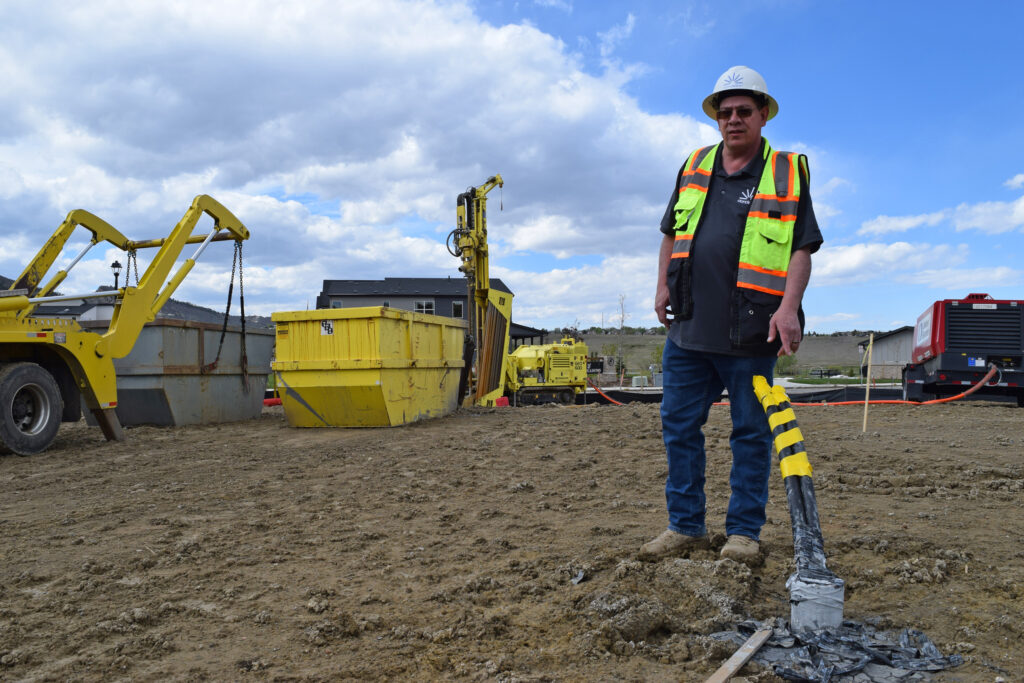
Earlier this year at Lennar’s Ken Caryl Ranch development, Dandelion’s drill team demonstrated a lightweight rig designed to quickly move from lot to lot, drilling boreholes and installing polyethylene pipe across the sprawling housing development before building foundations are poured.
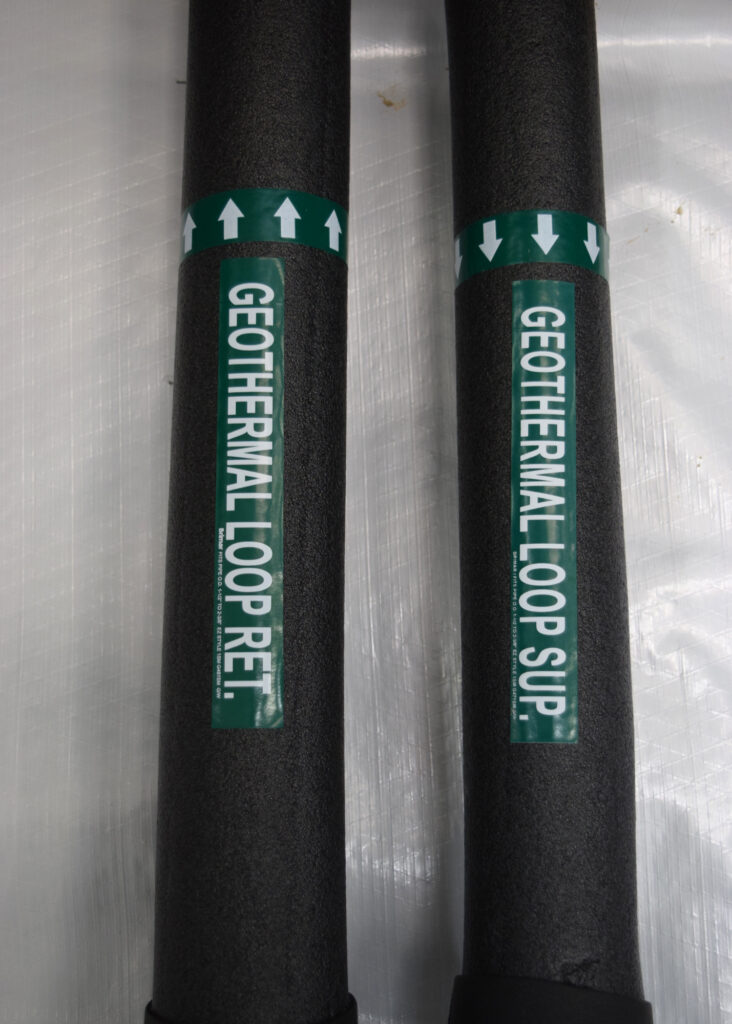
Each home gets a single bore between 200 and 500 feet deep, where temperatures are approximately 50 degrees Fahrenheit year-round. Water circulating through the pipe is warmed or cooled by the surrounding earth before a heat pump installed in the basement of each new home provides additional heating or cooling depending on the time of year.

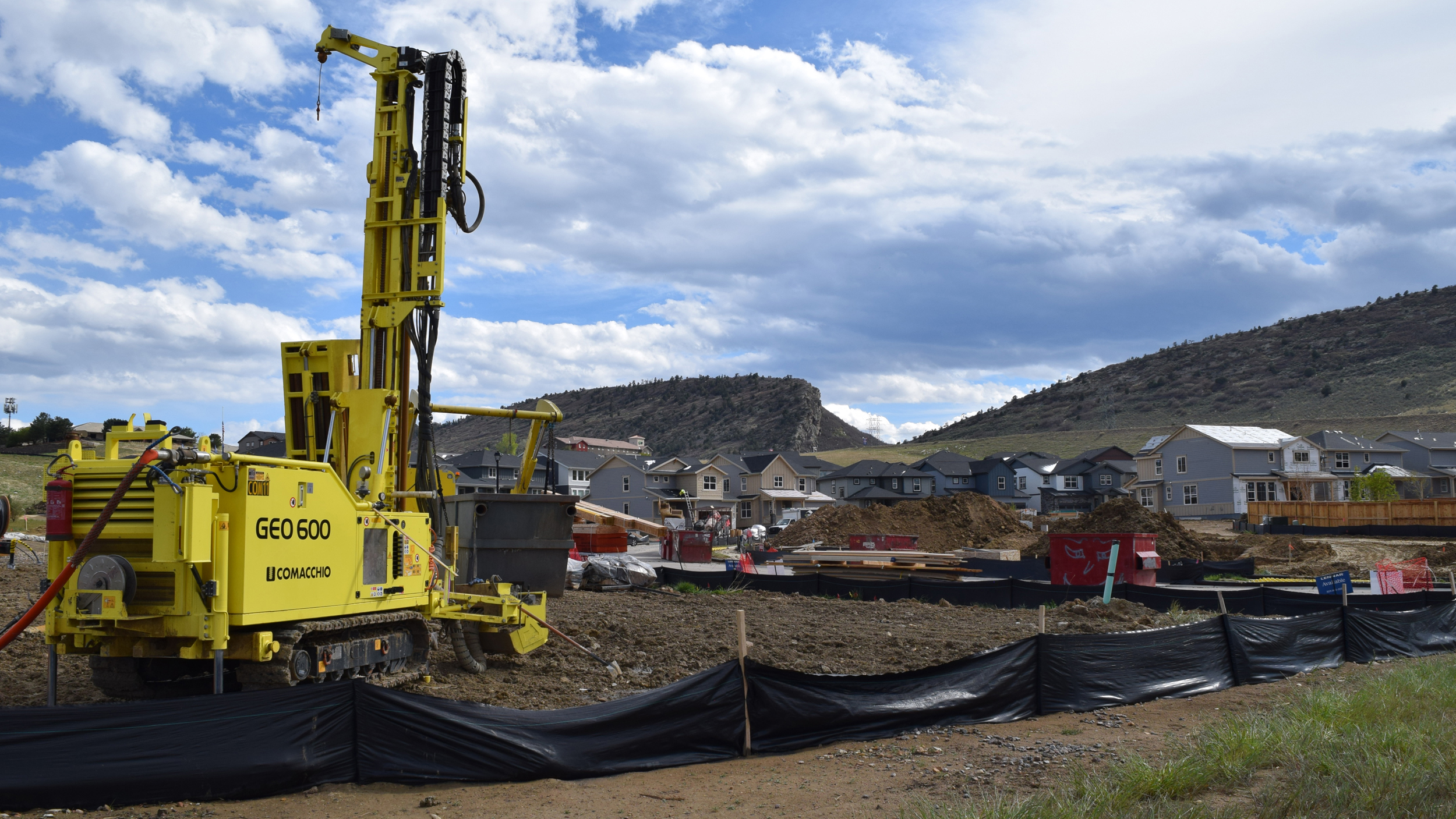
Dandelion’s drilling team can complete boreholes for one or more homes per day. If they had to drill a similar installation elsewhere for a single building, they could lose an entire day simply transporting the rig to and from the site.
Installing the devices across dozens of similar new homes at once also eliminates the need for custom plans for each building and avoids potentially costly retrofits to the buildings’ heating, ventilation and air conditioning systems.
The end result is a highly efficient heating and cooling system that Dandelion says outcompetes air-source heat pumps and conventional gas heating systems. This is especially true during cold snaps, when energy demand peaks and ground-source heat pumps use a quarter as much electricity as air-source heat pumps, Yates said.
It’s “the only system that actually reduces peak demand and electrifies homes at the same time,” he said.
The Ken Caryl Ranch development is part of a larger initiative the company launched with Lennar in 2025 to install geothermal heating and cooling at more than 1,500 homes in Colorado over two years. Dandelion hopes to scale up to 10,000 homes per year nationwide in the coming years.
“Our mission at Dandelion is to mainstream geothermal, and we think that the time has finally arrived for that to happen,” Yates said.
Just over a million U.S. homes have ground-source heat pumps, with approximately 100,000 new installations each year, according to a 2025 U.S. Department of Energy report. The agency found that geothermal heating and cooling could reach 7 million homes by 2035. Doing so would reduce winter peak energy demand by more than 40 gigawatts nationwide, resulting in roughly $4 billion in annual savings in U.S. electric grid costs, according to the report.
This story is funded by readers like you.
Our nonprofit newsroom provides award-winning climate coverage free of charge and advertising. We rely on donations from readers like you to keep going. Please donate now to support our work.
Ground-source heat pumps currently make up just a small fraction of new home heating and cooling systems. By contrast, 3.6 million air-source heat pumps were sold in the U.S. last year, outpacing gas furnace sales for the fourth year in a row, said Yara van Ingen, an associate with BloombergNEF’s building decarbonization team.
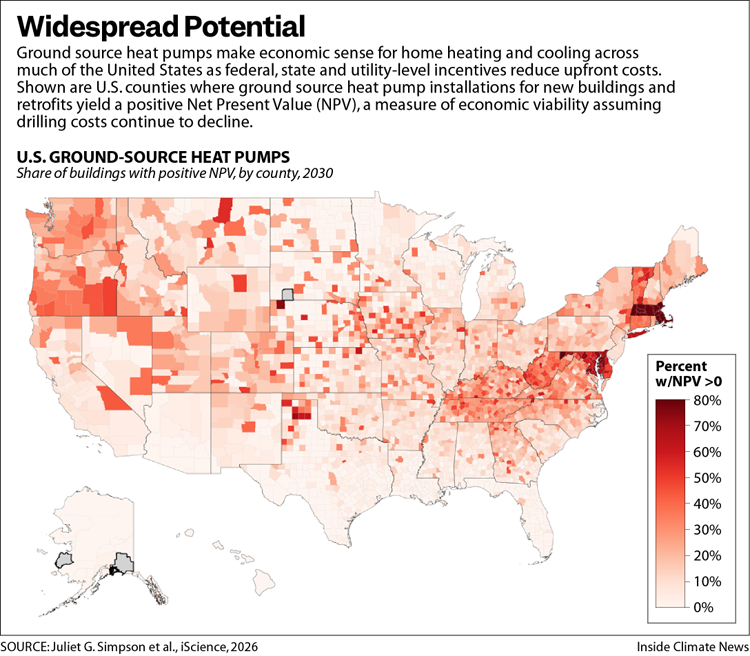
Ground-source heat pumps are economically viable across the continental United States, according to a study published this month in the journal iScience that considered incentives, energy costs and local climate and subsurface conditions.
“It is technically possible everywhere, and there is economic potential across all states,” said Juliet Simpson, a former research engineer at the National Laboratory of the Rockies and the study’s lead author.
A primary challenge for ground-source heat pumps is their upfront cost, which averages around $25,000 for a typical new home, according to the Energy Department report. Van Ingen added that space constraints, especially in dense urban environments, as well as permitting requirements that vary across the U.S. can also complicate borehole drilling.
Dandelion and Lennar, an investor in the geothermal company, are among those working to lower costs. But incentives and policy changes also help. An energy efficiency program by Xcel Energy, Colorado’s largest gas and electric utility company, provides approximately $25,000 per home for new, high-efficiency buildings with a ground-source heat pump to offset added building and heat pump costs.
“For large neighborhoods with hundreds of homes, builders may receive seven-figure rebate amounts,” an Xcel spokesperson said in a written statement.
The rebates help Xcel advance its climate goals and meet Colorado’s Clean Heat Standard requirement to reduce greenhouse gas emissions 22 percent below 2015 levels by 2030.
Colorado also provides a $2,000 tax credit for ground-source heat pumps and requires homebuilders to pay for new gas service expansion pipes, costs that are not incurred if developers build all-electric homes.
Policies that incentivize high-efficiency electric heating and cooling while discouraging fossil fuel use in homes are intended to reduce greenhouse gas emissions from buildings, said Will Toor, executive director at the Colorado Energy Office.
Other states and utility companies also offer incentives for ground-source heat pumps, including Maryland, where Dandelion recently announced plans to install the technology in 129 new homes. In addition, commercial ground-source heat pump projects are now eligible for federal tax credits that cover 30 percent or more of total installation costs.
“The economics just look better and better,” Jessica Silber-Byrne, senior manager of thermal energy networks for the Building Decarbonization Coalition, a nonprofit organization working to eliminate the use of fossil fuels in buildings. “There is a combination of both incentives and market signals that suggest that this is about to really take off.”
About This Story
Perhaps you noticed: This story, like all the news we publish, is free to read. That’s because Inside Climate News is a 501c3 nonprofit organization. We do not charge a subscription fee, lock our news behind a paywall, or clutter our website with ads. We make our news on climate and the environment freely available to you and anyone who wants it.
That’s not all. We also share our news for free with scores of other media organizations around the country. Many of them can’t afford to do environmental journalism of their own. We’ve built bureaus from coast to coast to report local stories, collaborate with local newsrooms and co-publish articles so that this vital work is shared as widely as possible.
Two of us launched ICN in 2007. Six years later we earned a Pulitzer Prize for National Reporting, and now we run the oldest and largest dedicated climate newsroom in the nation. We tell the story in all its complexity. We hold polluters accountable. We expose environmental injustice. We debunk misinformation. We scrutinize solutions and inspire action.
Donations from readers like you fund every aspect of what we do. If you don’t already, will you support our ongoing work, our reporting on the biggest crisis facing our planet, and help us reach even more readers in more places?
Please take a moment to make a tax-deductible donation. Every one of them makes a difference.
Thank you,

Reporter, Boston
Phil McKenna is a Boston-based reporter for Inside Climate News. Before joining ICN in 2016, he was a freelance writer covering energy and the environment for publications including The New York Times, Smithsonian, Audubon and WIRED. Uprising, a story he wrote about gas leaks under U.S. cities, won the AAAS Kavli Science Journalism Award and the 2014 NASW Science in Society Award. Phil has a master’s degree in science writing from the Massachusetts Institute of Technology and was an Environmental Journalism Fellow at Middlebury College.
