


Welcome back to Foreign Policy’s Latin America Brief.
The highlights this week: Acting Venezuelan President Delcy Rodríguez attends the United Nations General Assembly, oil-rich Guyana prepares to launch a development bank, and a Bolivian biologist discovers a new cat species.
Latin America was in the spotlight this week at the United Nations General Assembly in New York.
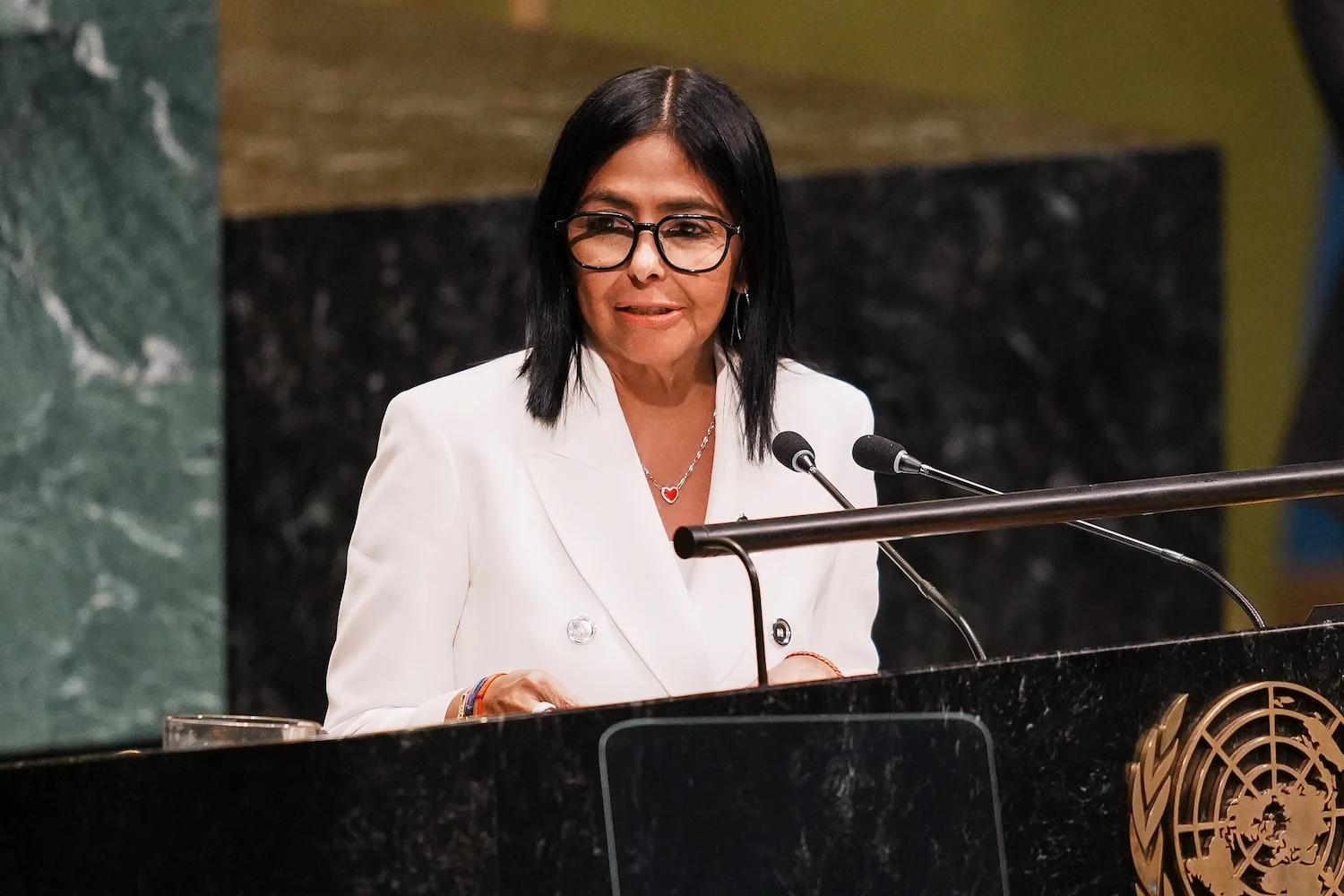
Venezuela saw a reentry of sorts into the international community, as acting President Delcy Rodríguez became the first Venezuelan leader to address the gathering in-person in eight years. Her predecessor, Nicolás Maduro, avoided the event in part due to fear of being arrested following his 2020 U.S. indictment on drug trafficking charges.
Maduro returned to New York this year but on very different terms: Since the U.S. military captured him in January, he has been held in a federal prison in Brooklyn, not far from the United Nations. Meanwhile, the Trump administration is working with Rodríguez on efforts to rebuild the country’s oil industry.
According to polls, Venezuelans overwhelmingly want free elections to choose their own leader. But both Rodríguez and the United States have declined to provide a timeline for a vote.
When Rodríguez took the podium at the U.N. General Assembly on Wednesday, she pledged that elections would occur in the country—but at an unspecified “right moment.” While in New York, she also met with U.S. President Donald Trump, who made no public mention of such a vote.
Some Latin American presidents seemed to show a growing willingness to go along with Trump in normalizing Rodríguez’s leadership. On his way to New York, Paraguayan President Santiago Peña made a stopover in Caracas, becoming only the second head of state after former Colombian President Gustavo Petro to pay the Rodríguez administration an official visit.
In New York, Chilean President José Antonio Kast—a longtime critic of Rodríguez’s Socialist movement who invited Venezuelan opposition leader María Corina Machado to his inauguration in March—held a meeting with Rodríguez.
Meanwhile, between meetings, Panamanian President José Raúl Mulino brushed aside a question about whether Machado should be able to return to the country, saying, “That’s a problem for Venezuelans, not for me.”
Machado has been outside Venezuela since she traveled to Norway to receive the Nobel Peace Prize last December. Because the Venezuelan government has refused to renew her passport, she depends on other methods—and at times the cooperation of other governments—to travel.
In recent weeks, Machado has been staying in Panama, which granted her a temporary diplomatic travel document, multiple outlets reported this week. But she was blocked from embarking on flights or boats that were part of a planned trip to Venezuela three times this week alone, one of her team members told journalists on Wednesday.
Altogether, the events suggest that Trump is in no rush for elections in Venezuela—and that Trump-friendly presidents in the region are not pushing for democratization, either. Brazilian President Luiz Inácio Lula da Silva was a lonely voice who suggested a different approach, saying in his General Assembly speech that “the Venezuelan people deserve to define their own destiny.”
World leaders and diplomats also used this week’s gathering to confer about the U.N. secretary-general race. On Saturday, former Chilean President Michelle Bachelet became the first candidate to withdraw from the election, writing in a statement that “strong winds” were blowing against her key principles of multilateralism, international law, and climate action.
Bachelet’s sponsor countries, Brazil and Mexico, can now back another candidate. If their endorsements give momentum to a current front-runner, it could keep the position in Latin America’s court.
Right now, the two top secretary-general candidates in the latest Security Council straw polls—a key step toward identifying a victor—are from the region: former Costa Rican Second Vice President Rebeca Grynspan and former Guyanese Foreign Minister Carolyn Rodrigues-Birkett.
But because no single candidate has clearly risen above the rest after three straw polls, more contenders might enter the contest soon—and could push its final outcome away from the region.
Sunday, Oct. 4: Brazil holds presidential and legislative elections.
Friday, Nov. 6, to Tuesday, Nov. 17: Pope Leo XIV visits Uruguay, Argentina, and Peru.
Militarized security policy. The Trump administration’s strikes on alleged drug boats in the Americas “plausibly constitute crimes against humanity,” Ben Saul, a special rapporteur for the U.N. Human Rights Council, wrote in a report released last week. He is the latest of many legal experts to denounce the strikes, which Trump says are justified as self-defense.
Meanwhile, Trump-friendly leaders from Latin America participated in a “Shield of the Americas” event this week on the sidelines of the U.N. General Assembly, where they agreed to explore sanctioning drug gangs and designating them as terrorists, as the United States has already done to several groups throughout the region.
The move means that more Latin American governments could soon use their armies to fight crime—and allow U.S. partners to join.
Tech utopianism. A mostly U.S. online community backed by crypto funding said this week that its members have agreed to move to a yet-to-be-constructed city in Uruguay. The city will be part of a larger development called +Colonia, helmed by Argentine businessman Eduardo Bastitta, an advisor to Argentine President Javier Milei.
Praxis, the online community, says it is “using AI to create our own country,” where governance will draw heavily on the technology.
Like El Salvador’s push to implement bitcoin as legal tender, Praxis’s physical hub would be an experiment in incorporating emerging technologies into governance in the region. The project also underscores the attractiveness of the Southern Cone for U.S. tech utopians, following billionaire Peter Thiel’s slew of investments and home purchase in Argentina.
However, another tech utopian project in the region stands as a cautionary tale. Honduras’s Próspera has low-tax, low-regulation rules to attract tech entrepreneurs but has triggered criticism from a nearby community over its water use and low contributions to public services.
It was not immediately clear from which data centers +Colonia would source its computing power, for example.
A tilcayo is seen at the Senda Verde wildlife sanctuary near Coroico, Bolivia, on Sept. 22. Aizar Raldes/AFP via Getty Images
Cat out of the bag. Bolivian biologist Paola Nogales-Ascarrunz has discovered the first new wild cat species in more than a century. The Leopardus tilcayo looks like a leopard but is smaller than a housecat. The findings were made official in a paper published last week in the journal Current Biology.
The tilcayo cat that Nogales-Ascarrunz identified was delivered to a wildlife sanctuary in 2017. It is native to the eastern slope of the Bolivian Andes Mountains. Nogales-Ascarrunz and her colleagues used genetic analysis to reveal that it split from other cat species more than a million years ago.
The second-most recently discovered cat also hails from South America: the Uruguayan pampas cat, identified in 1923.
Nogales-Ascarrunz’s cat, named Tigrino, still lives in the sanctuary near La Paz. He has become a newfound celebrity since the news of his status broke—though he is shy about interacting with his recent stream of visitors. Because his natural habitat is Bolivia’s endangered tropical forests, one of the sanctuary workers said Tigrino is an “ambassador for conservation.”
What year did El Salvador make bitcoin legal tender?
2021
2022
2023
2024
The government rescinded the requirement that bitcoin be accepted as legal tender in 2025, as part of International Monetary Fund conditions for the country to receive a loan.

An aerial view of a cargo ship next to the port in Georgetown, Guyana, on Sept. 3, 2025.Joaquín Sarmiento/AFP via Getty Images
Last week, oil-rich Guyana announced dramatic economic growth numbers for the first half of 2026: a 33.3 percent GDP expansion. High global oil prices due to the Iran war have supercharged the country’s oil boom.
Tiny Guyana is now producing around 900,000 barrels of oil per day, on the heels of Venezuela’s estimated 1.2 million barrels. But Guyana is home to around 1 million people, while Venezuela’s population is more than 28 million. Less than a decade after Guyana began oil production in 2019, it is now classified as a high-income country by the World Bank.
But many Guyanese say the government should be doing more to make sure the wealth reaches ordinary people. The relatively low share that private oil companies are required to pay the government has triggered criticism in the past.
More pushback is possible, too. A new opposition party surged to become the second-largest in the legislature last year. Guyanese leaders have faced anti-government protests since a state-run ferry capsized in July, killing dozens of people.
On Sunday, President Irfaan Ali announced the details of a new initiative to mete out the country’s oil wealth. A new development bank with $100 million in capital will open early next month and focus on small, no-interest loans to entrepreneurs across the country. It adds to previous policies, such as making universities tuition-free and issuing one-time, $500 cash transfer across the country.
This approach could make Guyana a laboratory for studying economic development. There’s only one problem: The government does not regularly publish data on poverty and other key socioeconomic indicators.
The Inter-American Development Bank estimated that Guyana had a more than 50 percent poverty rate in 2024, while some Guyanese analysts say the level is closer to 18 or 20 percent. The gap underscores how central high-quality data is to development.
