


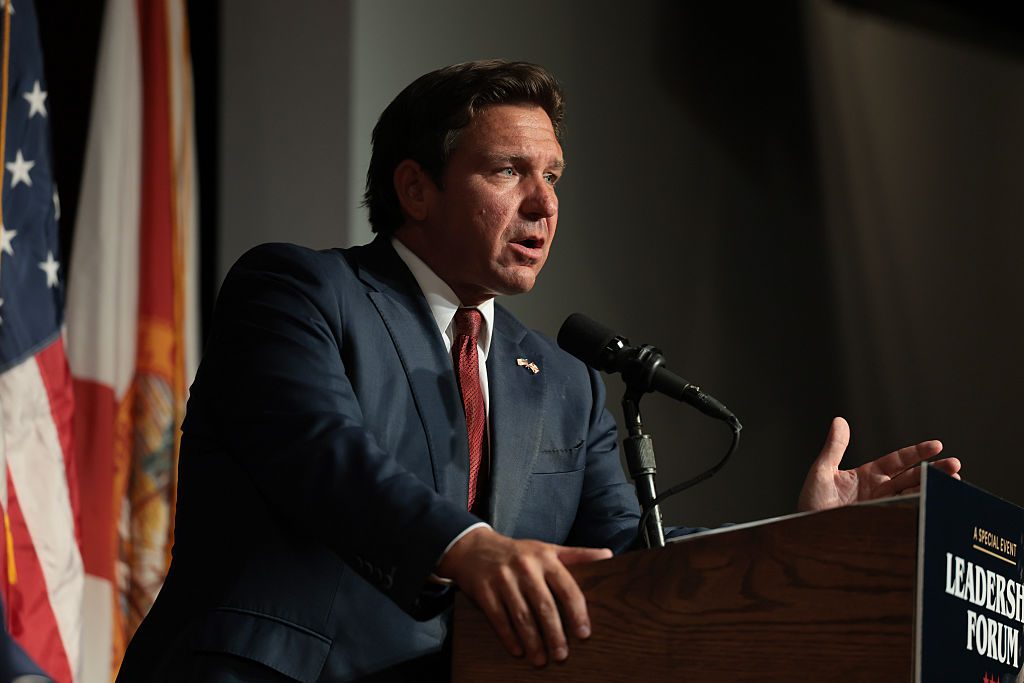
Florida Gov. Ron DeSantis is pushing for a state constitutional amendment to lower property taxes. (Photo by Joe Raedle/Getty Images)
Florida voters appear poised to reject a constitutional amendment backed by Gov. Ron DeSantis (R) that would reduce property taxes and limit how local governments can spend property tax revenue, despite massive spending by the proposal’s backers.
The measure has drawn nearly $18.5 million in combined contributions from supporters and opponents, making it one of the most expensive ballot measure campaigns among the 164 measures on state ballots nationwide this year. But it’s also among the most financially lopsided.
The support campaign raised $18 million through Sept. 18 – roughly 38 times the $472,000 raised by opposition committees – with all of the pro-Amendment 3 funding coming from the Florida Association of Realtors. However, the most recent poll found voter support to be below the 60% threshold needed for a constitutional amendment to pass.
(function(){function e(){window.addEventListener(`message`,function(e){if(e.data[`datawrapper-height`]!==void 0){var t=document.querySelectorAll(`iframe`);for(var n in e.data[`datawrapper-height`])for(var r=0,i;i=t[r];r++)if(i.contentWindow===e.source){var a=e.data[`datawrapper-height`][n]+`px`;i.style.height=a}}})}e()})();
What is Amendment 3?
On June 2, Florida lawmakers voted to put Amendment 2 on the November ballot after DeSantis had called for a special session of the Legislature aimed at providing property tax relief. While DeSantis’ original proposal included school tax relief and a trust fund mechanism for the state to backfill lost local government revenue, those provisions were not included in the Legislature’s proposed amendment. Despite the differences, DeSantis has endorsed Amendment 3.
The amendment would increase the homestead exemption applicable to non-school taxes from $25,000 to $150,000 in 2027 and $250,000 in 2028. Thereafter, the exemption amount would be tied to inflation. Property owners who are not permanent residents of Florida as of December 31, 2026, would be eligible for a smaller homestead exemption amount – $50,000 – for five years. After five years of residency, property owners could receive the full exemption.
If the amendment is approved, the Legislature would be required to establish a uniform procedure for counties and municipalities to increase the homestead exemption further – up to a property’s full assessed value. Special districts, which operate independently from local government, could do the same with voter approval.
Amendment 3 would also cut the annual cap on assessment increases for other non-homestead properties such as businesses and rental properties by half – from 10% to 5%.
Under the amendment, counties and municipalities would be limited to using property tax revenue solely for public safety, education, infrastructure, natural resources, bond debt service, public employee retirement benefits, operations and administration.
The Legislative Office of Economic and Demographic Research estimated that the amendment would result in revenue losses totaling $5 billion in 2027-28, $8.7 billion in 2028-29, $9.65 billion in 2029-30, and $10.7 billion in 2030-31.
Supporters and opponents
The Florida Association of Realtors has given $18 million to its political action committee Vote Yes on 3 since the beginning of September.
Florida Realtors, as the association is known, says it supports Amendment 3 because “the cost of owning a home doesn’t stop after you buy it,” and that “Property taxes, insurance premiums and other everyday expenses continue to put pressure on Florida households. Amendment 3 would lower property tax bills for eligible homeowners and help make it more affordable for people to stay in the homes they already own.”
Florida Realtors is the largest professional trade association in the state with more than 230,000 members, consisting of real estate agents, brokers, appraisers, property managers and other industry professionals.
Two opposition committees – Floridians for Shared Prosperity and Vote No on 3 – have raised a combined $472,379.
Floridians for Shared Prosperity has raised just over $84,000, with $62,250 coming from the Florida Policy Institute. The committee wrote: “Floridians are struggling with the affordability crisis, and we finally deserve a real tax break for us, not billionaires and corporations. But Amendment 3 is a scam and a tax shift. Either we get charged new taxes and fees or we lose important services like health care, EMTs, disaster recovery, public safety, and programs that help kids, seniors, or veterans.”
Vote No on 3 was established by former Leon County Commissioner Bryan Desloge (R). Desloge’s 501(c)(4) organization Stop Unfair Tax Shifts Inc. provided $240,000 of the committee’s $388,327. The Florida Association of Special Districts contributed $100,000.
The Vote No campaign argues that local government revenue losses from the property tax decreases would result in cuts to services or higher taxes elsewhere. Vote No on 3 wrote, “Public safety is the single largest budget item in more than 80% of Florida communities, consuming more than half of every general fund dollar spent. Deputies, firefighters, paramedics. When billions leave the tax base with no replacement plan, that’s where the cut lands. There’s no version of this math where it doesn’t.”
Organizations against Amendment 3 include the Florida State Fraternal Order of Police, Florida Sheriffs Association, Florida Association of Firefighters, Florida Fire Chiefs’ Association, Florida Police Chiefs Association, Tampa Bay Chamber, Florida Education Association, Florida League of Women Voters, Florida Library Association, Florida Economic Development Council, Florida Engineering Society, and Florida Recreation & Park Association.
The Vote Yes on 3 campaign acknowledged the “important question” many voters have had about the impact on local government budgets, writing: “The impact will vary by community, and each city and county will have to evaluate its own budget and priorities. Uncertainty about those decisions should not prevent Florida from addressing a known problem: the rising cost of owning a home. Public safety also remains a priority, with remaining property tax revenue prioritized for critical services such as police and fire protection.”
Polling indicates the measure lacks supermajority support needed to pass
A poll conducted Sept. 15-17 by StPetePolls among 913 likely Florida voters found that 44.9% supported Amendment 3, 30.4% opposed it and 24.8% were undecided. The poll described the measure as eliminating non-school property taxes on homesteaded primary residences.
Support for the amendment has declined substantially since earlier polling. Surveys conducted by Sachs Media in June and July found 64% and 63% of voters, respectively, said they supported the measure.
Speaking at the University of Alabama’s Shelby Institute for Policy and Leadership on Sept. 18, DeSantis said, “It’s a live issue. I don’t know if it’s going to pass with 60%. I wanted to be bolder. That would bring out more voters who were unenthused about voting. We’ll see if those folks are enthused enough about the Legislature’s proposal.”
Florida constitutional amendments require approval from at least 60% of voters to be adopted.
=
