


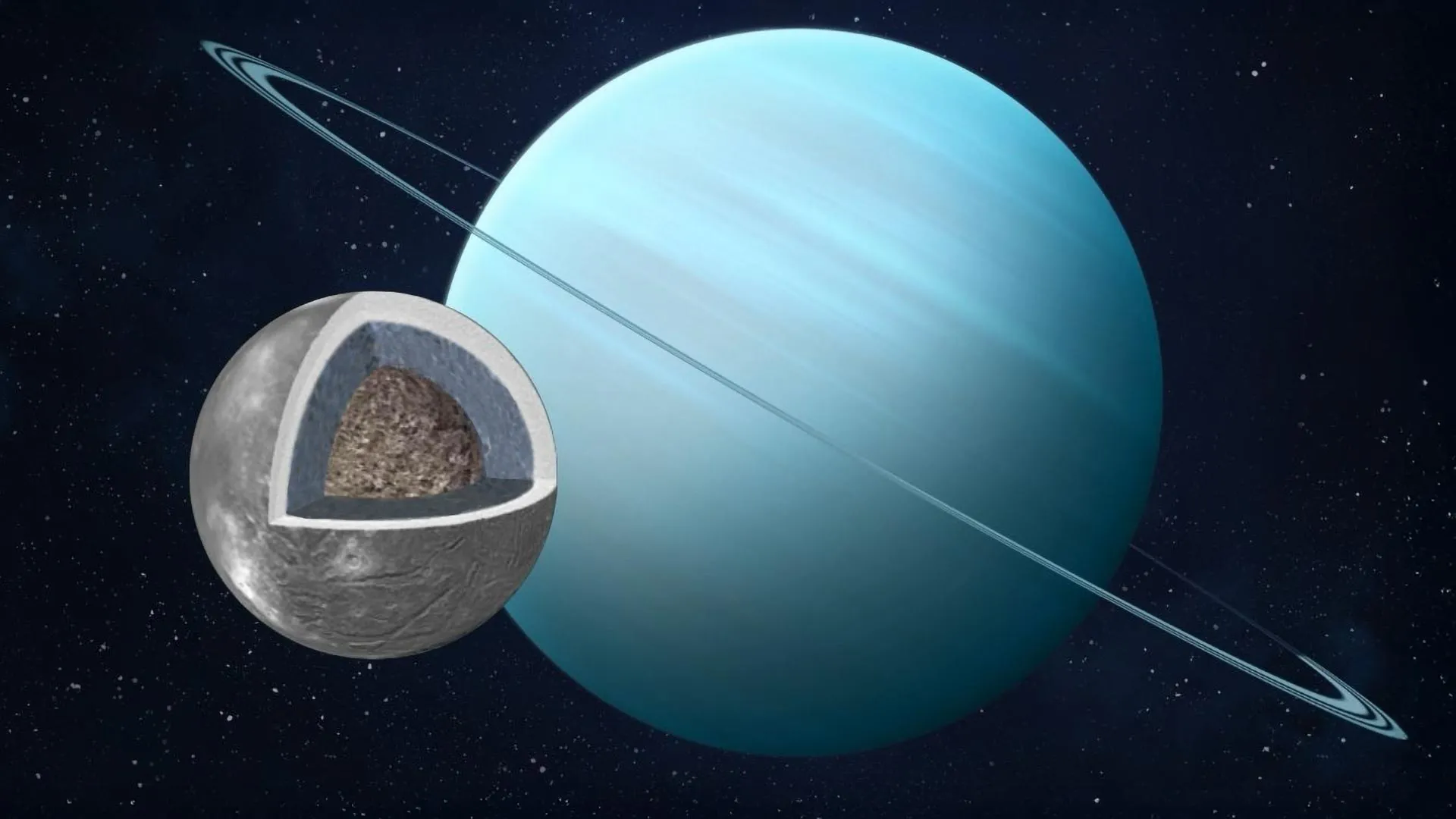
Evidence is building that Uranus’ moon Ariel may once have contained a vast ocean beneath its frozen exterior. Research published in Icarus explores how that hidden ocean may have changed over time and suggests it could once have been more than 100 miles (170 kilometers) deep. By comparison, the Pacific Ocean has an average depth of about 2.5 miles (4 kilometers).
“Ariel is pretty unique in terms of icy moons,” said paper co-author Alex Patthoff, a Planetary Science Institute senior scientist.
A Moon With a Surprisingly Violent Past
Ariel is the brightest of Uranus’ moons and the second closest to the planet. At only 720 miles (1,159 km) across (the distance from PSI in Tucson to Salt Lake City, Utah), it ranks as the fourth-largest moon in the Uranian system.
Despite its relatively small size, Ariel has an unusually complex surface. According to the paper’s first author, Caleb Strom, a recent graduate of the University of North Dakota, ancient features such as impact craters sit alongside much younger terrain. Some smooth regions may even have formed through cryovolcanism, a process in which water, ice, or other volatile materials erupt from an icy world rather than molten rock.
Ariel is also covered in fractures, ridges, and grabens, areas where sections of the crust have dropped below the surrounding terrain. Some of these structures occur on scales larger than those found almost anywhere else in the Solar System.
Reconstructing Ariel’s Hidden Interior
Those enormous surface features are what motivated the new investigation. The researchers wanted to determine what Ariel’s interior and orbit may have looked like in the past to produce the fractures visible today.
One key factor is orbital eccentricity, which describes how much an orbit differs from a perfect circle. Changes in Ariel’s interior structure and orbital eccentricity could both influence the amount of tidal stress acting on its icy crust. As the moon travels around Uranus, gravitational forces repeatedly stretch and squeeze it, potentially placing enough stress on the surface to cause large fractures.
“First, we mapped out the larger structures that we see on the surface, then we used a computer program to model the tidal stresses on the surface, which result from distortion of Ariel from soccer ball-shaped to slight football-shaped and back as it moves closer and farther from Uranus during its orbit,” Patthoff said. “By combining the model with what we see on the surface, we can make inferences about Ariel’s past eccentricity and how thick the ocean might have been.”
A Much More Eccentric Orbit
The researchers found that Ariel may once have had an orbital eccentricity of about 0.04, roughly 40 times greater than its value today.
Although 0.04 still represents an orbit that would look nearly circular, that difference would have greatly amplified the tidal forces acting on Ariel. Its orbit would have been about four times more eccentric than that of Jupiter’s moon Europa, whose icy shell is heavily fractured by the continual gravitational stretching and squeezing it experiences.
Those forces may have played a major role in shaping Ariel’s dramatic landscape.
“In order to create those fractures, you have to have either a really thin ice on a really big ocean, or a higher eccentricity and a smaller ocean,” Patthoff said. “But either way, we need an ocean to be able to create the fractures that we are seeing on Ariel’s surface.”
Uranus May Have Had Twin Ocean Worlds
The Ariel study is the second in a series examining what may once have existed beneath the surfaces of Uranus’ moons. Last year, the same research team reported similar results for Miranda, another icy moon orbiting Uranus.
Together, the findings raise the possibility that more than one moon in the Uranian system may have contained a substantial subsurface ocean.
“We are finding evidence that the Uranus system may harbor twin ocean worlds,” said coauthor, Tom Nordheim of Johns Hopkins University Applied Physics Laboratory and principal investigator of the NASA Solar System Workings grant that funded the Miranda and Ariel studies. “Unfortunately, we’ve only seen the southern hemispheres of Ariel and Miranda. But our results can give us predictions of what a future spacecraft might see on the moons’ unimaged northern hemispheres, such as the location of fractures and ridges there. Ultimately, we just need to go back to the Uranus system and see for ourselves.”
What a Future Uranus Mission Could Reveal
Scientists still do not know exactly when Ariel’s deep ocean may have existed, or how long it lasted. However, the new results offer an important foundation for future studies investigating how subsurface oceans on distant icy worlds form, evolve, and potentially disappear over time.
A future spacecraft mission to Uranus could also test the researchers’ predictions by imaging the unexplored northern hemispheres of Ariel and Miranda and searching for the fractures and ridges expected from their models.
This research was also funded by the North Dakota Space Grant Consortium.
