


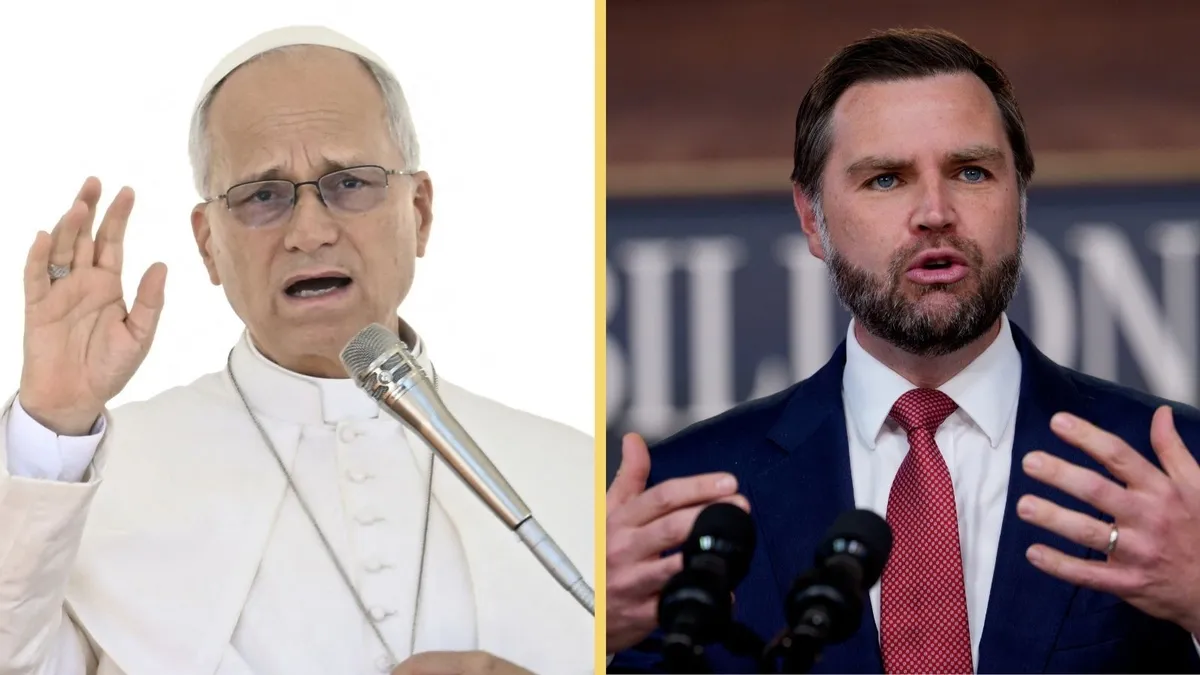
Pope Leo XIV and U.S. Vice President JD Vance publicly criticized each other’s thoughts about compassion.
In September 2026, a claim circulated alleging Pope Leo XIV and U.S. Vice President JD Vance had a back-and-forth of verbal jabs criticizing each other on the subject of compassion.
For example, Sept. 23, a Facebook user named Dee Wallace after the “E.T. the Extra-Terrestrial” actor, shared (archived) an image with photos of Vance and Leo.

(@DeeWallaceOfficialFB via Facebook)
According to the post’s caption, Vance responded to one of Leo’s messages, with Vance calling compassion a form of weakness. Leo then supposedly responded with a “fiery” retort:
BREAKING: J.D. Vance attacks Pope Leo XIV — and gets a FIERY response he won’t soon forget
J.D. Vance thought he could score political points by criticizing Pope Leo XIV’s message of compassion and inclusion. Instead, the pontiff delivered a response that left the room stunned.
“You say compassion is weakness,” Pope Leo XIV began. “Then when did caring for the sick become weakness? When did helping the poor become weakness? When did loving our neighbors become weakness?”
The audience fell silent.
Then came the line that hit hardest:
“Can we imagine hatred in heaven? Can we imagine cruelty in heaven? Then why do we tolerate these things on earth?”
What started as a political attack quickly turned into a powerful moral challenge — and a message that is now spreading far beyond that room.
Please like and share Pope Leo XIV’s inspiring words!
Other Facebook users shared the claim. A Snopes reader also asked of the rumor, “Is this a true story?”
Searches of DuckDuckGo, Google and Yahoo failed to locate any news media outlets reporting about the alleged discussion, including the purported direct quotes. If the story truly occurred, journalists with reputable outlets, such as The Associated Press or Reuters, would have widely reported on it. That was not the case.
In sum, we found the rumor was fictional and was created with the help of artificial intelligence.
Some of Vance’s authentic past remarks about Leo possibly served as the inspiration for the fabricated story and fake quotes. In April, Vance, speaking at a rally for the conservative Turning Point USA organization, said he likes when the pope comments on immigration, abortion and matters of war and peace, even when there’s disagreement. He also said he believed the pope should “be careful” when opining about theology.
Regarding the Facebook account named for Wallace, no evidence credibly confirmed the actor shared the post. The Facebook account displayed the word “official” in the handle — @DeeWallaceOfficialFB — as well as a verification badge supposedly designating authenticity. However, upon selecting the word “Copywriter” near the top of the profile, then clicking “Transparency and privacy policy,” we found an older page name previously defined its purpose as a fan page, as well as that six accounts based in Vietnam served as its only managers. The page’s recent posts all featured some forms of AI and fiction, as well.
We contacted a representative for Wallace to ask about this matter and will update this article if we receive further details. We were unable to contact the Facebook page via Messenger.
Researching the AI slop rumor
This claim about Leo and Vance resembled glurge, which Dictionary.com defines as “stories, often sent by email, that are supposed to be true and uplifting, but which are often fabricated and sentimental.” Creators of such content capitalize on social media users’ willingness to believe and share the made-up stories, profiting from advertising revenue on external websites to which the posts link. (Snopes has previously reported on the business strategy.)
One of the aforementioned search engine queries found articles from June telling a longer version of the same story. A generic-looking, advertisement-filled WordPress blog that hosted the stories — named only “News And Tips” — included some Vietnamese-language characters and lacked standard signals of authenticity, for example including standard legal documentation including a terms of service and privacy policy, as well as information about a website’s founding.
One of the blog articles included some text appearing to guide users on how to publish monetized, emotionally charged content. A scan of the story’s text with the artificial intelligence detection tool Pangram displayed the results, “We believe that this entire text is AI,” as well as, “100% of this text is AI.”
Snopes doesn’t depend solely on AI detection tools, which vary in reliability, and instead considers the tools’ results as one of several data points toward judging an image’s authenticity. For Pangram, we bear in mind the platform’s strong performance in third-party and internal evaluations, as well as criticisms of the tool.
For further reading, we previously reported about a rumor alleging Leo used AI to write parts of his first encyclical.
