


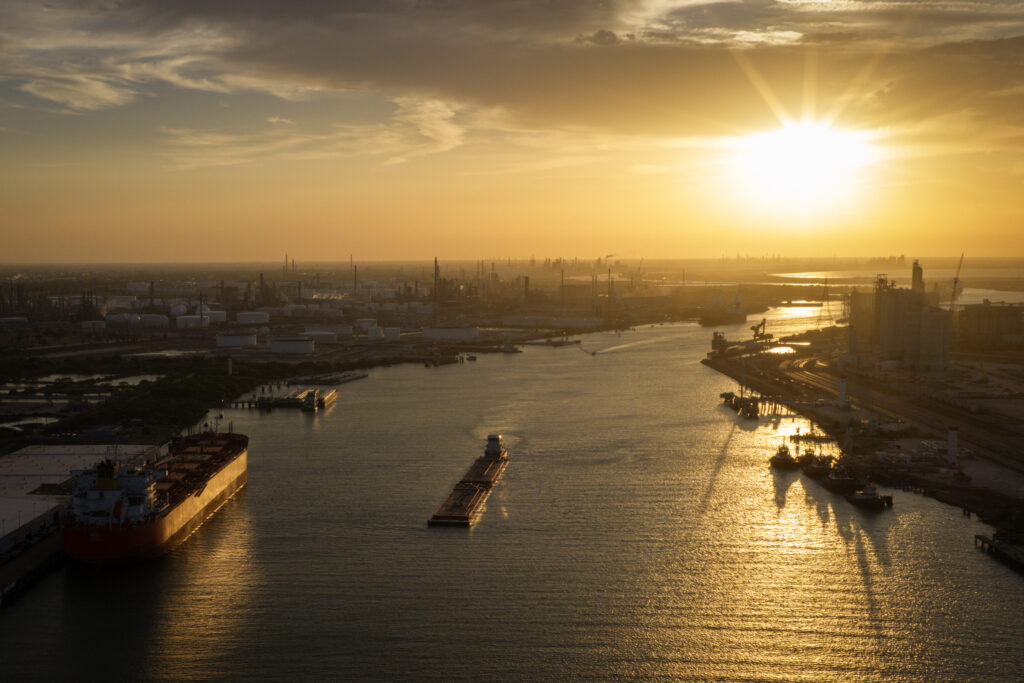
Heading into election season, leaders in Corpus Christi face a puzzling question: what to do with $235 million from the state of Texas for a seawater desalination plant that was never built.
This month, officials in the Gulf Coast city declined to pursue the flagship water supply project for the second time in a year over cost concerns. Now Corpus Christi may have to return the money, including $50 million it already spent, plus $72 million in interest.
“That’s going to be a painful experience if the State of Texas calls our notes due,” said City Council member Mark Scott at the Sept. 1 meeting before the vote that rejected the desalination project. “I think we are dangerously close.”
Returning the money would “seriously damage our relationship with state leadership, negatively impact any future loan applications and continue to put downward pressure on our credit ratings,” Scott said in a follow-up statement.
For almost a decade, city officials in Corpus Christi have debated the desalination project’s location, cost, development model, benefits to residents and potential environmental impacts, even as a regional water shortage grew increasingly likely. State officials in Texas have also pushed to develop seawater desalination plants for nearly 25 years with little to show for their efforts.
Corpus Christi should return the state’s money and lay the project to rest, said City Council member Sylvia Campos, an opponent of the desalination project.
“That is the only way we can finally finish this,” she said. “We need to once and for all kill it and move on.”
Other city leaders say that won’t happen, even if it means reviving the controversial desalination project for another political cycle. The city has requested an extension of its funding agreement with the state, but state leaders haven’t publicly addressed the question, leaving Corpus Christi an uncertain path forward.
“This is very much the first time this has ever happened,” said Perry Fowler, executive director of the Texas Water Infrastructure Network, a construction and engineering trade coalition. “They’re having to figure out how to unravel what they’re in right now.”
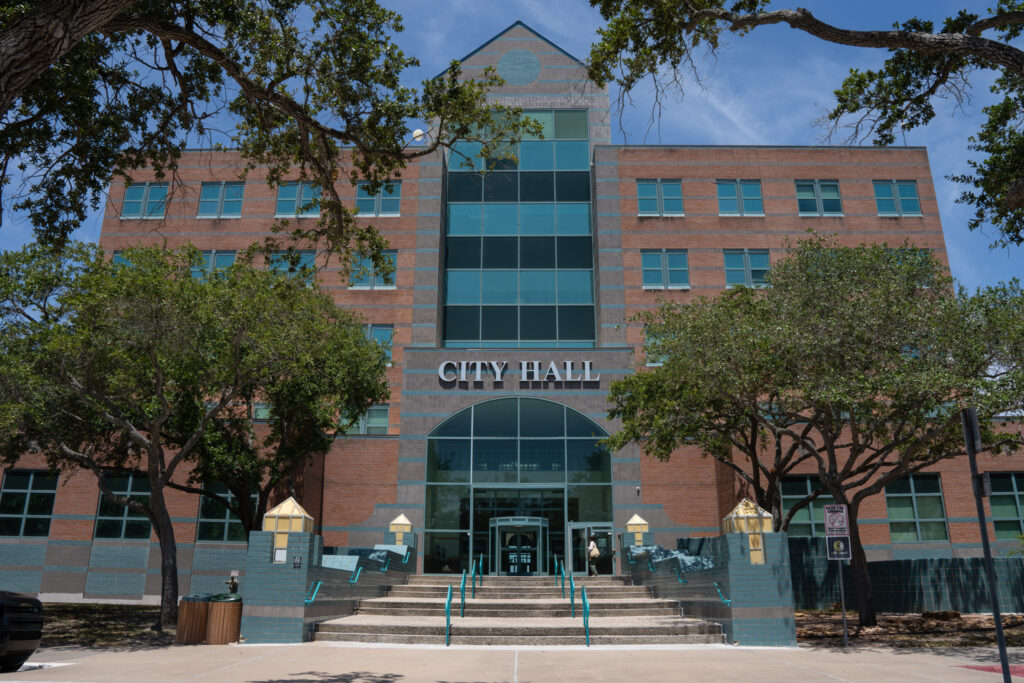
Fowler said Corpus Christi would be the first party to return funding awarded through the State Water Implementation Fund of Texas, a $2 billion program lawmakers created in 2013.
The Texas Water Development Board and the office of Gov. Greg Abbott did not respond to requests for comment.
An Ill-Fated Desalination Plant
The $235 million that Corpus Christi would have to return represents cash the city has drawn to date through a $757 million financing agreement with the Texas Water Development Board for Corpus Christi’s Inner Harbor seawater desalination plant, which was envisioned to produce millions of gallons of freshwater per day from the Gulf of Mexico.
“Other projects could already be well underway with this funding,” Fowler said. “It’s just really unfortunate.”
This story is funded by readers like you.
Our nonprofit newsroom provides award-winning climate coverage free of charge and advertising. We rely on donations from readers like you to keep going. Please donate now to support our work.
Plans for the desalination plant in Corpus Christi date back to 2014, when operators of the region’s sprawling refineries and chemical plants formed a special committee to evaluate the feasibility of treating seawater for industrial use.
Corpus Christi received its first $2.8 million through the SWIFT program in 2017, $11.4 million in 2020 and $211 million in 2024, while its Inner Harbor desalination project became mired in delays, political indecision and steep cost inflation. The state approved Corpus Christi’s application for another $535 million for the Inner Harbor project in 2024, but those funds were never withdrawn.
According to KIII News, Lt. Gov. Dan Patrick criticized city leaders during a campaign event last week at Valero’s Corpus Christi refinery—the region’s second-largest water user. “We will send hundreds of millions of dollars to Corpus to help you through this water crisis, but we need a local government that says ‘yes,’” Patrick said. “They’re turning their back on this money.”
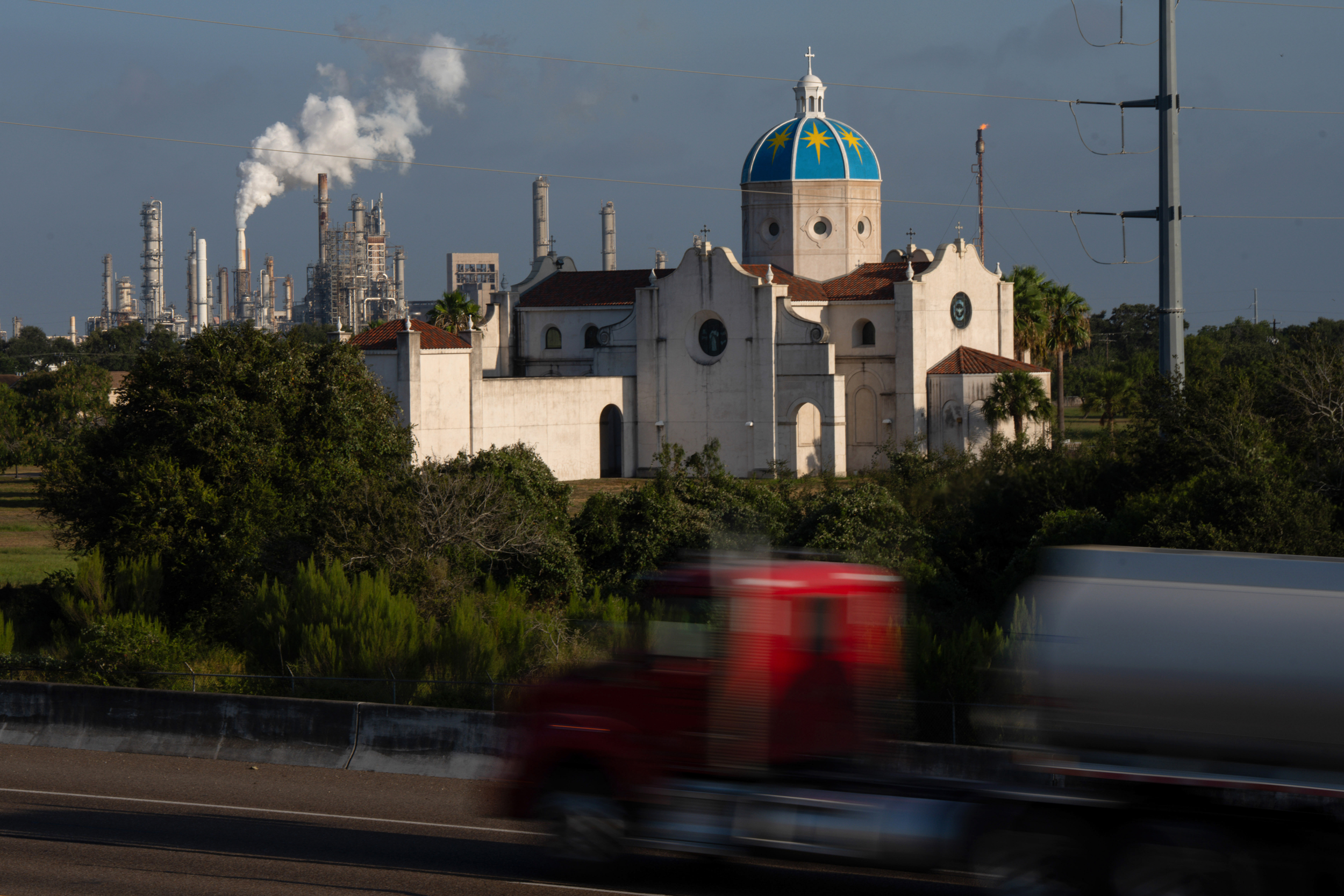
Corpus Christi’s City Council first canceled the Inner Harbor project contract, estimated at $1.2 billion, in a 6-3 vote in 2025, then declined to issue a new contract in a 5-3 vote at its meeting Sept. 1. But the project isn’t dead yet, said Corpus Christi City Manager Peter Zanoni, and there are currently no plans to return the loans to the state, a process called defeasance.
“The city is kind of on hold right now,” he said. “There’s no rush to cancel anything. There’s no rush to try to talk about defeasance.”
Every seat on Corpus Christi City Council is up for election in November and a new slate of leaders might view the project differently, Zanoni said. The debate over water supply and desalination is driving the campaign season, he said, especially after the region narrowly avoided a water emergency this year.
“The Inner Harbor desalination project is a foremost policy item to be considered with the new council,” he said.
A Heated City Election
Corpus Christi Mayor Paulette Guajardo, an advocate for the project and a candidate for a third term in November, also hasn’t given up.
“We have invested years in the Inner Harbor desalination project, secured the major environmental permits, and preserved critical infrastructure and financing,” Guajardo said. “We should take advantage of that opportunity and move the project forward.”
One of the project’s leading opponents, City Council member Gil Hernandez, is also running for mayor.
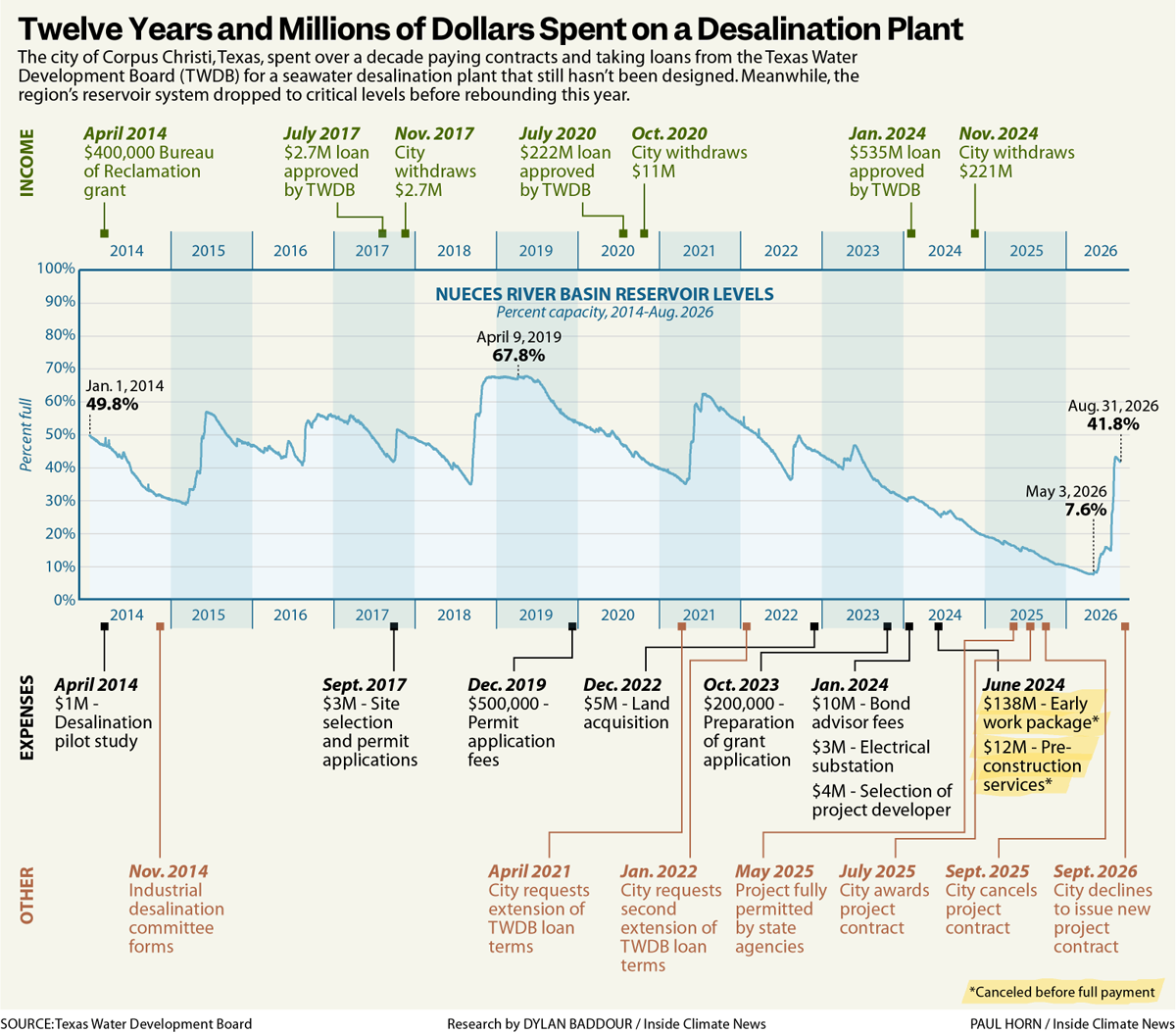
Hernandez has challenged the city’s plans over financial concerns since he joined City Council in 2018. In 2020, he cast the only vote against the city’s plan to apply for $222 million from the TWDB
“We should not have borrowed that money at that point in time,” Hernandez said. “I saw the mistakes that we’ve made, I’m trying my best to correct it.”
He said the city should ask TWDB to apply its funding to other water projects like groundwater. However, he acknowledged that the city made that request to use the funds in other ways in 2025 and the TWDB denied the request.
“It’s still entirely the choice of the water development board and ultimately the governor to allow us that flexibility,” Hernandez said. “So far there hasn’t been any indication of that flexibility.”
In March this year, as reservoir levels fell below 10 percent, Gov. Abbott said that Corpus Christi had “squandered” its $750 million in state funding commitments.
“Corpus Christi is a victim not because of lack of water, they’re a victim because of lack of ability to make a decision,” Abbott told KXAN News. “We can only give them a little time more before the state of Texas has to take over.”
Following Abbott’s statement, Mayor Guajardo called an emergency meeting to approve the desalination project, but it was repeatedly rescheduled.
Meanwhile, major rainstorms in May and July refilled the reservoir system well above critical levels before the City Council reconsidered and rejected the project in September.
“We already spent $50 million and basically have nothing to show for it,” said City Council member Roland Barrera, a supporter of the desalination project. “We’re gonna have all these additional costs associated with canceling the project.”
Defeasance of the city’s loans would require it to pay 10 years of interest, some $72 million additional dollars. That’s one reason why the city’s business and industry groups are currently mobilizing in support of local candidates that promise to push the project through.
Also on the ballot this year: a petition put forth by activist groups that would levy millions of dollars in fees on the region’s industrial giants the next time reservoirs drop below 30 percent.
Meanwhile, as Corpus Christi tries to decide what to do about its longstanding Inner Harbor desalination project, the Nueces River Authority, a small water agency in the city’s hinterlands, is pursuing its own plans for a much larger desalination plant that, if built, could render Corpus Christi’s plans irrelevant.
The Nueces River Authority is working with an Israeli company, IDE Technologies, a global leader in desalination technology, but construction has yet to begin on an island in Corpus Christi Bay and it is unclear whether the project can attract the necessary financing.
Barrera, a City Council member since 2018, has reached his term limit and plans to retire. But his political machine is working as hard as ever, he said, ahead of a high-stakes election.
“I’ve never seen a more concerted community effort to get, in my opinion, the right people elected, pro-business people,” he said. “We can get back to a point there’s sensible decisions.”
About This Story
Perhaps you noticed: This story, like all the news we publish, is free to read. That’s because Inside Climate News is a 501c3 nonprofit organization. We do not charge a subscription fee, lock our news behind a paywall, or clutter our website with ads. We make our news on climate and the environment freely available to you and anyone who wants it.
That’s not all. We also share our news for free with scores of other media organizations around the country. Many of them can’t afford to do environmental journalism of their own. We’ve built bureaus from coast to coast to report local stories, collaborate with local newsrooms and co-publish articles so that this vital work is shared as widely as possible.
Two of us launched ICN in 2007. Six years later we earned a Pulitzer Prize for National Reporting, and now we run the oldest and largest dedicated climate newsroom in the nation. We tell the story in all its complexity. We hold polluters accountable. We expose environmental injustice. We debunk misinformation. We scrutinize solutions and inspire action.
Donations from readers like you fund every aspect of what we do. If you don’t already, will you support our ongoing work, our reporting on the biggest crisis facing our planet, and help us reach even more readers in more places?
Please take a moment to make a tax-deductible donation. Every one of them makes a difference.
Thank you,

Reporter, Austin
Dylan Baddour covers the energy sector and environmental justice in Texas. Born in Houston, he’s worked the business desk at the Houston Chronicle, covered the U.S.-Mexico border for international outlets and reported for several years from Colombia for media like The Washington Post, BBC News and The Atlantic. He also spent two years investigating armed groups in Latin America for the global security department at Facebook before returning to Texas journalism. Baddour holds bachelor’s degrees in journalism and Latin American studies from the University of Texas at Austin. He has lived in Argentina, Kazakhstan and Colombia and speaks fluent Spanish.
