


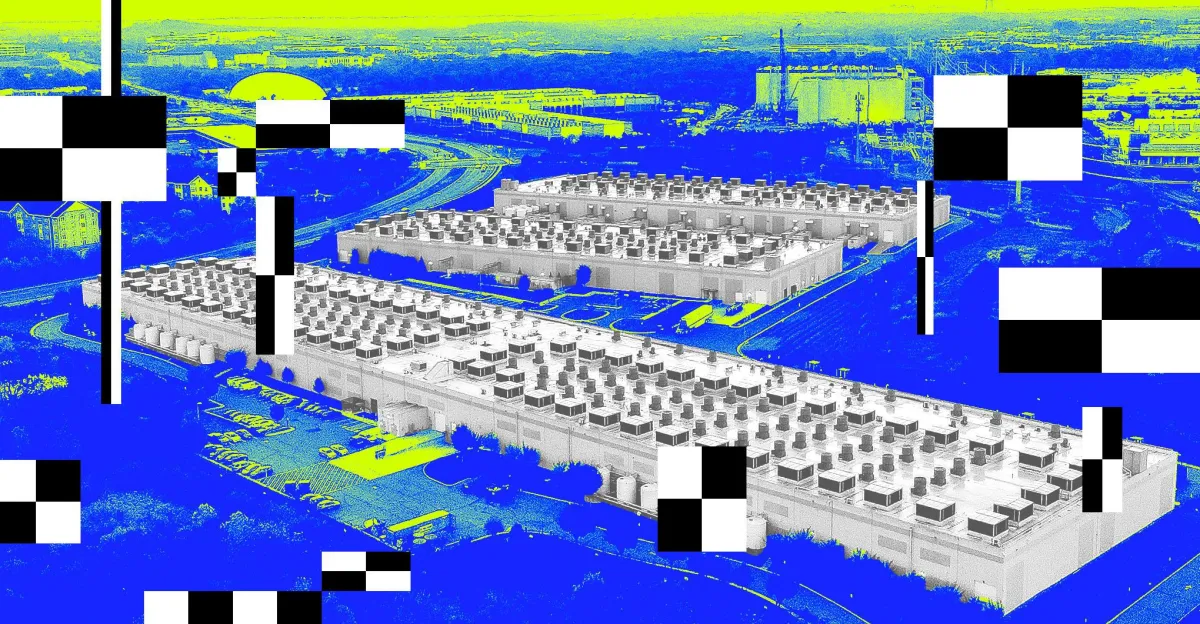
California Gov. Gavin Newsom signed a slate of bills on Monday that could finally give communities better data — and more say — on how data centers impact their electricity bills and water supply.
As data centers invade a growing number of communities across the US, they’ve triggered protests over how the infrastructure underpinning AI might stress power grids and local water systems. That’s fueled partly by concerns about how difficult it is to see just how much electricity or water they’re actually gobbling up. California’s new disclosure rules won’t offer a full picture, but starting next year, data center operators will have to start sharing some of these details. The transparency will help scientists and the public see whether data centers are raising bills, draining dwindling resources, and making good on sustainability commitments.
“It’s extremely frustrating to try to understand basic information,” says Mark Specht, senior manager for the climate and energy program at the Union of Concerned Scientists (UCS). “There’s a lot of hype about data centers right now … It doesn’t help that we just don’t have basic facts about what’s happening with them to try to understand how much of a problem they are.”
“It’s extremely frustrating”
The seven bills Newsom signed go beyond requiring disclosures. Senate Bill 886, Assembly Bill 2383, and Senate Bill 1168 direct the California Public Utilities Commission to create separate power rates for data centers to recoup the costs of connecting such power-hungry facilities to the grid. That’s supposed to prevent data centers from passing on the costs to other consumers of new infrastructure built to satisfy their energy demand. On top of that, AB 2383 also pushes data centers to use more renewable energy.
The rest of the legislation grapples with the enormous gaps the public has when it comes to how data centers impact surrounding communities and the environment. AB 1577 requires monthly reporting on data centers’ energy consumption. AB 2619 and AB 2469 require water disclosures, and the latter also makes data center operators responsible for covering the costs of infrastructure upgrades needed to serve them. And SB 887 eliminates categorical exemptions from the California Environmental Quality Act for data centers, ensuring that they’re subject to environmental review.
“As scientists, when we went to research state offers in California, I was kind of dismayed by the lack of information that there was to work with. And so I’m happy [AB 1577] passed,” Specht says.
Specht co-authored a fact sheet this year on how data centers could impact the power grid and utility rates in California. It describes one scenario where several factors drive up costs for Californians: ballooning electricity demand; a need for expensive new infrastructure to connect data centers to high-voltage transmission systems; and the risk of overbuilding if the AI bubble pops and data centers don’t end up using as much electricity as projected, leaving other utility customers to foot the bill .
A different scenario shows data centers could actually lower electricity costs
On the other hand, a different scenario shows data centers could actually lower electricity costs. Electricity rates include fixed costs for grid maintenance, so spreading those costs across more customers can bring bills down for everyone. The catch is that the potential savings depend on data centers contributing to costs across the distribution system that serves smaller customers at lower voltages. Large data centers often avoid these costs by connecting instead to the transmission system, which carries high-voltage electricity.
Without more information, it’s impossible to say which scenario is taking shape in California. “I wouldn’t say definitively that data centers have increased the cost [of electricity],” Specht says. “It’s possible they may even have brought them down some already, I just don’t think we have the numbers to demonstrate it.”
Even if data centers aren’t having much effect on electricity rates yet, that’s likely to change as their power needs grow, Specht adds — making it all the more important to see how much energy they’re using. “It’s just about getting ahead of it before we all start feeling it,” he tells The Verge.
Data centers’ water use has been just as opaque. While studying the impact of data centers on water-stressed communities in California, researchers from Santa Clara University recently contacted every water provider in districts housing data centers. Citing privacy regulations, the providers in every district refused to share data on how much water data centers use. The researchers also discovered that very few data centers in the state had environmental impact reports available to the public.
The laws still leave big gaps in what data centers need to report
That dearth of information is even more concerning considering what the researchers were able to find. As AI drives the development of hyperscale data centers, these facilities are moving farther from more affluent urban areas into more rural areas where small water systems and lower-income communities may have more difficulty coping with the added demand.
The laws still leave big gaps in what data centers need to report. Specifically, AB 2619 and AB 2469 only require companies to make water disclosures when applying for permits or getting a business license, so we won’t know how much water they’re actually using from year to year. The year in which they share their water use could be particularly wet or cool, not necessarily reflecting how much water the facility needs when it’s hotter and drier. It also makes it difficult to see if a data center’s consumption is growing or if a company is following through on its sustainability goals.
Still, “This is in many ways a step in the right direction. It’s signaling to the industry that people are paying attention, that lawmakers are paying attention,” says Iris Stewart-Frey, the lead author of that water report and a professor of environmental science at Santa Clara University.
She notes that Newsom actually vetoed a similar water disclosure bill last year, but that data centers have become a bigger concern for the public since then.
“The whole AI wave is not a force of nature, it’s not a hurricane,” she says. “This is something that we can actually regulate.”
