


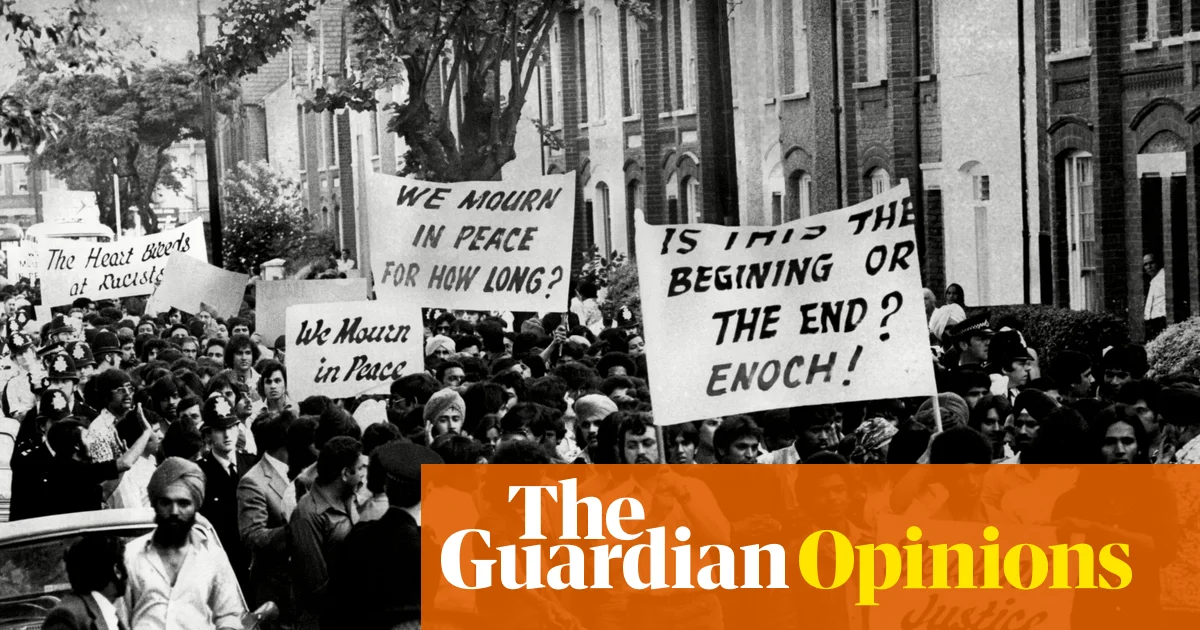
There it was: a pool of blood spreading across the pavement. A section of the high street had been cordoned off and a uniformed police officer gestured for bystanders to move along. It was the long hot summer of 1976, and a racist murder had stunned Southall in west London.
“What has happened here, officers?” asked Suresh Grover, then a curious 22-year-old, later to be widely known as a leading racial justice activist. “Go away, it’s just Indian blood,” was the response. Grover was soon to learn that 18-year-old Gurdip Singh Chaggar, an engineering student, had been stabbed to death by racist thugs the night before.
The late 1970s was the era of “Paki-bashing”: homes, shops and places of worship were attacked, while south Asians – young and old – were murdered on the streets. That day, Grover acted instinctively, taking some paint and daubing the pavement near the blood with the words: “This racist murder will be avenged. We’ll get you racist scum.”
This is the story of working-class youth who refused to turn the other cheek. From Southall to Sheffield and from Brick Lane to Bradford, the Asian youth movements were set up to physically defend communities from racist attacks. It was because of their heroic efforts that many of us in diverse towns and cities have grown up in safer environments.
But more than 50 years on, that racist violence has returned with shocking ferocity, a deterioration traceable to the summer of 2024, which marked some of the worst racist rioting in living memory.
In Hartlepool, a young south Asian man was walking down a street when he was punched in the face. Onlookers cheered, laughed and yelled racial slurs. “A Paki got banged,” one shouted, as those around him began to smash the windows of small businesses and kick down the door of a nearby house. In Middlesbrough, a group of white men stopped motorists and questioned them about their ethnicity, asking whether they were “white” before letting them through. In Rotherham and Tamworth, racist mobs tried to burn down hotels housing refugees.
And now? A seemingly relentless rise. Every five days, a mosque in Britain is attacked. The rhetoric of the far right has been mainstreamed.
After years spent researching and writing a book on the rich and proud tradition of political activism in the south Asian community, it seems clear to me that we cannot fight racism in silos. We must build broad movements that transcend racial and religious divides.
The Asian youth movements had a belief in the concept of political blackness as a banner that people of colour could unite under. To Tariq Mehmood, an Asian youth movement member who was born in Pakistan but raised in Bradford, there was no real difference between south Asian, African and Caribbean people: they were all the same to those who wanted to harm them. “We were called ‘black bastards’ on the streets,” he recalled. “We were commonly united with our African and Afro-Caribbean friends. They didn’t know they were black until they came here — I didn’t know I was a ‘Paki’ until I came to Bradford. We were united on those common issues of our oppression.”
They saw themselves as part of a broader working class. The Sheffield Asian Youth Movement and the Indian Workers’ Association, for instance, sent minibuses of their members to picket lines during the 1984-85 miners’ strike. They stood with white working-class communities fighting to save their industries, providing much needed financial support while challenging prejudice in these communities. Grover tells me that more than a decade after that strike, Kent miners were still attending Punjabi Sikh weddings in Southall because of the links that were built during that dispute.
These were movements rooted in their communities and strategic in their organising. They monitored the far right and mapped out who was most vulnerable to racist attacks. The Sheffield Asian Youth Movement had a big thick folder called the “fascist file”, in which they would compile information on local racists.
after newsletter promotion
But things changed. As the 20th century wore on, anti-racist activism was increasingly institutionalised as the struggle moved from the streets to council chambers and boardrooms. Where we once had grassroots anti-racist movements rooted in communities, we now have a race-relations industry in which a few people are paid to tackle discrimination. We also have the rise of self-proclaimed community leaders under the policy of state multiculturalism who often speak on behalf of entire communities. Too often, they become the prism through which authorities engage with ethnic-minority communities.
A revival of grassroots anti-racist movements is long overdue. But it must be of this time, attuned to the changing circumstances of 2026. Racism is not experienced equally. Class, gender and geography all matter. A hijab-wearing Muslim woman is more likely to be a victim of Islamophobia than a Muslim man. Those living in smaller, more isolated ethnic-minority communities are more vulnerable to racist attack. First-generation migrants have greater insecurity than the grandchildren of migrants. An effective anti-racist movement must reflect on these challenges and prioritise those most vulnerable to racist violence.
The good news is that we are starting to see a revival of this approach. A few months ago, I spoke alongside Grover at the launch of the Nottinghamshire Solidarity Network, which is taking a strategic approach to anti-racism by organising county-wide to ensure smaller ethnic-minority communities are not left isolated. A week later, I spoke at the launch of the Greater Manchester Workers’ and Tenants’ Association. Its members understand that the far right feeds on deprivation and despair in working-class communities, and they are seeking to organise on the basis of class in an attempt to offer a counter-narrative to that of division and hate.
All of these movements, past and present, understand that racism will not be defeated from above. It will only be defeated by us – ordinary citizens who refuse to look away.
