


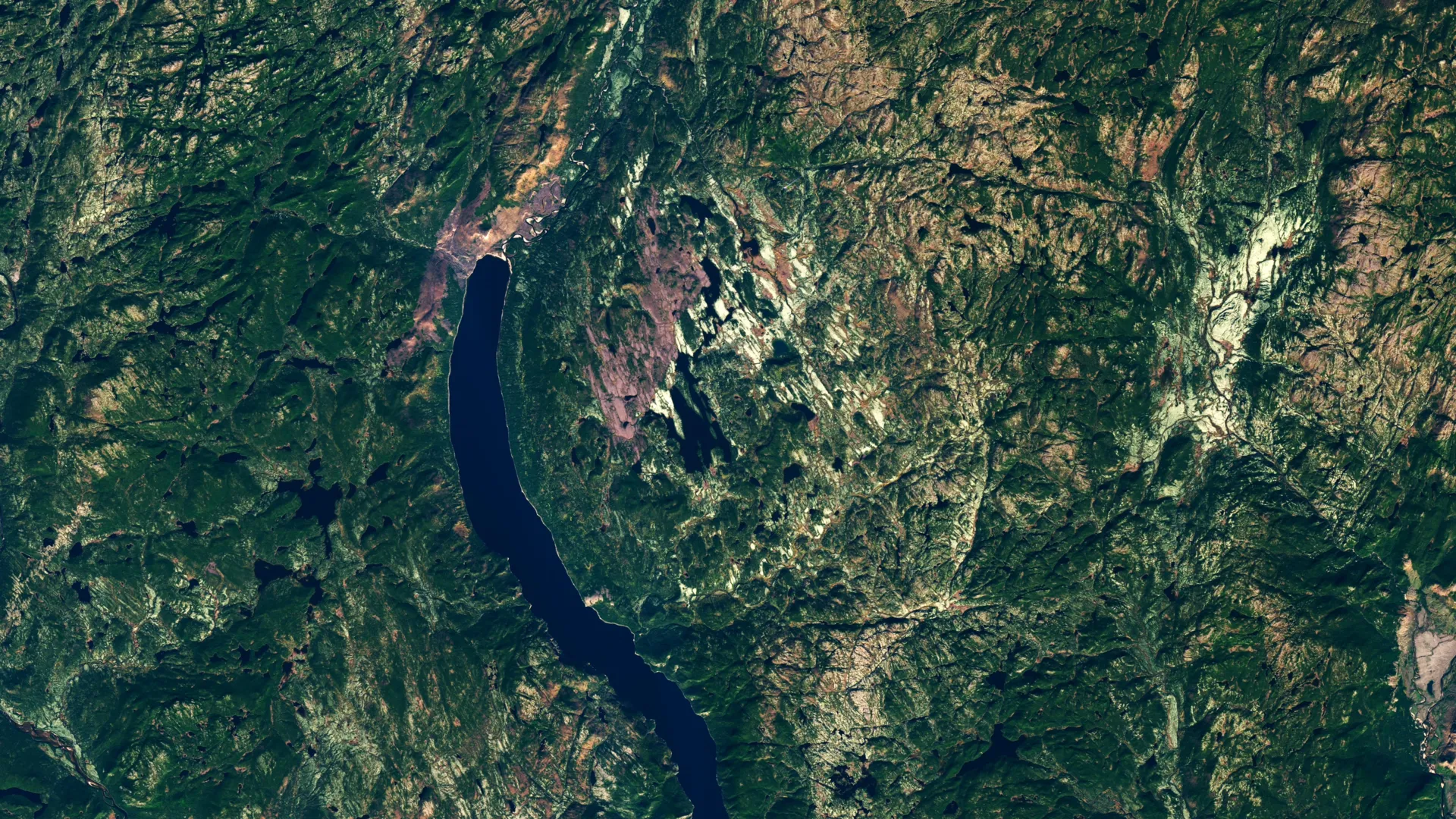
An amateur astronomer searching satellite maps for possible camping locations in Quebec ended up spotting something far more unusual: evidence of a previously unrecognized impact crater.
Earth has only about 200 confirmed impact structures, although geologists believe hundreds more have yet to be identified. One of those hidden structures now appears to have been found, and it is a substantial one. The newly confirmed site was first noticed by an amateur astronomer who was planning a camping trip in Quebec.
A Strange Circle on Satellite Maps
In 2024, Joël Lapointe was preparing for a trip to the remote Côte-Nord region when a circular feature near Lake Marsal caught his attention on online satellite imagery. He wondered whether the depression could have been formed by an impact and reached out to specialists in Europe and North America.
Lapointe’s inquiry helped prompt a group of French researchers to identify the lake area as the center of a potential 11th known impact structure in Quebec at a 2024 meeting of the Meteoritical Society. The possibility eventually drew the attention of Gordon Osinski, a planetary geologist at Western University who also directs the Impact Earth database.
Osinski was skeptical at first, but the possibility was intriguing enough that he organized an expedition to the isolated location in October 2025.
A Difficult Journey Into the Quebec Wilderness
Reaching the site proved challenging almost immediately. Osinski and his colleagues flew in by floatplane, but the aircraft could not make it all the way to shore. Carrying their equipment, the team had to wade through 50 meters (165 feet) of water before reaching land.
Conditions did not improve once they arrived. The landscape was rugged and swampy, filled with insects and dense vegetation that Osinski described as “deep, twisty, gnarly vegetation.” Despite years of fieldwork across six continents, he said the area ranked among the most difficult environments he had ever worked in.
Earlier geological surveys had interpreted the local breccia rocks as evidence of a funnel-shaped volcanic structure called a diatreme, which forms when explosive magma eruptions create a pipe filled with shattered rock.
By the expedition’s second day, however, the team began finding something far more decisive.
Shatter Cones Reveal an Ancient Impact
Researchers discovered shatter cones in numerous rock outcrops. These distinctive structures form under the intense pressures produced during an impact and provided compelling evidence that the feature was not volcanic after all.
“It’s the only unequivocal evidence of an impact event that you can see in the field with the naked eye,” Osinski said.
The object responsible for the collision was powerful enough to produce a complex crater structure measuring about 25 kilometers (16 miles) across. The site includes a central uplift as well as high cliffs displaying columnar jointing.
A comparable impact in modern Quebec would have enormous consequences. Osinski said it would cause “regional devastation on a scale that would wipe out major cities and have global climate impacts.”
A Crater About 390 Million Years Old
Analysis of rock samples suggests the crater formed roughly 390 million years ago. That places the impact around 100 million years before a major increase in cratering on Earth that researchers have suggested may be connected to collisions within the asteroid belt.
Following discussions with the Innu Council of Ekuanitshit, the researchers are referring to the crater as Uhackatik.
The team considers the impact origin essentially confirmed, although a Meteoritical Society committee is expected to provide formal recognition when it next meets.
Uhackatik is the largest impact crater discovered since the 31-kilometer Hiawatha structure was found in 2018.
Too Remote for Astronaut Training
Osinski is part of NASA’s first Artemis Geology Team and helps train astronauts in geology. Even so, he does not expect Uhackatik to become an astronaut training site because reaching it is so difficult.
A younger and much more accessible impact crater in Labrador, Kameshtashtan (also called Mistastin Lake), has already hosted astronauts for geology training in the past, he said.
An Amateur Observation Leads to a Major Discovery
For Lapointe, alerting scientists to the crater has become an unforgettable experience. He told CityNews that he was “over the Moon” when researchers confirmed that the feature really was an impact crater.
“I encourage everyone to not ignore intuition or an observation, even if it isn’t part of your field of expertise,” he told another outlet.
Citizen Scientists Can Join the Search
People interested in contributing to scientific discoveries have many opportunities through NASA citizen science programs.
The Daily Minor Planet project allows volunteers to help search for asteroids and comets that could potentially pose a threat to Earth. Through Impact Flash, participants can examine dark regions of the Moon for flashes produced by meteoroid strikes. The Exoasteroids project gives citizen scientists the chance to look for evidence of asteroids beyond our Solar System.
