


- Mexico President Claudia Sheinbaum has presented a draft fiscal budget for 2027, outlining the national government’s plans for the coming year for everything from tax rates and health care to infrastructure and education.
- When it comes to the budget’s climate policies, Sheinbaum has increased spending for a national energy transition strategy but decreased it for climate change adaptation efforts.
- Critics also pointed out that the budget for the national energy transition strategy includes billions of pesos for railroad projects and Petróleos Mexicanos , the state-owned oil company.
- Watchdogs called for lawmakers to redistribute resources toward forest conservation, sustainable water management, protected areas and the prevention of natural disasters.
MEXICO CITY — President Claudia Sheinbaum this month presented a draft fiscal budget for 2027, outlining the national government’s plans for everything from tax rates and health care to infrastructure, education and defense spending. When it comes to funding for climate policies, Sheinbaum has increased spending in some areas while decreasing it in others, and included projects that appear to have little or nothing to do with the environment.
Some parts of the climate budget, which still needs Congressional approval, continue to pump spending into fossil fuels, critics said. They expressed concern about the budget’s lack of detail and how the government will use the money.
“The fact that these programs appear [under climate change adaptation] doesn’t, in itself, demonstrate that all their expenditures can be considered mitigation or adaptation measures,” the Mexican Civil Council for Sustainable Forestry (CCMSS) said in Sept. 11 statement.
The proposed 252-page budget allocates 20.3 billion pesos ($1.2 billion) to the national energy transition strategy, an increase from the 17.9 billion pesos ($1 billion) allocated for 2026.
Around 8.8 billion pesos ($510 million) of that budget would go to strengthening “energy self-sufficiency, sovereignty and security,” as well as “sustainable development.”
Included in that effort is 2.5 million pesos ($145,000) for the Ministry of Environment and Natural Resources for environmental certification of companies.
Another 11.4 billion pesos (664 million) would be allocated to “strategic renewable energy projects” and “energy efficiency and technological innovation to mitigate environmental impacts and reduce dependence on fossil fuels.” Included in that is approximately 1.7 million pesos ($104,000) for projects involving Indigenous and Afro-Mexican communities adapting to climate change impacts.
But listed in the same category are 1.1 billion pesos ($64 million) for Petróleos Mexicanos (Pemex), the state-owned oil company, for “production, distribution and marketing of oil, gas, petroleum products and petrochemicals.”
Part of that funding would likely go to Pemex’s debt repayments, observers said. It’s part of a decades-long effort to prevent the company from failing as oil reserves decline.
Another part of the Pemex budget would go to researching renewable energy projects outlined in the company’s operation plan through 2035, including solar, wind, geothermal, geological hydrogen, biofuels, wave and tidal energy, and lithium extraction.
Pemex’s long-term plan aims to reduce methane emissions, while working to increase the availability of natural gas, including shale, which it considers a “transition fuel.”
Some critics of the proposed budget said this would be an ineffective approach to developing renewable energy in Mexico.
“What this government establishes as a strategic transition plan continues expanding the fossil-fuel frontier because it includes the use of shale gas to carry out that transition,” said Charlie Canek Punzo, a researcher with the Territory, Rights and Development program at Fundar, a Mexican NGO focused on budget transparency in the oil and gas sector.

Another cause for concern for Fundar and other organizations is the approximately 8.8 billion pesos ($510 million) earmarked to railway infrastructure for freight and passenger transport — over 43% of the entire national energy transition strategy budget.
The Sheinbaum government has maintained and expanded the 1,554-kilometer (966-mile) Tren Maya built by the previous government in the Yucatán Peninsula, and also developed other rail projects farther north. Critics of the budget questioned how so much money could be justifiably dedicated to these projects, and called for government transparency about the details of how it would really be spent.
“A railway system can contribute to reducing emissions; an agroforestry program can capture carbon and improve the resilience of territories; and even certain investments in the energy sector can reduce emissions,” the CCMSS statement said. “But a potential contribution is not enough to automatically convert a program’s entire budget into climate spending.”
Climate change adaptation
In its Nationally Determined Contributions (NDC), part of a global effort to reduce emissions, the Mexican government said 15% of the national territory is in a critical state of water availability, and projected it to decline by 21% by 2050. It also predicted droughts, the loss of major crops and rising death rates in the near future.
Across the country, Mongabay has reported on farming communities where soil has begun to dry up and long lines outside of convenience stores in cities because water hasn’t made it to homes.
Sheinbaum called the economic package “responsible,” with a 20.6% budget increase for agriculture and more than 10 times the budget for water management.
At the same time, the proposal reduces the total climate change adaptation spending from over 213 billion pesos ($12.3 billion) in 2026 to over 160 billion pesos ($9 billion) for 2027 — an approximately 24% decline. It’s also unclear whether large increases in the budget, such as for water management, will actually go to climate change impacts, critics said.

“Our concern is that the water will be used for the manufacturing industry,” Canek said, “not for human consumption, not for agriculture, not to support local populations, but to give priority to industrial and extractive projects.”
Lawmakers considering revisions to Sheinbaum’s proposal should ensure the budget contributes “in a verifiable way” to the country’s NDC, the Observatory of Climate Crisis and Public Budget in Mexico said in a statement.
The observatory also said the budget should redistribute resources toward forest conservation, sustainable water management, protected areas and the prevention of natural disasters.
“Simply increasing the budget isn’t enough,” the observatory said. “It’s essential that the resources earmarked for the energy transition be clearly linked to actions that contribute to progressively transforming the energy system, reducing emissions, decreasing dependence on fossil fuels, and ensuring a just transition.”
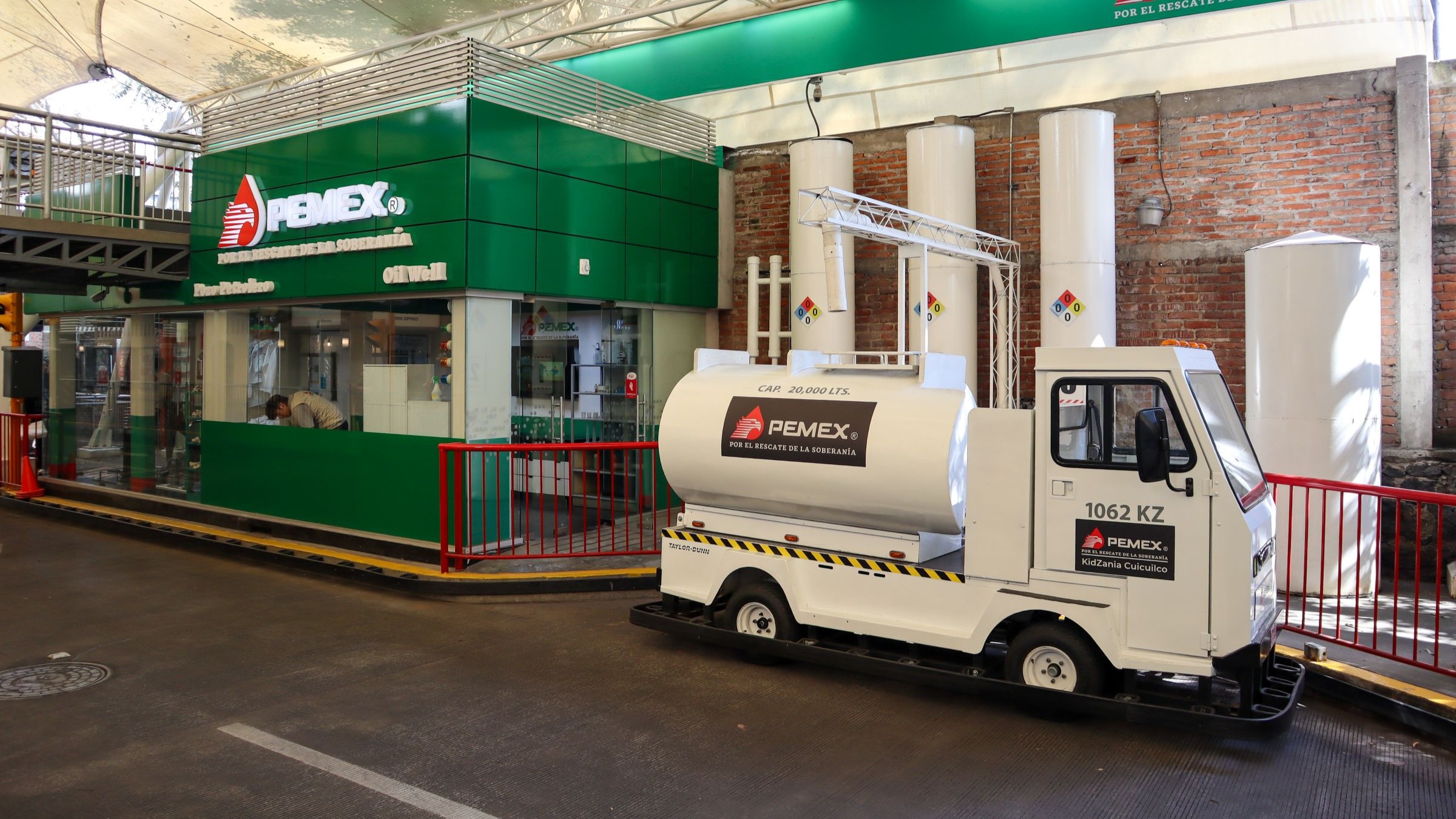
Banner image: Kidzania facilities, Tlalpan, Mexico City. Image by ProtoplasmaKid/Wikimedia. CC BY 4.0.
See related from this reporter:
Venezuela’s historic oil deal with the US reignites environmental, human rights concerns
FEEDBACK: Use this form to send a message to the author of this post. If you want to post a public comment, you can do that at the bottom of the page.

