


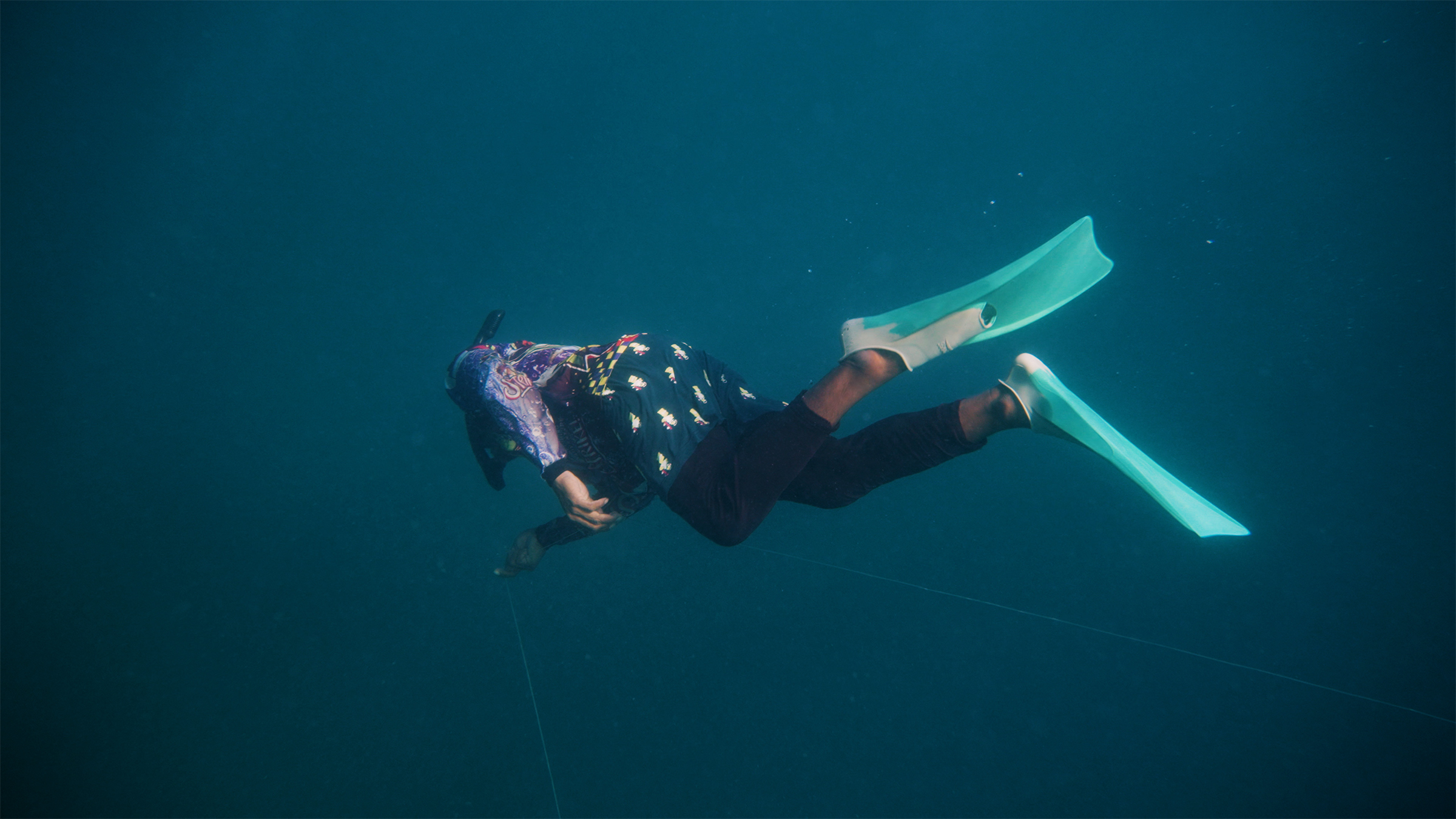
- The Bajau people of Indonesia, Malaysia and the Philippines have traditionally harvested the sea through freediving.
- A recent ban on compressor-assisted diving in Indonesia’s West Nusa Tenggara province has made traditional freediving skills more valuable than ever.
- On Sumbawa, one of the province’s largest islands, traditional fishers and a local NGO are working together to preserve Bajau diving techniques and to manage local marine and fisheries resources in harmony with traditional management practices.
POTO TANO, Indonesia — Mahari sits at the front of the boat, cigarette in hand, surveying the conditions of the waters off Poto Tano, a small fishing community on the island of Sumbawa, Indonesia. As ketua, the leader of this group of Bajau octopus fishers, Mahari decides which tool they will use today. He silently surveys the waters while the rest of the group sits back and waits for his cue.
The Bajau people are an Indigenous ethnic group spanning Indonesia, Malaysia and the Philippines. Traditionally living mostly on boats, Bajau people have harvested from the sea through traditional freediving for generations. In Sumbawa, a recent ban on dives assisted by an air compressor, a dangerous diving technique that provides the diver with continuous air, means these traditional methods have become more valuable than ever. With the right skills, freediving can be gentler on both the environment and the body than more destructive modern practices.
Through expeditions like this one, Mahari and the other fishermen in his community work in cooperation with local NGOs to ensure this knowledge is passed to new generations.
‘Pocong time’
Depending on current and water visibility, Bajau fishers typically use one of two methods to catch octopus. If there is low visibility or a strong current, they will use a “shell” tool adorned with hooks, which they let go in the water and trail behind their boat. If there is better visibility and a weaker current, they enter the water to freedive and use the pocong.
The pocong, the Indonesian word for “ghost,” is a fishing tool resembling a fake octopus made from wood and felt. Using the pocong, the Bajau dive to around 15–20 meters (50-65 feet) and dangle this decoy alongside the reef to lure an octopus. When their prey responds curiously to this lure, the fishers either spear the live octopus or grab it by hand. While it may sound simple, this is actually a very skilled technique, as they cannot let the octopus touch the pocong. “They will immediately realize it’s fake and swim away,” says one of the fishermen tells Mongabay. “Only 10 people in their community can use the pocong. You need strength and skill.”
On the boat, Mahari suddenly makes his pronouncement, “It’s Pocong time.”
The incredible skills and abilities of the Bajau freedivers are widely known and documented, earning them a global reputation as sea nomads and sparking studies in human physiology and genetics.
Mahari recalls some of his earliest memories in the ocean with a gleam in his eye, “As a Bajau, we know how to dive for as long as we can remember.” Another fisher, Nadir, tells Mongabay: “Bajau people can tell directions without GPS, but by reading the stars, the wind, the air, and the currents. One week after children are born, we bring them to the sea.”


In recent years, many Bajau fishers have felt the pull towards compressor diving as a more economically viable method of harvesting marine species. Often acting as the sole providers for their families, many feel pressure to bring home enough fish to support their households.
Compressor diving is a controversial and dangerous practice where divers breathe in surface air pumped by a compressor through a long hose, allowing them to stay underwater much longer and deeper than they would if freediving. Extending their time underwater both increases their chances of finding valuable species and of returning home with a larger catch. “With compressor diving, you can stay underwater for much longer,” one of the fishers, Well, tells Mongabay. “If you get more octopus, you get more money. There’s a temptation. We’re human, right?”
But compressor diving systems are often improvised, with no safety checks. The risks and impacts of this form of diving include decompression sickness, air embolisms, paralysis and chronic disabilities, long-term mobility issues and heightened drowning risks. While freediving does have some known health risks, including injuries from pressure changes, they pale in comparison to the risks associated with diving with compressors.
Acknowledging these risks, the Jari Foundation has started to work in partnership with many Bajau fishermen to ease their transition away from compressor diving and towards traditional freediving practices.
Jari is a marine-based program focused on management, ecotourism and community development that currently works across the islands of Lombok and Sumbawa. Together with the local government and a small group of Bajau fishermen, Jari has established a community-based fishery group called PELITA [Persaudaraan Nelayan Gurita (Octopus Fishermen Brotherhood)], says Hani Nusantari, who runs Jari alongside her husband, Boen. PELITA currently consists of around 40 octopus fishermen, many of whom previously relied on compressor diving. “Recognizing the long-term impacts this practice was having on their health, they chose to return to traditional freediving methods while also becoming actively involved in marine conservation initiatives and ecotourism,” Hani says.
Literally translating to “light”, PELITA is named after the traditional oil lamp that once illuminated the homes of fishing families. “PELITA represents a guiding light for coastal communities, bringing people together to care for the sea, strengthen solidarity among fishers, and ensure that marine resources continue to support future generations,” Hani says.
Through PELITA, Hani says she hopes to strengthen fishers’ livelihoods by supporting a return to traditional practices and by combining traditional knowledge with conservation, fisheries management and alternative livelihood projects. This type of fisheries management is supported by more than just the male fishers of PELITA. Hani initiated Women for Marine Conservation (WMC) in 2022 to strengthen community participation in conservation and fisheries management. Today, WMC members are also involved in fisheries data collection, tourism activities, environmental education and community organization.

The compressor ban
Indonesia’s fishery laws do not explicitly mention compressors, but regulations that ban destructive and unsafe fishing gear and methods indirectly prohibit them. In 2020, the West Nusa Tenggara provincial government added a regulation that specifically stipulates a ban on compressor diving. However, Jari’s Boen notes that the problem has not disappeared entirely: “The problem is that [some people] keep doing compressor diving at night when there is no surveillance. One night, we took our fishermen group out at night, and we found 50–60 compressor divers just in this area.”
All the PELITA fishermen have now stopped compressor diving. One of them, Wandra, says that many of his friends got sick, became paralyzed, or even died because of compressor dives gone wrong. Fellow fisherman Well decided to stop after becoming paralyzed for a month at a time, on three separate occasions. Mahari says he has been paralyzed 30 times, “I would go to the chamber, get healthy, and then go to the compressor to get back.”
Compressor diving also has long-term physical impacts on freedivers’ abilities. “When they breathe with the compressor for a long time, it’s a challenge to return to freediving because they’re used to the compressor,” Hani says.
Despite the known risks, implementing the compressor diving ban has been complex, Boen says: “Some people were happy with the regulation, but for the Bajau people there were mixed emotions. Many families faced uncertainty because they depended heavily on marine resources for their livelihoods, so we had a stakeholder meeting.” In December 2025, Jari proposed the addition of an article to place the Poto Tano village government in charge of governing its own marine resources, he says. “The problem is the Bajau are in the sea every day,” adds Mahari. “We suggest ecological management, so limits on catch and size. Everything is enough for everybody. The problem is when there are greedy people who take more than what they need.”
The fishers agree with conservation, Hani says, “It’s more a discussion about management approaches, where we propose sustainable use and local stewardship rather than unrestricted fishing.”

Rights-based fishery management
Boen and Mahari support the idea of traditional fisheries leading their own management under a rights-based fisheries management model practiced in other countries such as Canada and Australia. “Our ideal situation is community-based fisheries led by communities and traditional ecological knowledge,” Boen says.
Traditional practices already support conservation, Wandra says, “We close two to three areas at a time for a few months to help the fishing grounds regenerate.” If the fishers catch an octopus that is too small, they will release it, Well adds. Compared with industrial fisheries, the tools, boats and catches of the Bajau people are also limited to ensure sustainable practices.
The article on village self-governance of marine resources was just recently approved, and JARI and PELITA are working to develop further village-level mechanisms and local regulations.

What does the future hold for the Bajau?
It is too early to say whether the community can sustain a shift away from compressor diving. In the meantime, Hani is passionate about ensuring traditional Bajau practices are not lost. “The reality is that the majority of Poto Tano don’t know about their traditional culture,” Hani says. “The Bajau people have always had a strong storytelling culture, so we want to figure out how to pass down this knowledge in a way that makes sense to them.” There are nascent plans to create a Bajau museum in Poto Tano, she adds.
Kadir, another of the small number of fishermen skilled in using the pocong, says that “the younger generation has seen how others have been impacted by the compressor, so they don’t want to pursue it anymore.” Some youth, including Kadir’s son, are now involved in conservation, marine ecotourism and ecological monitoring.
“Bajau people will always rely on the sea,” Mahari says. “Now that I have a family and children, I think a lot more about how our kids are going to be impacted. There’s an interest in traditional technologies, but now there is also interest in gathering more data so that we can protect the reef better. Understanding trends over larger spatial areas would help us strengthen our management. My niece is now studying marine science.”
Banner image: Bajau/PELITA member Well uses the Pocong, an octopus shaped fishing lure, to try and tempt an octopus out of the reef. He does this by freediving under the boat and jigging the handmade lure above the reef to elicit a friend or foe response from any octopus below. Image by Cole Taft.
In an Indonesian village, compressor diving for fish is a dangerous business
Indonesian women sustain seaweed traditions in a changing climate
FEEDBACK: Use this form to send a message to the editor responsible for this story. If you want to post a public comment, you can do that at the bottom of the page.

