


Brynn Putnam and Tristan Walker have already done something that most founders only dream about: created companies so compelling that bigger outfits bought them. Putnam, a trained ballerina with a small chain of boutique studios, built the connected-fitness company Mirror and sold it to Lululemon for $500 million in cash less than three years later. Walker, who interned at Twitter while at Stanford business school, built the popular men’s grooming brand Walker & Company Brands, selling it five years later to Procter & Gamble for undisclosed terms (reportedly in the range of $20 million to $40 million).
That both of them are at it again is less surprising than the fact that their dramatically different new startups share the same north star: bringing people together, offline, in the same room.
Putnam’s new company, Board, which makes a 24-inch touchscreen table that recognizes physical game pieces as well as gestures, was built explicitly for a group sitting around it together rather than one person alone with a screen.
Walker’s Heirloom Craft is buying up and scaling fine-craft trade schools, starting with a leatherworking school in San Francisco founded by Hermès’s first American artisan-ambassador. (Walker also running Collaborative Holdings, a fund carved out by the venture firm Collaborative Fund built to give founders more time to build their businesses.)
On the surface, a game console and a leathercraft school don’t appear to have much in common. But both founders think there’s money is fostering the kind of connection that technology has eroded over the last couple of decades.
The timing isn’t accidental. In June of last year, the World Health Organization’s Commission on Social Connection formally classified loneliness as a defining global health challenge, estimating that one in six people worldwide are affected and linking the condition to roughly 870,000 deaths a year.
The opportunity to address that challenge is expanding, too, for those paying attention to it. In a Harris Poll survey sponsored by Marriott Bonvoy earlier this year, two-thirds of Americans said they were prioritizing experiences, like travel, over material purchases this year. (The same percentage said retail shopping today feels too generic, with all retailers looking and feeling the same.)
For now, East Coast entrepreneurs seem to be gravitating more naturally to the space, if it can be called that. Along with Putnam and Walker, two other founders whose newest businesses are focused on connection include Bonobos founder Andy Dunn and Audrey Gelman of the Wing.
Pie, Dunn’s now five-year-old company, has moved from friend-matching app to event-discovery tool to what he now calls a “social life operating system,” anchored by “Community Homes” — a permanent digital hub for recurring social groups like run clubs or watch parties.
Gelman tried this once before. Her last company, the Wing, built a business on bringing women together and folded during the pandemic amid accusations that it didn’t treat its own staff equitably. Now she’s found a different way to do something similar. Her current venture, the Six Bells Countryside Inn, an 11-room guesthouse in the Hudson Valley, hosts a monthly murder-mystery dinner where actors seed the crowd and, by dessert, someone turns up dead. The mystery itself is a little ridiculous by design, but the effect it has on guests is reportedly substantial. (According to a New York Times feature on the inn this summer, its visitors routinely linger in the bar past midnight, trading numbers with strangers.)
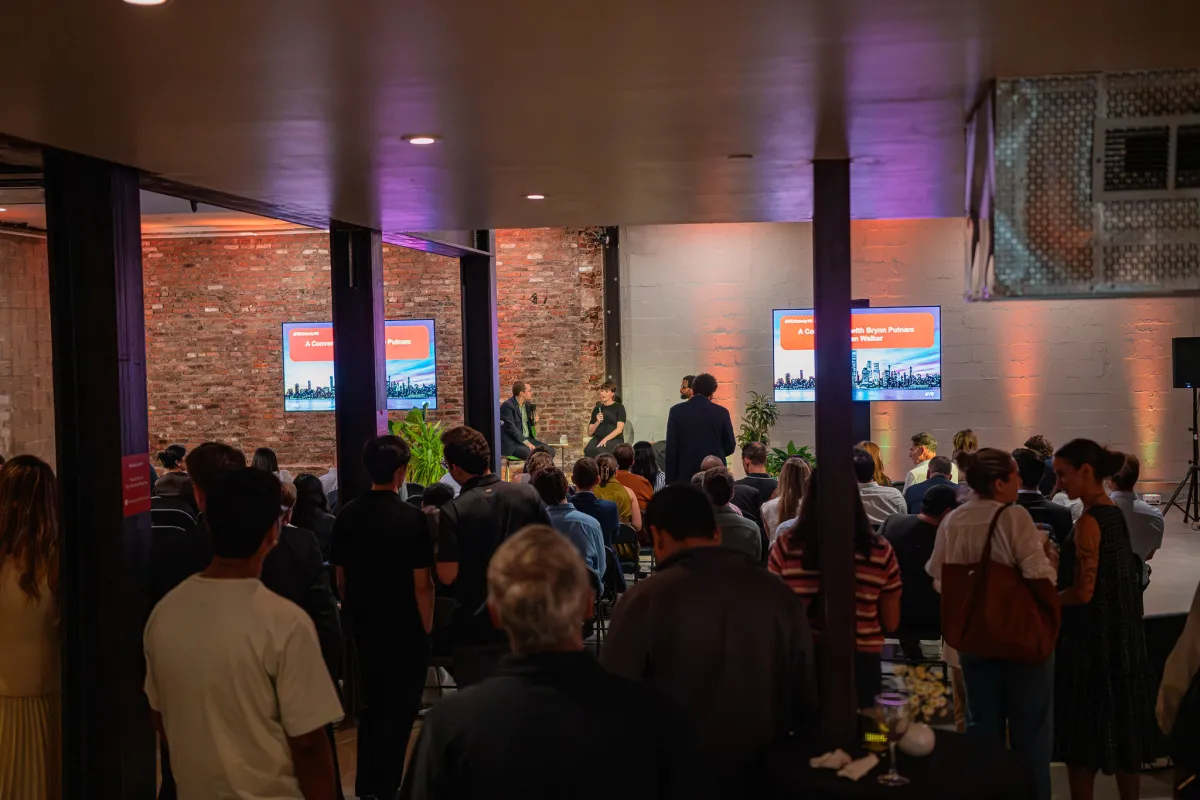
All of these new businesses come from a personal as well as a professional place. At one of TechCrunch’s recent StrictlyVC evening events, held in New York’s West Village, Putnam was candid about the fact that Mirror was built around her own life. She was pregnant with her first child, running brick-and-mortar fitness studios, and trying to bring that experience home through a screen using technology, as she put it, to work on “myself, my body, my fitness, my reflection.”
Board was built with the opposite in mind. Now a mother of five in a blended family — the household went from three people to seven — Putnam said she kept running into the same problem: no product on the market let people of wildly different ages and abilities play together. “How can we use tech to create a shared experience?” is the question she said drove the pivot. It wasn’t a “movement from digital to analog,” as she put it, “so much as how can we use tech to bring people together rather than take them apart.”
It’s why Board’s touchscreen recognizes the physical objects placed on it — a spaceship triggers an action, a knife performs a cut — instead of relying on the buttons and joysticks of a traditional controller; this way, a child and a grandparent can play the same game without a shared learning curve.
Walker had the same instinct, but his came from anxiety about what AI is doing to work and to community. He started Heirloom, he said, because he was worried about AI “stealing knowledge work” and pulling people away from each other. If he was going to build something after Walker & Company, he wanted it to bring people back together.
It’s an interesting bet. Speaking at the same StrictlyVC event, Walker said he believes the U.S. has forgotten how to transmit mastery, including leatherworking, watchmaking, and fragrance design. For 50 years, he argued, America has broken the chain from master to apprentice, offshoring production and stripping the prestige from manual skill to the point that apprenticeships became something people did when they couldn’t get into a four-year college.
Heirloom is a wager that that’s now reversing, and Walker had a number to back it up, telling a room full of founders and investors that roughly half of Gen Z and Gen Alpha say they don’t want a four-year degree at all. In fact, more than half of the capacity at Heirloom’s first location in San Francisco is currently filled not by career-changers or retirees but by young tech workers looking for what he calls a “phones-down creative outlet.”
So far, the dollars involved are relatively small for these venture-backed startups. Putnam has raised $35 million from VCs for three-year-old Board. Pie has raised $24 million. Six Bells has raised roughly $3.8 million. Heirloom, founded 11 months ago, hasn’t disclosed its funding.
One possible exception is WeWork co-founder Adam Neumann, whose new residential real estate venture Flow — marketed around the same premise of solving loneliness through physical space — has raised more than $450 million, largely from Andreessen Horowitz, dwarfing everyone else in this story combined.
Indeed, right now it’s unclear whether “togetherness” becomes its own sizable investment category. Getting strangers to show up for each other — as good as that may be for society — isn’t nearly as scalable as shipping software.
What’s notable is who’s building these companies: Putnam, Walker, Dunn, Gelman, and Neumann have all built a real brand once before. That makes it easier to raise capital and gives investors some confidence these are founders who know how to build something people actually buy. They’ve each guessed right about where the puck is headed once before. We’ll know more in another year or two whether enough customers follow along again this time.
When you purchase through links in our articles, we may earn a small commission. This doesn’t affect our editorial independence.
